Significant AI investments are yielding disappointing returns because current systems require users to interrupt workflows, transfer context, and access intelligence outside the point of decision-making. (Zapier Survey Finds 4 in 5 Enterprises Struggling to Integrate AI With Legacy Systems, 2025)
Despite significant investment in AI, sophisticated models, and high accuracy rates, many organizations find that business users are not adopting these solutions. (Data Suggests Growth in Enterprise Adoption of AI is Due to Widespread Deployment by Early Adopters, But Barriers Keep 40% in the Exploration and Experimentation Phases, 2024)
- Gartner: Has previously predicted that through 2025, at least 30% of Generative AI projects will be abandoned after proof of concept due to poor data quality, inadequate risk controls, or escalating costs.
- BCG: Noted in earlier transitions that while many companies pilot AI, only about 10% achieve significant financial impact, often due to a failure to reorganize business processes around the technology.
- MIT Sloan / BCG: Their research on “The Great AI Divide” highlights that the gap between “Winners” and “Observers” is defined by the ability to move from isolated pilots to integrated, “In-Flow” production environments.
Not because models are “bad.” Because execution happens inside workflows—and we keep shipping intelligence outside them. This is a fundamental flaw in enterprise AI deployment, resulting in greater costs than many organizations recognize.
Based on my experience leading AI transformation at Visa, Thomson Reuters, and McKesson, the key determinant of enterprise AI ROI is not model sophistication, but whether users must interrupt their work to access AI.
In-Flow AI involves strategically embedding intelligence directly into existing workflows and interfaces at every moment of user intent. This approach transforms AI from a separate tool into an intuitive, invisible extension of the product, guiding and enhancing users without disrupting their workflow.
Why “In-Flow AI” and Not “Embedded AI” or “Contextual AI”?
While terms such as “ambient AI,” “embedded AI,” and “contextual AI” exist, they do not capture the essential distinction. In-Flow AI focuses on fundamentally redesigning human-AI collaboration within existing workflows.
Existing Terms Focus On:
- Embedded AI: Where the AI is located (in the application)
- Contextual AI: What the AI knows (user context)
- Ambient AI: How visible the AI is (background processing)
In-Flow AI Focuses On:
- When: AI acts at the exact moment of user need (zero context switching)
- How: AI augments without interrupting (preserves flow state)
- Impact: Measurable productivity and adoption metrics (actual usage, not deployment)
This distinction determines whether AI systems are merely deployed or actively used.
The Business Case for In-Flow AI: Three Metrics That Matter For AI Adoption
Organizations that implement In-Flow AI principles are positioned to achieve the following results:
- Adoption Multiplier: 8–12x
When AI requires zero context switching, adoption behaves less like “enterprise software” and more like “daily utility.” This is why embedded writing assistants, in-suite copilots, and in-tool coding copilots explode in usage once they’re inside the work, not beside it. (Bano et al., 2025) - Productivity Recapture: 15–30%
Interruptions aren’t just annoying—they’re expensive. Research on workplace interruptions and task resumption routinely lands around the ~23–25 minute range to fully get back on track after a disruption. - AI ROI Acceleration: 3–5x
Traditional AI deployments can take forever to show ROI because they require new habits. In-Flow implementations show measurable impact faster because they integrate into existing habits rather than demanding behavior change. (Kumar et al., 2025)
Why Every C-Level Leader Should Be Obsessed With In-Flow AI To Enable AI Adoption
This approach is not merely about improving efficiency; it enables new levels of business performance and competitive advantage.
| CEO: Growth, Market Leadership, Shareholder Value | In-Flow AI becomes a strategic differentiator: higher satisfaction, deeper loyalty, and employees who are measurably more productive—because intelligence shows up where decisions get made. |
| CPO: Product Excellence, User Retention, Innovation | This is the secret sauce for sticky products. Remove friction + add help at the moment of intent and your product becomes indispensable. |
| CMO: Brand Trust, Customer Experience, Conversion | In-Flow AI enables personalization that feels helpful (not creepy). It reduces drop-off by guiding users without forcing tool-hops. |
| CTO: Scalability, Agility, Future-Proofing | This becomes your architectural north star: decouple model from UI, deliver sub-second inference, and build governance into the delivery surface—not after the fact. |
The true value of AI lies in its ability to support users and employees at the precise moment of need, simplifying tasks and enhancing business intelligence.
The Hidden $48M Tax
Let me show you the math that most executives miss when evaluating AI investments.
Most enterprise AI follows this pattern:
- User encounters a problem in their workflow
- User opens separate AI tool or interface
- User reconstructs context (copy-paste, re-explain problem)
- AI generates response
- User copies response back to original workflow
- User reorients to original task (remembers where they were)
The hidden cost: steps 2–3 and 5–6 destroy flow state.
And the interruption science is still brutal: returning to an interrupted task commonly takes ~23–25 minutes, depending on the study design and environment. (Berkeley, 2026)
So yes—your “$48M tax” framing holds. The exact number changes by org size and wage rate, but the mechanism is consistent: context switching is the silent killer of AI ROI.
In-Flow AI (noun): Artificial intelligence systems architecturally designed to deliver intelligence at the exact moment of user need, within existing workflows, requiring zero context switching. Distinguished from Destination AI, which requires users to interrupt work to access intelligence. Key characteristics: contextual awareness, proximity to problem, subtle augmentation, just-in-time value, one-click action.
Frequently Asked Questions: In-Flow AI
Q: What is In-Flow AI?
A: In-Flow AI is artificial intelligence that’s embedded directly into existing workflows at the exact moment of user need, eliminating context switching and preserving flow state.
Q: How is In-Flow AI different from embedded AI?
A: Embedded AI describes where AI lives. In-Flow AI describes how humans interact with it (seamlessly, without interruption).
Q: What are examples of In-Flow AI?
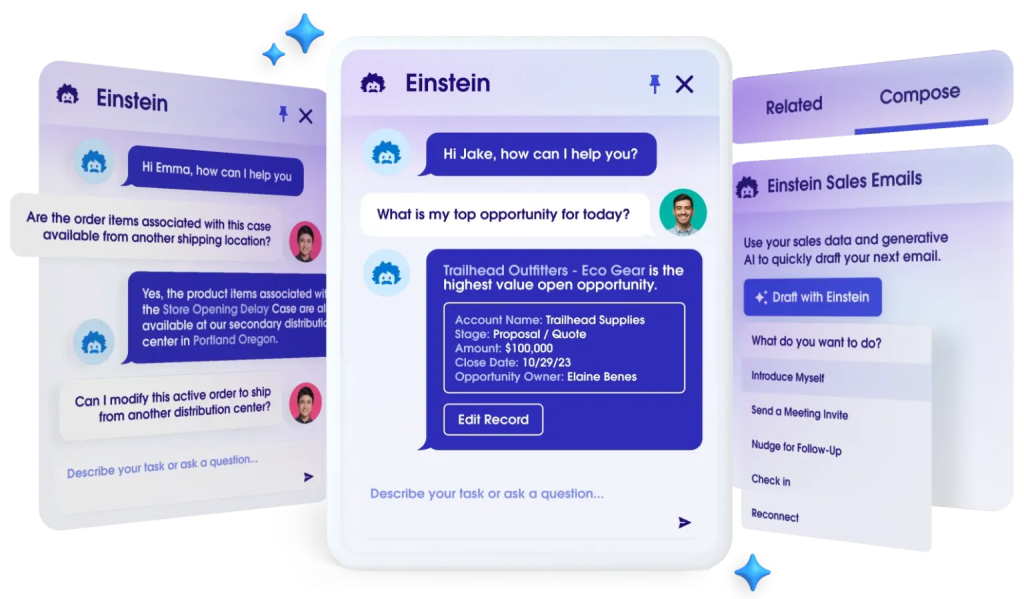
A: Grammarly providing real-time writing suggestions, Grok fact-checking posts directly in X, AI copilots that assist inside docs/email/IDEs, and CRM guidance surfaced directly in opportunity and comms workflows.
Q: What business results can I expect?
A: Higher adoption, real productivity recapture, and faster ROI—because value shows up inside existing habits, not behind another tab.