

The challenge is not with your AI models, but with requiring users to leave their workflow to access them. I propose the concept of “In-Flow AI” that ensures the elimination of context switching, interruption-free workflows, and AI that is seamlessly integrated and unobtrusive to users.
Billions invested in AI are yielding disappointing returns because current systems require users to interrupt their workflows, transfer context, and access intelligence separately, rather than embedding it where decisions are made.
This is a fundamental flaw in enterprise AI deployment, and it is likely costing more than anticipated. For instance, enterprises may be losing up to 10% of potential productivity gains annually, which equates to millions of dollars. These losses often stem from inefficiencies caused by context switching, resulting in wasted time and lower work quality.
The $20 Million Shelf-Ware Problem: Is Your AI Investment Gathering Dust?
Despite significant investment in AI, sophisticated models, and high accuracy rates, business users are not adopting the solutions developed.
Based on experience leading digital and AI transformations at Visa, Thomson Reuters, and McKesson, I have found that enterprise AI success depends less on model sophistication and more on whether users must interrupt their work to access AI.
This distinction between Destination AI and In-Flow AI explains why 73% of enterprise AI investments fail to deliver meaningful business impact. This statistic, sourced from a comprehensive McKinsey study (which says 95%; I am sticking to 73%; don’t ask me why!) on digital trends, underscores the importance of seamless AI integration in improving business outcomes. Executives can rely on this figure as a benchmark for evaluating their AI strategies.
The $64,000 Question: What Actually Makes AI Stick?
The answer requires a fundamental shift in how AI is integrated into products and operations. Moving beyond “Destination AI,” where users must stop their work, open separate tools, and transfer context, is essential. This approach is disruptive, inefficient, and ultimately ineffective.
Real-World Examples: When AI Meets Your Workflow
For example, when viewing a questionable claim on X (formerly Twitter), users prefer immediate answers without leaving their feed. Grok on X enables users to request context or fact-checking directly within the platform, providing instant insights and enhancing the user experience.

Similarly, in writing, tools like Grammarly offer real-time grammar corrections, stylistic suggestions, and tone adjustments within the user’s writing environment, serving as an intelligent co-author embedded directly in the document.
For sales teams, Salesforce Einstein proactively identifies critical follow-up actions for each client based on recent engagement, providing timely guidance without additional steps or context switching.
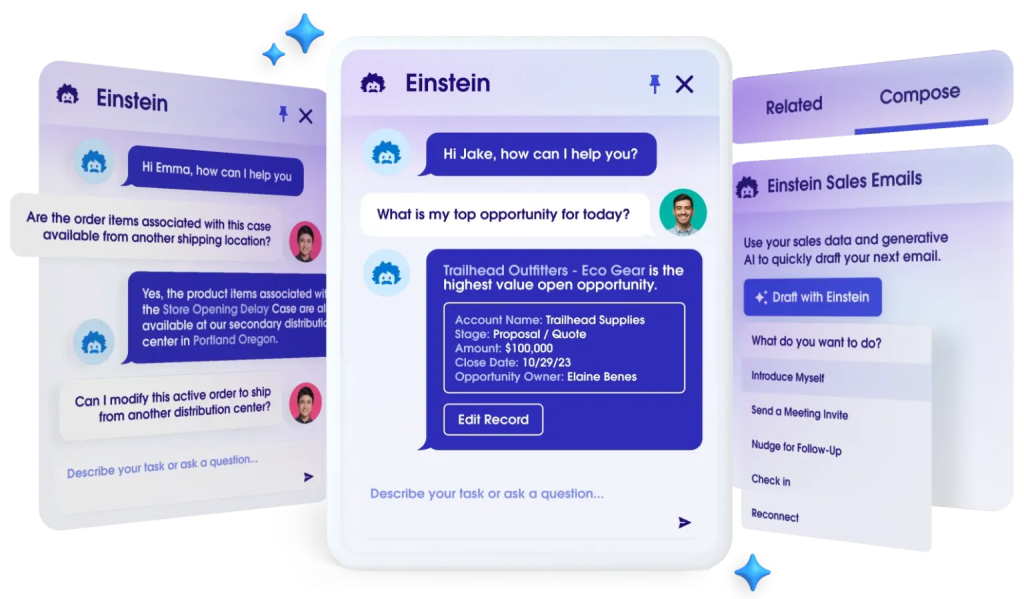
This is the essence of In-Flow AI.
Defining In-Flow AI: Intelligence That Doesn’t Interrupt
In-Flow AI involves strategically embedding intelligence directly into existing workflows and interfaces at every point of user intent. This approach transforms AI from a separate tool into an intuitive, seamless extension of the product.
This approach distinguishes between AI that reduces productivity and AI that enhances it.
Three principles of In-Flow AI:
- Eliminate context switching: Intelligence should appear where work occurs.
- Design for interruption-free workflows.
- The most effective AI is seamlessly integrated and unobtrusive to users.
The Architectural Shift: From Models to Integration
The focus is shifting from standalone “big AI models” to smart AI integration as a competitive necessity. Organizations that embed intelligence into core product experiences will fundamentally redefine their value propositions.
Mastery of In-Flow AI, supported by a decoupled architecture and real-time inference, is the key differentiator.
The Bottom Line
The future of successful products will depend not on the most powerful AI model, but on the ability to seamlessly and intelligently integrate AI into everyday tasks and decisions.
Organizations should deliver AI to users precisely when needed, within the flow of their work and daily activities, rather than requiring users to seek it out.
The key consideration is not whether to adopt In-Flow AI, but whether your organization will lead this shift or follow competitors. Firms like Salesforce, Google, and Microsoft are already integrating AI into their products with great success, setting benchmarks for others to follow. Observing their strategies can motivate proactive action and inspire executives to embed AI seamlessly into their workflows, enhancing business outcomes.
