Rohit Prabhakar

I build agentic revenue systems for Fortune 50 companies

  • Digital Transformation
  • Leadership
  • Marketing
  • Writing
  • Home
  • Privacy Policy

The Invisible Hand of Intelligence: Your Next Growth Engine has “In-Flow AI”

December 15, 2025 by Rohit Leave a Comment

The challenge is not with your AI models, but with requiring users to leave their workflow to access them. I propose the concept of “In-Flow AI” that ensures the elimination of context switching, interruption-free workflows, and AI that is seamlessly integrated and unobtrusive to users.

Billions invested in AI are yielding disappointing returns because current systems require users to interrupt their workflows, transfer context, and access intelligence separately, rather than embedding it where decisions are made.

This is a fundamental flaw in enterprise AI deployment, and it is likely costing more than anticipated. For instance, enterprises may be losing up to 10% of potential productivity gains annually, which equates to millions of dollars. These losses often stem from inefficiencies caused by context switching, resulting in wasted time and lower work quality.

The $20 Million Shelf-Ware Problem: Is Your AI Investment Gathering Dust?

Despite significant investment in AI, sophisticated models, and high accuracy rates, business users are not adopting the solutions developed.

Based on experience leading digital and AI transformations at Visa, Thomson Reuters, and McKesson, I have found that enterprise AI success depends less on model sophistication and more on whether users must interrupt their work to access AI.

This distinction between Destination AI and In-Flow AI explains why 73% of enterprise AI investments fail to deliver meaningful business impact. This statistic, sourced from a comprehensive McKinsey study (which says 95%; I am sticking to 73%; don’t ask me why!) on digital trends, underscores the importance of seamless AI integration in improving business outcomes. Executives can rely on this figure as a benchmark for evaluating their AI strategies.

The $64,000 Question: What Actually Makes AI Stick?

The answer requires a fundamental shift in how AI is integrated into products and operations. Moving beyond “Destination AI,” where users must stop their work, open separate tools, and transfer context, is essential. This approach is disruptive, inefficient, and ultimately ineffective.

Real-World Examples: When AI Meets Your Workflow

For example, when viewing a questionable claim on X (formerly Twitter), users prefer immediate answers without leaving their feed. Grok on X enables users to request context or fact-checking directly within the platform, providing instant insights and enhancing the user experience.

Similarly, in writing, tools like Grammarly offer real-time grammar corrections, stylistic suggestions, and tone adjustments within the user’s writing environment, serving as an intelligent co-author embedded directly in the document.

For sales teams, Salesforce Einstein proactively identifies critical follow-up actions for each client based on recent engagement, providing timely guidance without additional steps or context switching.
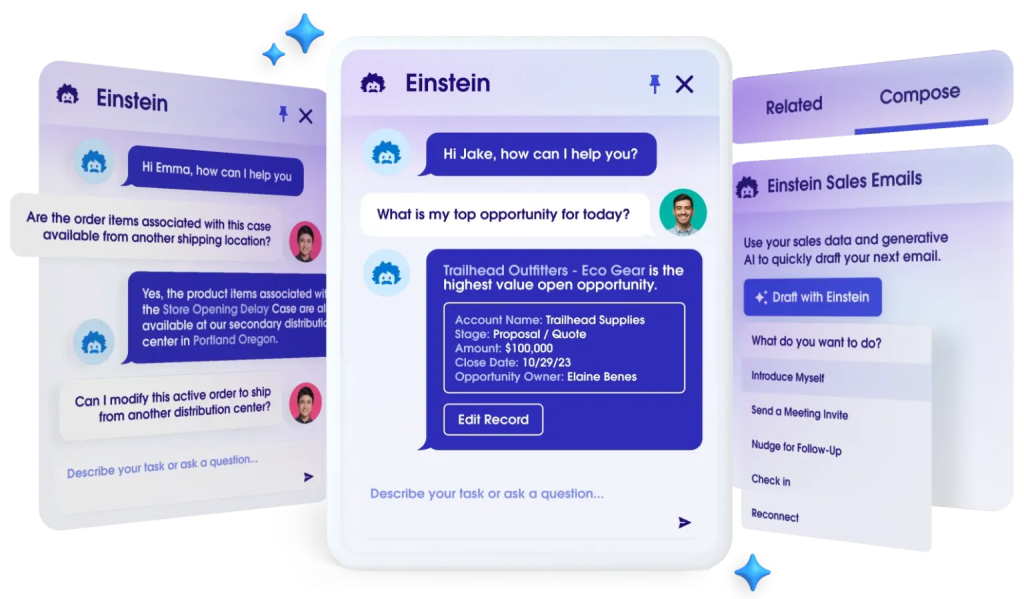
This is the essence of In-Flow AI.

Defining In-Flow AI: Intelligence That Doesn’t Interrupt

In-Flow AI involves strategically embedding intelligence directly into existing workflows and interfaces at every point of user intent. This approach transforms AI from a separate tool into an intuitive, seamless extension of the product.

This approach distinguishes between AI that reduces productivity and AI that enhances it.

Three principles of In-Flow AI:

  • Eliminate context switching: Intelligence should appear where work occurs.
  • Design for interruption-free workflows.
  • The most effective AI is seamlessly integrated and unobtrusive to users.

The Architectural Shift: From Models to Integration

The focus is shifting from standalone “big AI models” to smart AI integration as a competitive necessity. Organizations that embed intelligence into core product experiences will fundamentally redefine their value propositions.

Mastery of In-Flow AI, supported by a decoupled architecture and real-time inference, is the key differentiator.

The Bottom Line

The future of successful products will depend not on the most powerful AI model, but on the ability to seamlessly and intelligently integrate AI into everyday tasks and decisions.

Organizations should deliver AI to users precisely when needed, within the flow of their work and daily activities, rather than requiring users to seek it out.

The key consideration is not whether to adopt In-Flow AI, but whether your organization will lead this shift or follow competitors. Firms like Salesforce, Google, and Microsoft are already integrating AI into their products with great success, setting benchmarks for others to follow. Observing their strategies can motivate proactive action and inspire executives to embed AI seamlessly into their workflows, enhancing business outcomes.

Filed Under: Artificial Intelligence, Digital Transformation Guide, Innovation in business strategy, Robotics and artificial intelligence Tagged With: AI, AI Transformtion, customer experience, CX, GenAI, in-flow AI

Career Opportunities In Artificial Intelligence

August 2, 2022 by Rohit Leave a Comment

Artificial intelligence, or AI, is the most commonly discussed topic in recent years. The process of developing intelligent machines is referred to as artificial intelligence (AI). It is a phenomenon in which a computer, a robot, or any other equipment demonstrates human-like intelligence in areas such as learning from examples and experience, recognizing things, comprehending and reacting to language, making decisions, and solving problems.

AI and machine learning are often used interchangeably. It is, however, merely a subset of AI, and machine learning is a subset of deep learning. Machine learning is the idea that computer systems can learn from and adapt to new data without the need for human intervention.

Deep learning is a method of automating learning by absorbing large volumes of unstructured data such as text, photos, or video. Artificial intelligence, or AI, is the most commonly discussed topic in recent years. The process of developing intelligent machines is referred to as artificial intelligence (AI). It is a phenomenon in which a computer, a robot, or any other equipment demonstrates human-like intelligence in areas such as learning from examples and experience, recognizing things, comprehending and reacting to language, making decisions, and solving problems.

AI and machine learning are often used interchangeably. It is, however, merely a subset of AI, and machine learning is a subset of deep learning. Machine learning is the idea that computer systems can learn from and adapt to new data without the need for human intervention.

Deep learning is a method of automating learning by absorbing large volumes of unstructured data such as text, photos, or video.

Artificial Intelligence (AI) career options

Artificial Intelligence employment prospects are plentiful, thanks to the growing need for experts with this subject’s understanding. Some of the roles that are available are as follows:

1. Information scientists

Data scientists are in short supply on the job market right now, thus demand is strong. It is the most highly regarded in the IT business for both Digitization And Digitalization.

The primary responsibility of a data scientist is to collect and analyze relevant data from a variety of sources in order to make useful insights. The findings drawn from the data are critical in making decisions that will benefit the organization in the long run.

A data scientist takes into account the many tendencies in a pattern from the past and displays them in order to create accurate forecasts. They should be able to produce ideas for a certain project to the point of understanding.

As a result, the job of data scientist is at the top of the AI professional ladder. Prerequisites for becoming a Data Scientist include the following:

  • They should have strong analytical abilities.

2. Data Analyst using AI

The major responsibility of an AI data analyst is to do data mining, data cleaning, and data interpretation from pre-loaded data. An AI data analyst makes conclusions from data and assists in the decision-making process for a corporation.

An AI data analyst has a lot of responsibilities.

  • An undergraduate degree in mathematics or computer science is necessary to work as an AI data analyst.
  • It is essential to have prior experience with MS Excel.

3. Big Data Engineer

If you want to further your Artificial Intelligence career, this is the position for you. The major responsibility of a notable data engineer is to create an environment for managing a company’s big data.

Inferences are drawn after a large-scale analysis of massive data.

The following are the requirements for becoming a Big Data Engineer:

  • Python, R, and Java are just a few of the programming languages that will be useful in this field.

4. Developer of Business Intelligence (BI)

The primary responsibility of a BI developer is to promote, grow, and maintain BI products and interfaces for Digitization And Digitalization. They must also translate highly machine-level language comprising technical jargon and complex facts into layman’s words so that the rest of the firm can understand it.

They propose calculated answers to an organization’s difficult challenges. They should be able to work with data from the past as well as data created recently because they will be examining a significant volume of data.

They evaluate complex data sets and analyses their vitality in order to uncover distinct business trends that are currently circulating in the market. They play a key role in increasing the company’s profit margin without jeopardizing its efficiency.

Business intelligence developers are responsible for the company’s growth, from planning and preserving data for cloud-based platforms to streamlining workflows and procedures. Their need is unlikely to wane anytime soon, making an AI profession relatively secure.

The following are the requirements for becoming a Business Intelligence (BI) Developer:

  • It is necessary to have prior knowledge and comprehension of computer programming and data collections.
  • In this field of AI, a bachelor’s degree in computers, mathematics, or engineering is required.
  • For this career advancement in Artificial Intelligence 5, a basic understanding of SQL servers and queries, as well as data warehouse design, is essential.

5. Engineer in Machine Learning

Machine learning engineers are in charge of developing and maintaining self-running software that supports machine learning efforts. They are always on the watch for them by businesses. As a result, it is the finest area to start a career in AI, and openings are uncommon. They work with large amounts of data and hence require exceptional data management abilities for Digitization And Digitalization.

They work in the fields of image and speech recognition, fraud prevention, consumer insight, and risk management.

Machine Learning Engineers must meet the following requirements:

  • This AI vocation requires a basic understanding of programming, computers, and mathematics.
  • It is preferable to have a master’s degree in mathematics or computer science.
  • Python, R, Scala, and Java are just a few of the languages you’ll need to know.

Conclusion

Artificial intelligence will help in the construction of buildings and other structures such as bridges, making them faster and safer. Artificial intelligence may be used to monitor the efficient operation of an industry, as well as its results and profit margins, by those in control.

Artificial intelligence is the world’s future, with numerous AI-related occupations. To have a good career in AI and take advantage of job prospects in artificial intelligence, one must have a thorough understanding of the subject’s demand.

Filed Under: Digitization And Digitalization, Robotics and artificial intelligence, The Frontier Tagged With: Digital Transformation, google, rohit

Advanced AI Optimization Research for Marketing & Advertising Campaigns

January 6, 2022 by Rohit Leave a Comment

Traditional marketing modes such as Advertisements have become quite expensive. The modern and effective content marketing channels are overcrowded, making it hard to maintain and coordinate the omnichannel presence. To get through these situations, Advanced AI for Marketing can prove useful in providing solutions to optimize marketing campaigns. Many vast enterprises are already implementing the possibilities offered by various machine learning algorithms. Also, deep neural networks help them select the right advertisement to show to the right customer at the right time.

Top technical companies like Google, Amazon, and Alibaba have been implementing superlative machine learning approaches that can demonstrate their effectiveness at optimizing marketing campaign allocation with improvising customer targeting. Here on this topic, you will find out the latest breakthroughs also, the latest and best practices from the leading enterprises that will provide you with the latest advancements introduced by Advanced AI researchers throughout the previous few years.

Field-aware Factorization Machines in a Real-world Online Advertising System

To predict a customer’s response is among the core ML tasks in AI-based marketing. Field-aware Factorization Machines or FMMs have been established recently as modernistic methods to face such situations and, in particular, to win over the competition. In this research, those results have been included that are concluded through implementing this method in a production system. It forecasts click-through and conversion rates for displaying advertisements. It also displays how this method effectively wins modern marketing challenges and is lucrative in real-world predictions.

The Summary of This Paper

FMM methods have demonstrated quite impressive results in numerous competitions. However, it is concluded that the training speed for the algorithms of this method is comparatively too low for a production system. The researchers have introduced two solutions that can help with increased training speed to deal with this situation. These techniques are named Premature Warm Start and A Distributed Learning Mechanism. After conducting experiments with the implementation of these two methods, it was suggested that it helped with an increased number of advertisement displays and increased return on investments while also being fast enough for real-world online marketing campaigns.

Deep Interest Evolution Network for Click-Through Rate Prediction

Click-through rate predictions that help us estimate the possibility of user clicks have become a necessity for marketing systems. Implementing the CTR prediction model is essential to attain the latent user interest behind the user behavior data. User interests evolve, dynamically accompanying the external environment and internal cognition changes. Even though plenty of CTR models can be used for interest modeling, most of them directly consider the representation of behavior in terms of interest. Also, these models mostly lack modeling for latent interest behind a user’s concrete behavior.

The Summary of This Paper

The research suggests that attaining a user’s interests and dynamics is major to advancing the performance of CTR prediction models. Also, it claims that a user’s explicit behavior doesn’t directly demonstrate their latent interest. Therefore, the researchers establish a Deep Interest Evolution Network that models users’ interest evolving process and accordingly improvises the accuracy of CTR predictions in online marketing campaigns. 

Contextual Multi-Armed Bandits for Causal Marketing

The Advanced AI-based model estimates and optimizes the casual effects of automated marketing. With a focus on casual effects, you ensure better ROI by only targeting the right customers who don’t prefer to take organically. The approach draws on the strengths of the casual interface, uplift modeling, and multi-armed bandits. The model optimizes on casual treatment effects instead of pure outcomes; it also incorporates counterfactual generation within the data collection. The research optimizes over the casual business metric following uplift modeling results. Contextual multi-armed bandit methods help scale to various treatments and perform off-policy policy evaluation of the collected data.

The Summary of This Paper

The marketing team of Amazon suggests a new approach to optimizing advertisement campaigns. The approach draws upon casual interface, uplift modeling, and multi-armed bandits. It allows the targeting of marketing campaigns based on casual outcomes rather than only pure outcomes. Ultimately, this presented model approach helps target only those responsive customers who don’t prefer to respond to marketing campaigns just after seeing them. The research optimization confirms that a focus on casual effects can lead to higher investment returns.

The Conclusion 

Customers expect any marketing campaign to understand their interactions with your product. This understanding works as fundamental for building effective marketing campaigns. Numerous Advance AI tools can automate marketing activities and significantly improvise marketing analytics and insights. These researches are some of the working models that bring the maximum user interactions from implementing AI for Marketing and advertising campaigns. By following this topic, you can rest assured that you are informed about the latest breakthrough in AI optimization research for marketing & advertising campaigns.

Filed Under: Marketing Technology, Robotics and artificial intelligence, Technology, The Frontier Tagged With: Advanced AI, AI for Marketing, How to Increase Marketing ROI, Innovative b2b Marketing Strategies

How Artificial Intelligence is Changing Business Forever

January 27, 2021 by Rohit Leave a Comment

The world around us is changing very fast, industries are transforming, and small companies are slowly capturing the market with innovations. Robotics and artificial intelligence have faded the business’s word monopoly, and anyone with an innovative solution and right approach can establish their brand in the market.

Robotics and artificial intelligence

Importance of AI

Artificial intelligence is becoming more diverse as it provides businesses the ability to analyze the data, fraud detection, improving customer satisfaction, and building relationships. Companies are getting an edge over others and serving their customers even better than ever before. AI is providing solutions to complex human problems with the help of algorithms in a computer-friendly way.

Advanced ML and AI are now actively implementing businesses and industries as robots, self-driven cars, consumer electronics, and an application to improve business processes, products, and services. In the upcoming years, most business processes will be automated, and human efforts will be put into creative aspects of the business, such as brainstorming, innovating, and researching. AI-based apps allow business leaders to focus on business growth & save time by automating common business processes.

However, experts have made many AI predictions and how it is going to shape the business forever. Here are some of the business areas where AI has proved its worth and changed the way businesses used to operate.

Market & Customer Insights

Artificial intelligence is helping businesses to analyze market trends and customer insights. Data collected from system to web matrix and social media can be used in the predictive analysis to enhance customer satisfaction and build a better product. AI provides opportunities for start-ups to adopt different thought processes and search for innovative solutions for business growth. Businesses are optimizing marketing strategies, and AI helps them opt for effective marketing tools to target potential customers and eliminate unlikely customers. Social media has emerged as one of the greatest mediums for getting customer insights, and most businesses are using these platforms to connect with customers. Artificial intelligence effectively understands social media trends, and data mining allows AI to analyze different types of social media traffic. This will enable businesses to adapt to the changing market scenario and continually improve business performance.

Virtual Assistance

Virtual assistants and AI chatbots are becoming important tools for businesses to connect with customers and provide 24/7 chat support and customer service. Many companies have already added these to their website, and others plan to use artificial intelligence for virtual assistance. Many businesses are still skeptical about the idea of the customer speaking with the machine, but still, there is a potential for machine-driven aid with human-driven customer service. E-commerce industries are using AI chatbots to answer simple questions, while human-driven customer support can solve complex service issues. Chatbots and virtual assistance provide 24/7 interaction with potential buyers that is not that easy & effective to achieve with human-driven customer support. There is no doubt that next decade virtual assistants and AI chatbots will become an integral part of customer service. More companies are going to focus on improving and enhancing customer service.

Efficient sales process

AI has changed the old sales technique and moved businesses from cold calling and long emails to customers. Social media platforms like Facebook, Instagram, print media, and TV commercials are becoming effective tools to connect with new and old customers. Artificial intelligence helps businesses adopt an innovative and effective sales approach to connect with the right customer on the right platform. AI helps sales teams know their customers better and offer tailored offers to convert a potential lead into sales. E-commerce platforms are using AI for conducting online surveys, asking questions to understand customer’s preferences. This enables these platforms to show products that are the best fit for a customer, increasing the chance of a conversion. AI has transformed and made the sales process efficient where customers are offered tailored solutions. Better conversion rates and getting customer insights are some of the major benefits of AI that help improve sales and serve them better.

Data Unlocking

Earlier businesses are generating relatively less data, which is easy to store databases in a structured way and also analyze it. Having fewer data to explore makes it easier for business leaders to give valuable insights from the collected data for business. But now, the entire business scenario has changed. With so much data from different resources, it isn’t easy to understand and categorize whole data in a structured way. Most of the business data from the digital platforms are unstructured that makes it hard to analyze. In the upcoming years, a business challenge is to effectively analyze this unstructured data and use it to take their business to the next level. 

AI helps organizations in data unlocking and provides businesses with opportunities to offer well-structured data and analyze it efficiently. Businesses are improving their sales and customer satisfaction by identifying customer personalities with the help of AI. 

Process Automation

Businesses have realized the potential of automation and, in the last few decades, automate their processes. Automation tools are helping businesses to innovate and develop solutions to make the processes automated. Automation tools were introduced in the home appliances and later paved their way in the industry as industrial robots. Now, in industries, humans and robots are working alongside to deliver the best results. Most industrial leaders have predicted this rise of AI will create a new era of automation. Even small algorithms are playing a major role in industries like retail, hospitality, and e-commerce industries. Automating the processes allows industries to do a task efficiently and work 24 hours without a break.

Conclusion

Artificial intelligence in robotics has allowed big and small businesses to innovate and implement new methods to improve and meet their desired goals. Even new start-ups are actively using AI to get an edge over established businesses and setting them up as brands in the market. From self-driven cars to robots used in manufacturing processes to deliver better efficiencies compared to humans, there is no denying that AI has slowly become an essential part of our lives.

Filed Under: Robotics and artificial intelligence, The Frontier Tagged With: artificial intelligence, business growth, intelligence in robotics, market trends, Robotics, Robotics and artificial intelligence

Copyright © 2026 · Genesis Framework · WordPress · Log in