


The hidden problem that’s costing you millions in lost opportunities—and how to fix it
The Problem Everyone Has But Nobody Talks About
Let me paint a picture you’ll probably recognize.
Sarah visits your website three times over two weeks, reads your blog, downloads a whitepaper, and finally fills out a contact form. Your marketing team is thrilled—new lead! But when Sarah calls customer service the next day with a question, the rep has no idea she’s been researching your company. When she meets with sales, they ask her to explain her needs all over again because they can’t see her website activity.
Sound familiar?
This isn’t just annoying for Sarah—it’s costing you real money. Companies lose an average of $62 million annually due to poor customer data management. More importantly, Sarah’s going to buy from someone who actually knows who she is.
The culprit? Your customer data is probably a mess.
Why Your CRM Isn’t Enough (Even Though Everyone Pretends It Is)
“But we have a CRM!” you might say. “We know our customers!”
Here’s the uncomfortable truth: your CRM only sees about 30-40% of what your customers actually do. It’s like trying to understand a movie by watching every third scene.
Think about it:
- Your CRM knows Sarah filled out a form, but not that she spent 47 minutes reading your competitor comparison page
- It tracks her as a “lead,” but doesn’t know she’s already a customer through a different division
- It shows her last purchase, but misses that she’s been frustrated with your mobile app for months
- When she calls support, they start from scratch because her service history lives in a different system
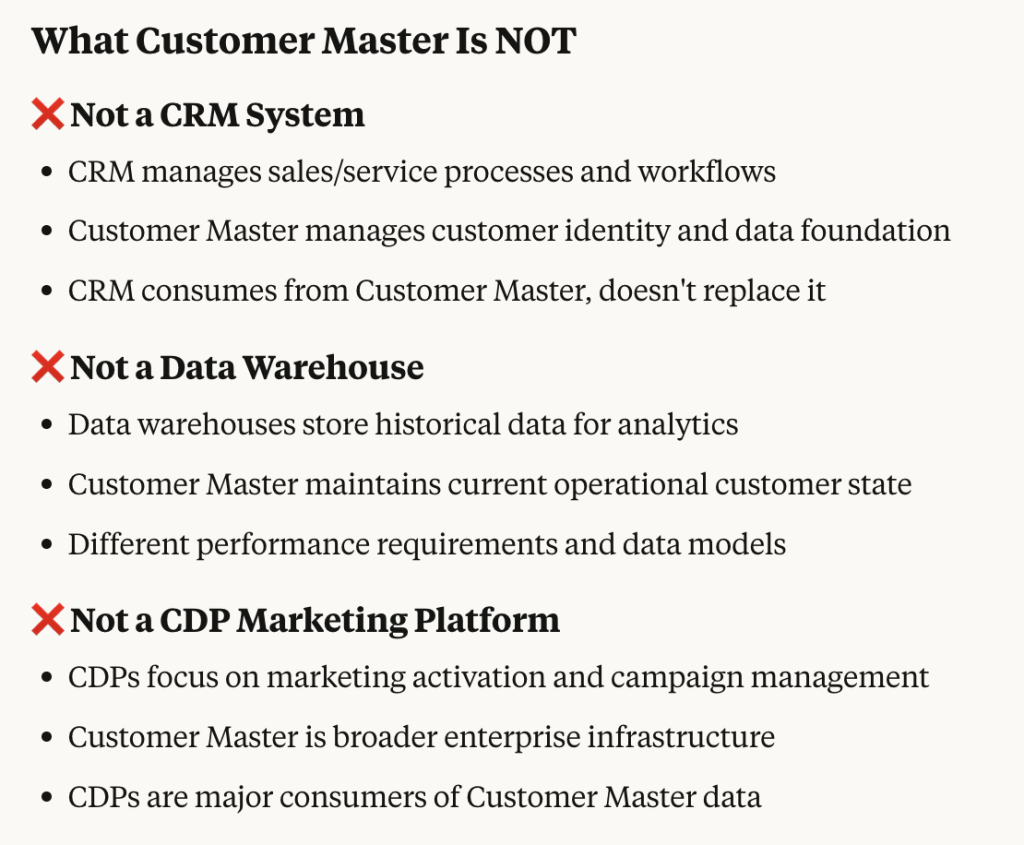
Your CRM was built to manage sales processes, not to understand customers. That’s why it fails as your customer data foundation.
What Is Customer Master, Really?
Forget the jargon for a moment. Customer Master is simply this: one place that knows everything important about each customer, and keeps everyone else informed.
Think of it as your company’s memory about customers. Just like you remember your friend’s coffee preference, their birthday, and that story they told you last month, Customer Master remembers everything meaningful about each customer interaction.
Here’s what that looks like in practice:
Before Customer Master:
- Marketing: “We sent Sarah three emails this week”
- Sales: “Who’s Sarah? Oh, this lead? She seems pretty cold”
- Service: “Sarah called about login issues. No idea what she’s trying to access”
- Website: “Anonymous visitor viewed pricing page 6 times”
With Customer Master:
- Everyone: “Sarah’s been researching our enterprise solution for two weeks, downloaded our ROI calculator, called about implementation questions, and is ready to talk pricing. The sales rep should emphasize security features since she spent most time on that page.”
The Real Business Impact (Beyond the Buzzwords)
Let me share what happens when companies actually implement this properly.
Starbucks built a Customer Master that connects their mobile app, in-store purchases, and website behavior. Result? They can predict what you’ll order before you do, and their revenue from personalized marketing programs hit $2.65 billion. That’s not technology magic—that’s knowing their customers.
Sephora connected online browsing with in-store purchases and social media engagement. Now when you walk into a store, they can recommend products based on what you’ve been looking at online. Their customers spend 30% more because the experience feels personal, not generic.
But here’s a cautionary tale: A major retailer (I can’t name them) tried to use their CRM as their customer foundation. Three years and $15 million later, they had to rebuild everything because they couldn’t create consistent customer experiences. Their customer satisfaction actually went down during their “digital transformation.”
The Hidden Costs of Messy Customer Data
You’re probably losing more money than you realize:
Marketing Waste: You’re sending promotional emails to existing customers, advertising to people who already bought, and missing opportunities to upsell because you don’t know what they already have.
Sales Inefficiency: Your reps are starting every conversation from zero, asking questions you already know the answers to, and missing warm leads because they look cold in your system.
Service Frustration: Customers are explaining their situation over and over, feeling like just another ticket number, and getting inconsistent information from different departments.
Missed Revenue: You can’t recommend relevant products, predict when customers might churn, or identify expansion opportunities because you’re flying blind.
One client told me: “We realized we’d been treating our best customer like a stranger for two years because her data was split across five different systems. She was worth $2 million in annual revenue, and we were sending her generic promotional emails.”
What Actually Makes Customer Master Work
Forget the technical specifications for a moment. Here’s what really matters:
It Connects the Dots
Every customer interaction—web visit, phone call, purchase, complaint, social media mention—gets connected to one customer profile. No more puzzle pieces scattered across different departments.
It Happens in Real Time
When Sarah updates her preferences on your website, customer service sees it immediately. When she calls with a question, that context flows to the sales rep she’s meeting tomorrow. No delays, no syncing issues, no outdated information.
It Protects Privacy
With regulations like GDPR and CCPA, customer data isn’t just about marketing—it’s about legal compliance. Customer Master handles consent, deletion requests, and data protection automatically. One client avoided a $2.8 million fine because their Customer Master had proper audit trails when regulators came knocking.
It Speaks to Everything
Your email platform, website, mobile app, call center system, billing platform—they all get customer information through secure connections. It’s like having a universal translator for customer data.
The “But Our Situation Is Different” Objections
I’ve heard every reason why Customer Master won’t work:
“Our customers aren’t digital enough” Your customers might not be digital, but your business processes are. Even if Sarah only calls and never visits your website, Customer Master ensures her service history, purchase preferences, and communication logs are available to whoever helps her next.
“We’re too small for this” Actually, smaller companies benefit more. You can’t afford to waste opportunities or frustrate customers. One lost customer hurts more when you have fewer of them.
“Our CRM vendor says they can do this” Of course they do. They want to sell you more licenses. But CRM vendors are like hammer manufacturers—everything looks like a nail to them. Customer Master is specialized infrastructure, not a sales tool wearing a disguise.
“It’s too expensive” Know what’s expensive? Sending irrelevant marketing to existing customers. Having sales reps restart every conversation. Losing customers because they feel unknown. Customer Master typically pays for itself in 6-12 months through improved efficiency alone.
What Success Actually Looks Like
Here’s how you’ll know it’s working:
Your marketing team stops complaining about bad lead quality because they can see the complete customer journey, not just form fills.
Your sales reps become confident because they walk into every conversation knowing the customer’s history, preferences, and potential value.
Your customer service metrics improve because reps spend time solving problems, not gathering context they should already have.
Your customers start saying things like “You guys really get me” and “It feels like you actually know my business.”
Your revenue grows not from more advertising spend, but from better customer relationships and more relevant offers.
The Choice That Defines Your Future
Every day you wait, your competitors are getting better at knowing their customers. Amazon didn’t become Amazon by accident—they built this foundation early and never stopped improving it.
Meanwhile, companies that keep patching together customer data with spreadsheets, CRM workarounds, and “we’ll figure it out later” approaches are falling further behind.
The question isn’t whether you need Customer Master. If you have customers, you need it. The question is whether you’ll build it properly now, or spend twice as much fixing it later.
Because here’s what I know after helping dozens of companies through this: Customer Master isn’t a technology project—it’s the foundation for actually caring about customers at scale.
And in a world where customers have infinite choices, being genuinely customer-obsessed isn’t just nice to have.
It’s how you win.
