Rohit Prabhakar

I build agentic revenue systems for Fortune 50 companies

  • Digital Transformation
  • Leadership
  • Marketing
  • Writing
  • Home
  • Privacy Policy

AI Marketing Platforms: A Strategic Intelligence Dashboard for Enterprise Leaders

June 1, 2025 by Rohit Leave a Comment

Understanding the $5+ billion transformation reshaping how marketing gets done with AI Marketing Platforms.

We’re witnessing the most significant transformation in marketing technology since the advent of digital advertising. Global agency holding companies and consulting giants are investing billions to become AI-native organizations, fundamentally reshaping how marketing services are delivered at enterprise scale with their AI Marketing Platforms.

As a leader, you need actionable intelligence on these AI Marketing Platforms—not just vendor marketing materials, but comprehensive competitive analysis that reveals true capabilities, market positioning, and strategic implications for your organization.

That’s why I’ve created the AI Marketing Platform Competitive Landscape, an interactive intelligence tool that provides unprecedented visibility into the five major platforms competing for enterprise marketing transformation leadership.


What This AI Marketing Platforms Dashboard Reveals

The Five AI Marketing Platforms Strategies Analyzed

🔵 WPP Open – The AI-Native Operating System Approach

  • $400M+ annual investment in comprehensive marketing integration
  • Proprietary “Four Brains” AI architecture (Audience, Brand, Channel, Performance)
  • 27,000 active users across global network

🔴 Publicis CoreAI – The Data-Driven Intelligent System

  • €300M investment over three years, 2.3 billion consumer profiles
  • Superior financial performance (+6.3% growth) driving market confidence
  • Platform transformation from holding company to intelligent system

🟡 Omnicom Omni + IPG – The Scale Through Acquisition Strategy

  • $71B combined media billings creating 32% market share
  • Acxiom identity integration with commerce-focused AI development
  • Cautious but scale-driven approach to AI implementation

🟣 Dentsu Merkle – The Customer Experience Specialist

  • 280M consumer IDs with focus on privacy-compliant personalization
  • Salesforce partnership ecosystem for enterprise CRM integration
  • Proven 20% ROAS improvements and 25% reach expansion

🟢 Accenture Song – The Enterprise Consulting Heritage

  • $19B revenue scale with $3B total AI investment
  • Industry-specific AI agents and transformation methodology
  • Consulting-led approach to marketing technology implementation


The AI Marketing Platform Wars: What’s Really at Stake

Beyond Technology: Business Model Transformation

These platforms represent fundamentally different visions for the future of marketing:

  • WPP Open: Marketing as unified, AI-native operating system
  • Publicis CoreAI: Marketing as data-driven intelligent system
  • Omnicom-IPG: Marketing as scaled media and commerce platform
  • Merkle: Marketing as customer experience optimization
  • Accenture Song: Marketing as enterprise business transformation

The Winner-Take-Most Dynamic

Unlike traditional software markets, marketing platforms benefit from network effects, data accumulation, and client lock-in that create winner-take-most dynamics. Early platform choices may determine competitive positioning for the next decade.


The Request: Help Improve This Intelligence

To AI Marketing Platforms Leadership Teams

If you’re leading AI marketing initiatives at WPP, Publicis, Omnicom, IPG, Dentsu, or Accenture, this analysis would benefit from your insights:

Technical Accuracy: Are there capabilities, partnerships, or architectural elements we’ve missed or mischaracterized?

Performance Metrics: Can you share additional client success data, platform adoption rates, or technical performance benchmarks?

Strategic Direction: What future developments, partnerships, or platform enhancements should enterprise leaders anticipate?

Competitive Positioning: How do you see your platform’s unique value proposition relative to competitors?

Contact for AI Marketing Platform Intelligence Collaboration

Reach out directly if you’d like to:

  • Provide additional technical specifications
  • Share client success case studies
  • Correct any analytical errors or omissions
  • Discuss platform roadmap developments
  • Contribute to ongoing competitive intelligence

This analysis represents independent research and is updated regularly as new information becomes available.


The AI Marketing Platforms Dashboard Advantage

Use this interactive intelligence tool to:

  • Facilitate strategic discussions with standardized platform comparisons
  • Accelerate vendor evaluation with comprehensive SWOT analysis
  • Benchmark competitive positioning against industry platform investments
  • Support board presentations with authoritative market intelligence

Looking Forward: The Next Phase of Marketing AI

What I am Tracking

  • Platform consolidation and acquisition activity
  • Technical differentiation through proprietary AI development
  • Client success metrics and adoption rate acceleration
  • Partnership ecosystem development and strategic alliances
  • Regulatory impact on data-driven platform capabilities

The Ongoing Evolution

This dashboard will be updated quarterly with new platform developments, financial performance data, and client success metrics. The AI marketing platform wars are just beginning—strategic intelligence will determine who wins.


Access the Interactive Dashboard: [Link to Dashboard]

Connect for Platform Intelligence: For strategic discussions on AI marketing platform selection, competitive analysis, or collaborative intelligence development.

The future of marketing is being built now. Make sure you’re building with the right platform partner

Filed Under: The Frontier, Trends

Enterprise Video Creation Just Hit Its ChatGPT Moment

May 28, 2025 by Rohit Leave a Comment

The Breakthrough Nobody Saw Coming

This week, I created five product demo videos in under 30 minutes. Not mockups. Not storyboards. Finished, professional-quality videos ready for deployment.

You donot believe me! Just watch this video and read this article on WSJ.

Just six months ago, the same output required juggling four different AI platforms, an orchestration tool like n8n, and roughly 10x the time investment. Today? One platform. One workflow. Game changed.

Google’s Gemini Veo 3 represents more than incremental progress—it’s the inflection point where AI video generation transitions from “interesting experiment” to “mandatory enterprise capability.”

Why This Time Is Different

The Consolidation Signal

When multiple specialized tools collapse into a single platform, adoption accelerates exponentially. We saw this with:

  • Desktop publishing replacing typesetting, paste-up, and photo development
  • Smartphones replacing cameras, GPS units, and MP3 players
  • Cloud platforms replacing server farms, backup systems, and disaster recovery sites

The same consolidation just happened in AI video. What previously required orchestrating Runway for generation, ElevenLabs for voice, ElevenLabs for assets, and D-ID for avatars can now be accomplished in one interface.

The Quality Threshold

For the first time, AI-generated video passes the “LinkedIn test”—you’d share it professionally without disclaimers. The uncanny valley has been bridged. Lighting looks natural. Motion feels organic. Text overlays animate smoothly.

More importantly, brand consistency is maintainable. Enterprise marketing teams can input brand guidelines, approved messaging, and visual standards to ensure every generated video aligns with corporate identity.

The Speed Imperative

Modern marketing operates on a content treadmill that accelerates quarterly. Consider these realities:

  • Social platforms favor video content 10:1 over static posts
  • B2B buyers consume 13+ pieces of content before purchasing decisions
  • Personalized content delivers 6x higher engagement rates
  • Global teams need localized content in dozens of languages

Traditional video production—with its 4-8 week timelines and $10K-50K budgets—simply cannot scale to meet these demands.

The Enterprise Opportunity Matrix

Immediate Use Cases (Deploy This Quarter)

Product Demonstrations Transform static product pages into dynamic experiences. Generate variations for different industries, use cases, or buyer personas. A SaaS platform could create 20 targeted demos from one master script.

Social Media Content The 8-second current limitation? That’s not a bug—it’s perfect for TikTok, Instagram Reels, and LinkedIn’s new short-form video format. Create daily content that would traditionally require a full production team.

Internal Communications CEO town halls, training materials, and policy updates become infinitely more engaging. Generate versions in multiple languages simultaneously. Update content monthly instead of annually.

Sales Enablement Every sales rep becomes a content creator. Customize pitches for specific prospects. Create follow-up videos that reference actual meeting discussions. Close deals with personalized proposals that include video elements.

Strategic Advantages (6-12 Month Horizon)

A/B Testing at Scale Instead of guessing which message resonates, test 10 variations. Change narratives, visual styles, calls-to-action, or talent representation. Let data drive creative decisions.

Hyper-Personalization Imagine product videos that automatically adjust based on viewer demographics, browsing history, or CRM data. “Hi Sarah, here’s how our solution specifically addresses the challenges you mentioned in our Austin branch…”

Content Velocity as Competitive Moat While competitors deliberate their “AI strategy,” early adopters will have published thousands of videos, learned from performance data, and refined their processes. The learning curve advantage compounds.

The Implementation Playbook

Start With Controlled Experiments

  1. Secure a private instance – Work with Google or enterprise AI vendors to ensure data security and compliance
  2. Choose bounded use cases – Internal training videos offer low risk with high learning value
  3. Establish quality benchmarks – Define “good enough” for different content types
  4. Create feedback loops – Track engagement metrics religiously

Build Cross-Functional Capabilities

The biggest mistake? Treating this as purely a “marketing tool.” Winners will involve:

  • Legal/Compliance: Establish guardrails early
  • IT Security: Ensure infrastructure meets enterprise standards
  • Sales: Gather use cases and success stories
  • HR: Explore recruiting and onboarding applications
  • Product: Consider video documentation and tutorials

Prepare for Scale

Current limitations (8-second clips, generation quotas) will evaporate within months. Build processes assuming:

  • 60-second videos by Q2 2025
  • Unlimited generation by Q3 2025
  • Real-time generation by Q1 2026
  • Interactive/personalized delivery by Q2 2026

The Cost of Waiting

Every month of delay represents:

  • Hundreds of videos your competitors are creating
  • Thousands of customer touchpoints missed
  • Millions in production costs that could be redirected
  • Immeasurable learning and optimization opportunities lost

The enterprises that waited to adopt social media, mobile apps, or cloud computing paid dearly for their hesitation. AI video represents a similar discontinuity—except the adoption curve will be steeper and the advantages more pronounced.

Think – Act

The question isn’t whether to adopt AI video generation. It’s whether to lead or follow.

My recommendation? Allocate Q1 2025 as your learning quarter:

  1. Secure budget for experimentation (hint: one traditional video production covers months of AI generation)
  2. Assign a tiger team mixing creative, technical, and business talent
  3. Set aggressive targets: 100 videos in 100 days
  4. Share learnings publicly—thought leadership compounds when you teach

The tools exist. The quality threshold has been crossed. The business case is clear.

The only remaining variable is courage.

Filed Under: The Frontier, Trends

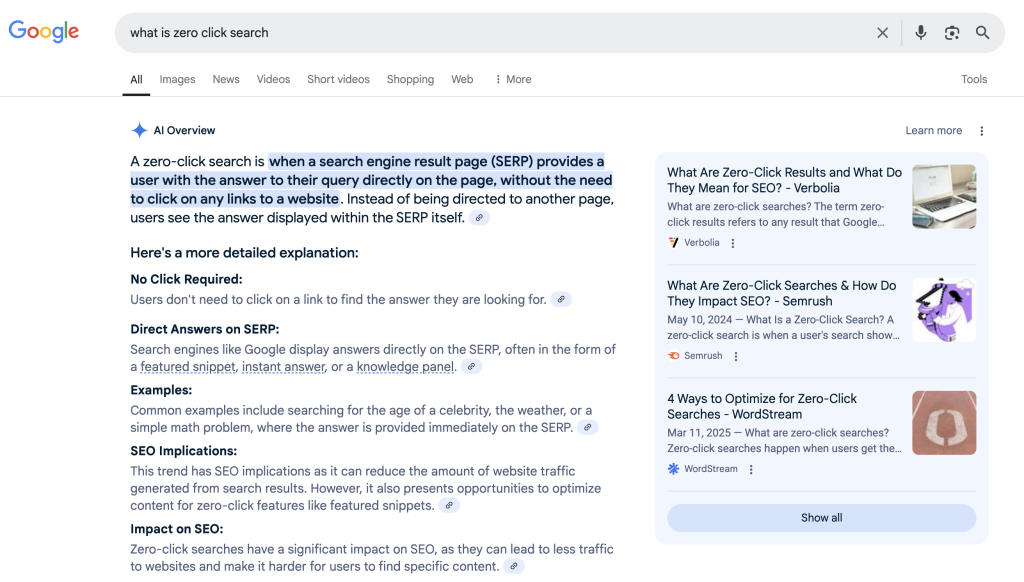
The Zero-Click Conundrum and Rise of LLM Black Box

April 26, 2025 by Rohit Leave a Comment

New Frontier of Digital Search

The digital world is evolving faster than ever. With the rise of large language models (LLMs) and AI-powered search engines, the way consumers interact with information and brands is fundamentally shifting. We must closely track two major trends that are redefining the landscape:

  • Zero-click search phenomenon
  • Black box effect created by LLM-driven search

These changes present new challenges and new opportunities for how we connect with consumers in an increasingly AI-driven world.

Source:
Source: SearchEngineLand

The New Competition – Google

Zero-click searches provide answers directly within the search results, bypassing brand websites and other channels 60+% times

For Business, this means:

  • Diminished brand visibility
  • Harder path to drive traffic and conversions
  • Risk of consumers missing out on learning about payment solutions

Frontdoor to Web is Changing

Internet was once navigated primarily through apps, search engines, and browsers, LLMs now serve as a new gateway to the web. In future LLMs will dominate the entry points

Google Search is still 373x bigger than ChatGPT search but LLM search market is growing. Just CHatGPTs Market Share Has Exploded by 740% in last 12 Months. We donot understand the magnitude of this shift as other apps like Perplexity don’t make data public.

One major hurdle we face with LLMs is the opacity surrounding user prompts. In contrast to conventional search engines, where keyword data is accessible, the exact questions and dialogues that lead to LLM responses often remain concealed. Making it difficult for brands to:

  • Understand consumer behavior
  • Measure campaign performance
  • Optimize content strategies

Implications for business

Brand Marketing: Zero-click search and LLM blackbox will make it harder to build brand awareness. We need to innovate ways to connect with consumers.

B2B Marketing: Lead generation becomes more complex with opaque search content. We need innovative indentifying and targeting strategies within and outside LLM ecosystems.

Consumer Marketing: A more experimental and iterative approach is necessary to optimize both zero-click and conversational search outcomes to effectively reach out and connect with consumers.

So what’s the plan

To thrive in this new era, every business must adapt and adopt some cutting-edge solutions

  • Optimize for AI crawlability. Adapt your content for semantic search, emphasizing high-intent, long-tail terms. Forget PDFs and gated content—they’re relics in an AI-driven ecosystem.
  • Enhanced Content Optimization for LLMs: Tailoring content for conversational AI platforms. Go beyond text. Use video and interactive formats to boost visibility in generative AI search. Prioritize deep topical authority over shallow keyword tactics.
  • Strategic Content Partnerships: Collaborating with publishers and creators to embed company’s message within broader online conversations.
  • Exploring New Platforms and Formats: Experimenting with short-form videos and interactive content.
  • Investing in Advanced Analytics: Tracking nuanced user behaviors across the new search landscape. Shift from click-focused metrics to measuring search impressions and AI reach. Optimize for influence over direct conversions.
  • Building Direct Consumer Relationships: Creating personalized, trust-driven relationships with consumers and clients at scale.

By combining bold strategic partnerships, pioneering internal expertise, and relentless innovation, we are poised to not just survive but lead in the shifting sands of search.

Filed Under: The Frontier, Trends

Resilience and Good Anxiety: Harnessing Stress for Strength

March 26, 2025 by Rohit 1 Comment

Fifteen years ago, I believed resilience was purely a mental exercise—something you could develop by reading books and acting resilient. That was a good starting point, but real resilience is something built over years. It emerges from how we navigate challenges, manage stress, and adapt to adversity.

At its core, resilience is a dynamic process, not just a trait. It evolves with our experiences and the ways we respond to stress. This creates an interesting paradox: stress itself is both the problem and the catalyst for resilience. Like yin and yang, stress and resilience are intertwined—each shaping the other.

The Catch-22 of Stress and Resilience

In Good Anxiety, Dr. Wendy Suzuki highlights this paradox, showing that anxiety—often seen as a negative force—can actually be a tool for growth. Anxiety and stress can weaken resilience, but they also present opportunities to build it. When managed effectively, they push us to adapt, learn, and grow stronger.

Resilience isn’t just about enduring hardships; it’s about responding to them in a way that strengthens us. This happens on three levels:

1. Brain – Our neural pathways adapt when we face and overcome challenges.

2. Body – Physical health, exercise, and self-care reinforce our ability to handle stress.

3. Mind – Our mindset, habits, and emotional regulation determine how we process adversity.

Building Everyday Resilience

Resilience is not something we need only in crisis—it’s something we need every day. The good news? We are wired for it. The brain has a natural ability to adapt and strengthen through experiences. But to build resilience intentionally, we must:

• Recognize stress as an opportunity – Instead of fearing it, we can use it as a trigger for growth.

• Seek support when needed – Resilience isn’t built in isolation; it’s strengthened through relationships and conversations.

• Prioritize self-care – Sleep, nutrition, exercise, and relaxation techniques form the foundation for emotional strength.

• Reframe anxiety – Instead of seeing anxiety as a weakness, we can treat it as a guide, helping us identify areas that need attention.

The Role of “Good Anxiety” in Strengthening Resilience

Anxiety can either deplete or build resilience—it depends on how we engage with it. When anxiety is unmanaged, it drains our energy and weakens our ability to cope. But when we use anxiety constructively, it becomes a motivator. It tells us where we need to focus, pushes us to prepare, and even fuels creative problem-solving.

So, the next time stress or anxiety surfaces, ask yourself:

• What is this feeling telling me?

• Who can I talk to about it?

• How can I respond in a way that strengthens me?

By shifting our mindset around stress and anxiety, we can transform them from obstacles into opportunities. In the end, resilience isn’t just about bouncing back—it’s about growing stronger every time we do.

Filed Under: Leadership, Self Development, The Frontier

The Illusion of Corporate Empires: Why Legacy Outlasts Ambition

March 14, 2025 by Rohit Leave a Comment

In the fast-paced, high-stakes world of corporate life, it’s tempting to equate success with building empires—towering structures of influence, profit, and power. We often pour their energy into amassing resources, expanding reach, and cementing their names atop the organizational hierarchy. But history, at least of my few years in this corporate world, whispers a sobering truth: even the mightiest empires crumble. What remains, long after the corner office is vacated and the balance sheets fade, is the legacy you leave behind—the imprint of your business impact, the way you led your team, and the relationships you cultivated.

The pursuit of empire-building in the corporate realm is often a mirage that I have also struggled with. It’s a race to construct something grand, only to realize that organization shifts, disruptive arrangements, or simple frailty can topple it overnight. Think of the titans of industry from decades past—leaders once deemed invincible, now eliminated from even our memory. The lesson isn’t that ambition is futile; it’s that ambition misdirected toward scale alone misses the mark. True staying power lies not in the size of the empire, but in the substance of what you create.

Your business impact is the first pillar of a lasting legacy. It’s not just about revenue or market share—it’s about the value you deliver to customers, the problems you solve, and the innovation you spark. Did your work make lives better? Did it push an industry forward? A leader who focuses on meaningful outcomes over mere expansion plants seeds that outlive quarterly reports. Take the example of leaders that prioritized focusing on basics and build strong foundations in their area of accountability —years later, their influence endures not because they dominated, but because they did what mattered.

How you lead your team is the second cornerstone. Empires may be built by individuals, but they’re sustained—or undone—by the people behind them. A leader who inspires, empowers, and respects their team creates a ripple effect that extends beyond their tenure. Contrast this with the manager: their empire might soar briefly, but it collapses under the weight of unhappiness and turnover. Great leaders build loyalty, not just headcount. They mentor, listen, and foster a culture where others can thrive. Years later, it’s the team members who say, “I grew because of them,” that cement a leader’s true legacy.

Finally, the relationships you forge are the threads that tie it all together. Corporate life can feel transactional—handshakes, arrangements, and networking —but the connections that endure are the ones built on trust and authenticity. A colleague you supported in a tough moment, a client you went the extra mile for, a team member you invested your time in —these are the human bonds that outlast corporate battles. Empires may dazzle with their scale, but relationships quietly anchor your influence in the lives of others.

In the end, corporate life isn’t about erecting an unassailable fortress; it’s about leaving a mark that time can’t erase. Empires will rise and fall, as they always have. But a legacy of impact, leadership, and connection? That’s what stands the test of time. So, the next time you’re tempted to chase the throne, ask yourself: What will they remember me for when the dust settles?

Filed Under: The Frontier, Trends

Different Is Not Bad

January 28, 2025 by Rohit Leave a Comment

Sometimes I find myself in situations where things don’t go the way I’m used to, and my immediate reaction is to label them as bad. Sometimes, I even get frustrated and behave differently, which I hate.

Occasionally, I manage to resist the urge to run away from the unfamiliar and temporarily embrace it, often due to external circumstances or necessity. Many of those times, I discover that the new approach is actually better than what I was accustomed to. Yet, despite this realization, I often revert to my old habits.

I’m making a conscious effort to remember those new experiences, focus on their benefits, and actively embrace change. It’s not easy, but I believe it’s essential for personal growth and becoming a better leader. Different is not bad—it’s often an opportunity to grow.

Filed Under: The Frontier, Trends

Beyond Generative AI: How Agentic AI Will Reshape Digital Business

January 15, 2025 by Rohit Leave a Comment

The evolution of marketing technology has led to both excitement and disappointment, with many organizations struggling to achieve satisfactory ROI from their MarTech investments. However, the emergence of Agentic AI presents a promising solution to these challenges, offering the potential for true marketing automation and improved efficiency. I am excited to think how Agentic AI will reshape Digital Business.

Achieving optimal ROI from MarTech investments has been challenging due to organizations’ reluctance to allocate sufficient resources for content creation and skilled personnel. However, the emergence of Agentic AI, coupled with Generative AI, offers a promising solution to these longstanding issues.

As I have observed with previous MarTech trends, there’s a possibility that the initial enthusiasm surrounding Agentic AI may follow a similar trajectory. Despite the promise, organizations should remain cautious and strategic in their adoption of Agentic AI, focusing on optimization rather than expansion in the near term. 

Agentic AI today can serves as an on-demand digital twin, empowering team members to deliver unprecedented value.

These AI co-workers will enhance productivity, efficiency, and innovation across various business functions like marketing, sales and ecommerce. Here are some the use cases where these can be deployed and tested in marketing and sales:

  • Personalized Marketing Campaigns: AI tailors marketing content to individual users based on their real-time behavior, boosting engagement and conversions.
  • Content Creation and Curation: AI generates and manages diverse content aligned with marketing strategies, ensuring relevance and timeliness across all platforms.
  • Real-Time Market Research: AI continuously analyzes trends, consumer behavior, and competitor activities, helping marketers predict and capitalize on emerging opportunities.
  • SEO and Ad Optimization: AI dynamically adjusts SEO strategies and manages ad spend across platforms to maximize ROI.
  • Lead Generation and Qualification: AI automates lead identification, scoring, and nurturing, delivering only high-quality prospects to sales teams.
  • Event Management: AI handles all aspects of digital or hybrid events, from invitations to follow-ups, maximizing attendance and engagement.
  • Dynamic Pricing: AI adjusts pricing and promotions in real-time based on market data, optimizing sales volume and profit margins.
  • Brand Monitoring: AI tracks brand mentions online, managing or escalating responses to protect and enhance brand reputation.
  • Customer Journey Mapping: AI analyzes customer interactions across all touchpoints, suggesting improvements to enhance satisfaction and loyalty.
  • Customer Onboarding: AI streamlines the onboarding process, providing personalized guidance and support to new customers.

If you are also in e-commerce industry here are additional ones:

  • Personalized Shopping Experience: AI analyzes your browsing history, past purchases, and preferences to create a tailored shopping journey. It offers product recommendations, styling advice, and personalized shopping lists, making your experience feel uniquely curated.
  • Checkout Optimization: AI streamlines the buying process by intelligently suggesting the most efficient payment methods based on your history. It offers one-click purchases for returning customers and sends timely reminders to complete abandoned carts, significantly reducing friction at checkout.
  • Visual Product Search: This feature allows you to upload images of products you like. AI then scans the e-commerce catalog to find identical or similar items, enhancing product discovery. It can also identify items in lifestyle photos for easy addition to wishlists or immediate purchase.
  • Product Listing Boost: AI generates optimized product descriptions, tags, and titles that are both SEO-friendly and appealing to customers. This improves product visibility in search results and increases click-through rates, ultimately driving more sales.
  • Voice Shopping: Integrated with popular voice assistants, this feature enables hands-free shopping using natural language commands. You can search for products, add items to your cart, and complete purchases entirely through voice interaction, enhancing accessibility and convenience.
  • Fraud Protection: AI continuously analyzes transaction patterns and user behavior to identify potential fraudulent activities in real-time. It flags suspicious transactions for review, protecting both the business and consumers from financial losses and identity theft.
  • After-Sales Support: AI manages various post-purchase interactions, including processing returns, providing detailed setup guides, and offering troubleshooting assistance. This ensures a smooth experience even after the sale, boosting customer satisfaction and loyalty.
  • 24/7 Customer Support: AI-powered chatbots and virtual assistants provide round-the-clock support, answering queries, managing complaints, and even suggesting relevant products. They can track shipments, process refunds, and offer detailed product information, ensuring customers always have access to help.
  • Smart Loyalty Programs: By analyzing customer purchase history and preferences, AI tailors loyalty rewards and discounts to individual shoppers. This personalized approach increases the likelihood of repeat purchases and fosters long-term customer relationships.

Agentic AI represents a significant advancement in MarTech, offering solutions to long-standing challenges of efficiency and ROI. By strategically implementing Agentic AI while maintaining ethical standards and human oversight, organizations can unlock new levels of marketing performance and customer engagement. As this technology evolves, marketers must stay informed and adaptable to leverage its full potential while navigating potential pitfalls.

Filed Under: The Frontier, Trends Tagged With: Agentic AI, Digital Business, Digital Transformation, Ecommerce, Generative AI, Machine Leanring, marketing, Sales

  • « Previous Page
  • 1
  • …
  • 13
  • 14
  • 15
  • 16
  • 17
  • …
  • 28
  • Next Page »

Copyright © 2026 · Genesis Framework · WordPress · Log in