Day 2 of CES 2025 highlights integrating AI, enhancing user experiences, and pushing the boundaries in both consumer and industrial technology. There were announcements beyond Agentic AI into Physical AI which marks the beginning of the new era in AI.
🕶️ AI and Smart Glasses: Halliday introduced smart glasses with a hidden display and proactive AI, enhancing user interaction through voice commands and a smart ring for control. BioLite also showcased a smart battery backup system for home appliances, ensuring power during outages.
🏎️ Automotive Innovations: CES 2025 featured significant automotive tech, including BMW’s panoramic iDrive system for a comprehensive dashboard display, and Even Realities presenting AR glasses with real-time translation and navigation.
⌚ Portable and Expandable Tech: Lenovo revealed the ThinkBook Plus with an expandable OLED screen, offering a flexible display for increased productivity.
🤖 Consumer Electronics: Samsung unveiled a stretchable Micro LED display that can turn 2D into 3D, while TCL introduced the Playcube, a versatile portable projector with a ‘magic cube’ design for adjustable projection angles.
🤸♀️ Health and Fitness: The Amazfit Active 2 smartwatch was highlighted for its affordability and features like offline maps and a variety of sports modes, complemented by hashtag#AI assistance.
🕹️ Gaming and Entertainment: Razer showcased new gaming hardware including the thin Blade 16 laptop and Project Arielle, an RGB gaming chair with thermal regulation.
🥬 Sustainability and Energy: Innovations in sustainable technology were evident with products like the BioLite Backup power system for home appliances, aiming for energy efficiency.
It is impressive how AI has changed how we consume information and especially summarizing what matters to me individually. This summary is again brought to you via Grok as I am not attending in person.
CES 2025 Day 1
A broad spectrum of technological advancement were announced at “CES 2025 Day 1” today – from AI and health to gaming and automotive innovations.
Some are particularly noteworthy 🥸
I am not attending CES but here is the summary via Grok AI
🚀 Nvidia’s Project Digits and Cosmos: Nvidia introduced Project Digits, a $3,000 personal AI supercomputer, and Cosmos, an open-source AI model for training robots and autonomous vehicles, alongside the Nvidia GB200 NVL72, a data center superchip with impressive GPU capabilities.
🪞 AI-Powered Health Mirror: A 360° AI-powered body scanning health mirror was unveiled, capable of scanning heart, weight, and metabolic health, showcasing advancements in health technology.
🛜 Nvidia RTX 50 Series Graphics Cards: These new graphics cards include AI features like neural rendering capabilities, with the RTX 5090 boasting 4,000 AI TOPS, 380 ray-tracing TFLOPS, and 1.8 TB/s bandwidth, highlighting a significant leap in gaming and computational power.
📺 Samsung’s New TV and Monitor Lineups: Samsung announced the NEO 8K flagship TV, the Frame Pro with enhanced brightness and contrast, and the OLED Smart Monitor M9, which focuses on AI-driven picture optimization and upscaling.
⌚ Garmin Instinct 3: This sports watch introduces an AMOLED display with up to 24 days of battery life, targeting adventurers with its solar charging and health monitoring features.
🏎️ BYD’s Yangwang U9 Supercar: BYD debuted a supercar with a “jumping suspension” system, allowing it to leap over obstacles, showcasing innovation in automotive technology.
🤖 Roborock’s New Robovac: Featuring a mechanical arm to pick up small items, this robovac adds a new level of functionality to home cleaning robots.
🕹️ Hyperkin’s Competitor Controller: This Xbox controller redesign incorporates elements from the PS5 DualSense, including Hall effect joysticks for improved longevity and accuracy.
⏰ JBL’s Horizon 3 Alarm Clock: With enhanced sound and features aimed at improving sleep quality through nature sounds and light therapy.
📺 LG’s StanbyME Update: LG is enhancing its portable TV with better resolution, more ports, and longer battery life, adding new accessories for increased portability.
🕶️ Halliday Smart Glasses: Introduced with AI capabilities like conversation assistance and live translation, these glasses aim to blend technology into everyday wear seamlessly.
Is Google Quantum Computing Chip “Willow” A Bitcoin Killer?
Quantum computing has transitioned from an abstract possibility to a burgeoning revolution. Among the latest innovations, Google Willow a cutting-edge quantum chip—has emerged as a game-changer, boasting advancements that significantly reduce computational errors while exponentially increasing processing power. While this achievement marks a new horizon for technology, it also raises critical questions about its impact—specifically on Bitcoin, the world’s premier cryptocurrency. Here I examine the intersection between Google Willow – quantum computing, and Bitcoin, highlighting the risks, solutions, and opportunities laid before us.
What Is Google Willow, and Why Is It Revolutionary?
Google’s Willow chip represents a monumental leap in the quantum computing space. With 105 qubits and enhanced error correction capabilities, Willow achieved two unprecedented milestones:
- Exponential Error Correction – Willow demonstrated the ability to reduce computational errors as more qubits are added. This achievement, known in the quantum field as being “below threshold,” has been a longstanding challenge since quantum error correction’s inception in 1995. Unlike prior systems, Willow now proves that scaling qubits can enhance stability rather than amplifying errors.
- A Benchmark in Computational Power – Willow performed a computation, using a process called Random Circuit Sampling, in under five minutes—a task that would take one of today’s fastest supercomputers an incomprehensible 10 septillion years. This staggering number surpasses the known timescales of the universe and underscores the chip’s unmatched capabilities.
These feats suggest that quantum systems like Willow are not just scientific experiments but are closing in on commercially viable applications for fields ranging from AI to physics. However, this also brings into focus its implications for cryptographic security—a core pillar underpinning Bitcoin.
Quantum Computing and Bitcoin’s Foundational Security
Bitcoin relies on cryptographic algorithms, including SHA-256 and Elliptic Curve Cryptography (ECC), which secure wallet privacy, verify transactions, and sustain the blockchain’s decentralized ledger. These algorithms depend on complex mathematical problems that are effectively unbreakable for classical computers.
Quantum computers like Willow pose a challenge because they can solve these problems exponentially faster. For example, Shor’s Algorithm could render ECC obsolete by swiftly deriving private keys from public addresses, while Grover’s Algorithm could significantly undermine the efficiency of SHA-256, reducing its security strength by half.
Are Cryptocurrencies at Immediate Risk?
Despite the extraordinary advancements of Willow, experts like those referenced in the Binance article suggest that the immediate threat to Bitcoin remains mitigated. Quantum technology today, while powerful, still needs further development to execute cryptographic breaches at scale. Nonetheless, the field’s rapid propulsion, coupled with Google’s roadmap toward “practical, commercially-relevant” quantum applications, accelerates the need for quantum-resistant solutions across industries.
Why Google Willow’s Progress Elevates the Concern for Bitcoin
Google Willow’s breakthroughs mark the beginning of a potential paradigm shift that could compress timeframes for quantum threats. Cryptocurrencies like Bitcoin are inherently vulnerable to quantum attacks without significant upgrades. Specifically, 25% of existing Bitcoins remain stored in legacy P2PK (pay-to-public-key) addresses—an outdated format with exposed public keys susceptible to quantum decryption.
The Deloitte analysis corroborates this by revealing approximately 4 million Bitcoins residing in such vulnerable wallets, representing $40 billion in assets. Furthermore, even secure wallet addresses become temporarily exposed during transactions, opening brief but critical windows for quantum-enabled attacks. Willow’s ability to run complex processes in mere minutes accentuates these concerns.
Mining the Opportunities Amid Quantum Challenges
Although the potential risks are significant, quantum computing also presents opportunities for Bitcoin and blockchain networks. Here’s a closer look:
1. Transforming Blockchain Infrastructure
Quantum-level computing power could optimize blockchain scalability, allowing for faster verification processes and improved mining efficiencies. These advancements could address pressing concerns such as Bitcoin’s transaction latency and high energy consumption.
2. Catalyzing Cryptographic Innovation
The threat of quantum decryption has galvanized research into quantum-resistant cryptography. Techniques like XMSS (eXtended Merkle Signature Scheme) and protocols incorporating lattice-based or hash-based signatures are being developed to safeguard cryptocurrencies against quantum attacks. While implementing these on the Bitcoin blockchain will require international consensus, it also opens the door for future-proof digital currencies.
3. Inspiring Market Confidence through Adaptation
Adapting to quantum threats can position Bitcoin as a resilient, forward-facing digital asset. By showcasing proactive evolution, Bitcoin could reinforce trust within its diverse investor network, mitigating concerns of obsolescence due to disruptive technologies.
Navigating Toward a Quantum-Resilient Future
The timeline for actionable threats from quantum computing remains debated. The Coinbase article highlights that current quantum systems are error-prone and years from commercialized cryptographic compromise. However, Google Willow’s achievements condense those timelines, making quantum-resilience an urgent priority rather than a distant contingency.
Upgrading the Bitcoin protocol, however, will face challenges—not just technical, but governance-related. Achieving consensus across Bitcoin’s decentralized ecosystem for a protocol upgrade is a complex endeavor. Industry-wide collaboration and coordinated international policies will be critical to implementing post-quantum security measures.
Quantum computers like Google Willow represent both a burgeoning threat and an unprecedented opportunity. While their potential to disrupt Bitcoin’s cryptographic architecture is evident, their capacity to refine and revolutionize blockchain technology could prove equally impactful. The success of Bitcoin in this quantum era will depend not just on its ability to anticipate risks, but also on how effectively the community can build and adapt resilient mechanisms.
Much like Bitcoin’s triumphs over previous challenges, the answer lies in its ability to evolve. If the cryptocurrency ecosystem bands together, its future alongside quantum technology could be as transformative as its origin story.
How Bowtie B2B Growth Model is different from Traditional Sales Funnel
The Bowtie B2B growth model is a modern approach to understanding and optimizing the customer lifecycle in business-to-business (B2B) settings. Unlike the traditional sales funnel, which focuses heavily on attracting and converting leads without much emphasis on post-sale engagement, the Bowtie model takes a holistic view of the customer journey—before and after conversion.
Why It’s Different from the Sales Funnel
While the sales funnel narrows everything down to a single event—closing the deal—the Bowtie B2B model expands the focus beyond the initial purchase. It recognizes that sustainable growth is built not just on acquisition but also on the long-term value and success of your customers. By emphasizing retention, customer success, and potential for expansion, this model helps B2B businesses build stronger, more profitable relationships.
Think of the process as a bowtie: one side focuses on getting customers in, and the other on ensuring they stay and grow with your business.
Key Stages of the Bowtie B2B Growth Model
1. Acquisition
This is the starting point where you attract and convert prospects into paying customers. Marketing and sales efforts drive this stage, focusing on lead generation, qualification, and closing deals. However, unlike the funnel, the story doesn’t end here.
2. Activation
Once a customer signs on, the focus shifts to helping them engage with your product or service quickly and effectively. Activation ensures the customer achieves the first meaningful interaction or value (the “aha moment”) with your offering. This stage is critical in setting the tone for a lasting relationship.
3. Adoption
Here, the goal is to ensure your customers fully adopt your product as part of their work processes or systems. Training, onboarding, and regular support play a huge role in driving adoption. The better integrated your solution becomes in their operations, the more likely they are to stick around.
4. Retention
Retention is about keeping customers satisfied so they continue to see value. This stage hinges on proactive customer support, relationship management, and consistent communication. It’s often where many upsell or cross-sell opportunities naturally arise as you deepen customer trust.
5. Expansion
The final stage focuses on growing the account. Expansion can take many forms—selling additional seats for a subscription model, offering premium features, or introducing complementary solutions. By keeping existing customers happy, you unlock opportunities to increase lifetime value (LTV) and foster advocates who bring referrals.
How the Bowtie B2B Growth Model Optimizes Growth
The brilliance of the Bowtie B2B growth model lies in its cyclical nature. By not stopping after the sale, it ensures every aspect of the customer experience—both pre- and post-purchase—is intentional and optimized. This approach doesn’t just maximize revenue per customer; it also reduces churn and transforms customers into loyal, long-term partners.
A Real-World Advantage
For businesses using this model, the benefits are clear. A software-as-a-service (SaaS) company, for example, would use the Bowtie model to ensure that after a subscription sale, the customer fully understands the product’s capabilities (activation), integrates it into their workflow (adoption), finds ongoing value (retention), and eventually subscribes to additional features (expansion). It’s a full-circle approach that turns sales into a continuous loop of growth.
By putting customer success at the center of your strategy, the Bowtie B2B growth model offers a smarter, more sustainable way to not just win customers but keep them—and grow with them over time.
Practical Use Cases of Generative AI: Beyond the Snake Oil
When approached thoughtfully and strategically, Generative AI reveals a wealth of practical applications that can drive real value across industries. Particularly in marketing, sales and customer experience (CX) where creativity and analytics are crucial, generative AI can transform processes and enhance customer engagement. These applications have also proven to improve operational efficiencies and reducing cost.
Generative AI is not the “Snake Oil” but how vendors who label everything as GenAI to sell. Generative AI has faced skepticism, labeled as a passing trend or “snake oil”. I talked about that in my last post and share how we can be on the lookout for Snake Oil as we try to implement practical use cases of Generative AI.
Some of the areas where there are ample amount of use cases, generative AI is production-ready and also matches organizational readiness are:
1. Content Generation
Generative AI can automate the creation of various types of content, from blog posts to social media updates. Tools like Canva’s Magic Write, Jasper, Editor and Copy.ai allow marketers and sales to produce high-quality written content efficiently, freeing up time for strategic initiatives. These platforms leverage AI to understand brand voice and tone, enabling personalized content creation that resonates with target audiences.
Example: Jasper has been used by companies like HubSpot, which reports significant increases in content production speed and engagement. Jasper
2. Creative Development
AI-driven tools can assist in generating creative assets, including graphics, videos, and ad designs. Tools like Canva’s AI Photo Editor and Adobe Firefly empower marketers to create visually appealing materials quickly. These platforms harness AI to suggest design elements, streamline workflows, and enhance overall creative output.
Example: How generative AI streamlined my creative process Adobe
3. Analytics and Insights
Understanding customer behavior is critical in marketing. Generative AI can analyze vast datasets, clean those data sets to uncover insights and trends. Companies like Google have incorporated AI features into Google Analytics 4, which helps marketers interpret user data more effectively, offering predictive analytics and actionable recommendations that guide marketing strategies. It can also be used in auto generation of visualization and dashboards in tools like Tableau and others
Case Studies: How Generative AI Can Support Advanced Analytics Practice MIT Sloan
Another good post I suggest reading is from Forbes
4. Interactive Chat Experiences
Chatbots powered by generative AI can elevate customer service and engagement. Microsoft, Drift and Intercom utilize AI to create conversational experiences that assist customers while collecting valuable feedback. These tools personalize interactions based on user data, making conversations more relevant and engaging.
Example: Drift has reported that businesses using their AI chat solutions see a 50% increase in customer engagement rates compared to traditional methods. Drift
5. Experience and Campaign Optimization
Generative AI can optimize marketing campaigns by predicting outcomes and suggesting adjustments in real-time. Technologies like Adobe Sensei, Braze, LINK AI helps marketers analyze past campaign performances, enabling them to tweak ongoing efforts for better results. This capability can lead to more effective budget allocations and higher ROI.
Case Study: How AI-powered ultra-personalised experiences are boosting our beauty brands Unilever
Other Real-World Applications
• Netflix: The streaming giant uses generative AI to tailor content recommendations and generate promotional materials. By analyzing viewing habits, they create personalized marketing campaigns that drive user engagement and retention.
Reference: “How Netflix Uses AI to Personalize Recommendations” Forbes Article
• Coca-Cola: The brand has employed AI to develop new flavors and enhance customer experiences. Through AI-driven insights, Coca-Cola can better understand consumer preferences, leading to more targeted product launches.
Case Study: Coca-Cola’s use of AI for product innovation was highlighted in a 2021 report by the Harvard Business Review. Harvard Business Review
• Unilever: This consumer goods company utilizes AI for product development and marketing strategies. Their AI models analyze social media sentiment and customer feedback to inform new campaigns and product offerings.
Reference: “Unilever’s AI-Driven Marketing Strategy” – McKinsey, 2023. McKinsey Article
Conclusion
Generative AI when applied with a clear strategy and focus on relevant areas, it offers tangible benefits in marketing and beyond. By embracing content generation, enhancing creativity, leveraging analytics, and improving customer interactions, companies can unlock the full potential of AI technologies. The future of marketing is not just about adopting Generative AI; it’s about experimenting wisely, expanding it mindfully and ensuring AI and GenAI capabilities are driving real results.
GenAI Snake Oil: Separating Hype from Reality in AI
The surge of artificial intelligence (AI) into our professional and personal lives has been nothing short of transformative. From automating routine tasks to enhancing decision-making processes, AI’s potential seems limitless. But with every new technology trend comes a familiar shadow — the alluring yet myriad promises that ultimately underdeliver, otherwise known as “Snake Oil.” In this case “AI Snake Oil” or GenAI Snake Oil.

In today’s fast-paced digital ecosystems, recognizing the difference between genuine AI prowess and inflated claims is increasingly crucial, not only for business success but for upholding the integrity and advancement of AI as a field of innovation.
Understanding AI Snake Oil
At its core, AI Snake Oil refers to the marketing and selling of artificial intelligence products or services that are more hype than help. This phenomenon is not unique to AI but has found fertile ground in an industry where capabilities can be complex and their outcomes not immediately visible. It’s the digital iteration of 19th-century elixirs, promising health and vitality with no scientific backing. AI Snake Oil can range from overpromised software functionalities to exaggerated AI-automation improvements.
I don’t know who invented this term of GenAI Snake Oil but I was recently introduced to this term via an article I read from Arvind Narayanan of Princeton University on “How to recognize AI snake oil”.
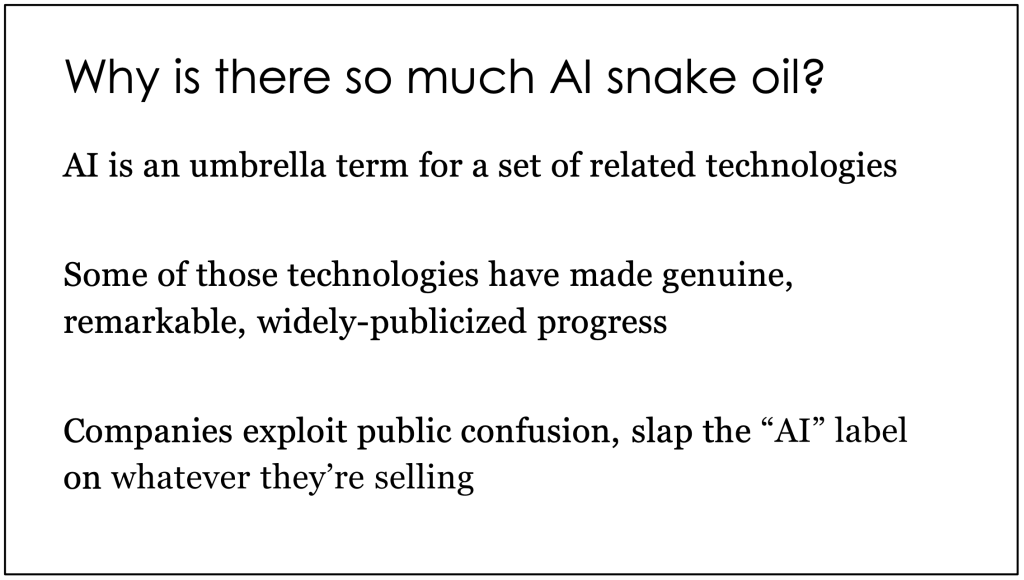
How to recognize AI snake oil by Arvind Narayanan of Princeton University
The Cost of Credulity
Believing in GenAI Snake Oil can be more than just a disappointment; it can be a costly mistake. For a business, investing in AI products or consultancy services based on inflated claims not only wastes resources but can set back critical projects and breed a climate of distrust in the whole organization’s AI strategy.
AI Debt
The insidious spread of AI Snake Oil has broader repercussions. Beyond the immediate financial costs, there can be loss of considerable value as we create AI Debt similar to a Tech Debt.
AI Debt is the implied cost of future reworking or reimplementation required if the AI investment doesn’t pay because the promised features were not available or not working as promised.
Sowing Seeds of Doubt on AI industry
As investors and practitioners become cautious due to previous snake oil experiences, the entire industry will face a stagnation of trust. This will slow down the adoption of potentially groundbreaking AI applications and dilutes the confidence needed for the market to continue pushing boundaries.
Identifying the Warning Signs
Detecting AI Snake Oil is a subtle skill. There are no straightforward litmus tests, but there are red flags to watch for. Claims of ‘one-size-fits-all’ solutions, lack of specific technical details, and absence of verifiable results are warning signs that an AI product might not be all it’s cracked up to be. Product has been in existence for few years and they were never talking about AI and suddenly now they are company that was build on AI principles and everything they do id Generative AI.
How to recognize AI Snake Oil
AI Snake Oil presents a pressing challenge to the burgeoning AI industry, but it is one that can be overcome through a combination of individual vigilance and collective responsibility
Investigate Before Investing
Before making a purchase or approving a contractual relationship with an AI provider, you must cultivate a healthy skepticism. This involves digging into use case examples, asking for details about training Data and methods, and ensuring that the company’s track record aligns with the purported capabilities.
Building a Transparent AI Landscape
The responsibility to mitigate the spread of AI Snake Oil does not lie solely with consumers. The AI community should be tasked with establishing ethical guidelines and industry standards that can distinguish reputable products and services from those that merely glimmer with the promise of AI magic.
Fostering Ethical AI Practices
Organizations at the forefront of AI must champion transparency, providing clear benchmarks and values that prioritize genuine results over inflated claims. By doing so, they not only protect their own reputations but also help nurture a more trustworthy landscape for AI adoption.
Steering Clear of False Promises
To navigate the burgeoning AI industry, we must remain informed and discerning. By embracing a culture of critical evaluation, we can collectively stem the tide of AI promises that exist only in the sales pitch. This means continuously educating ourselves, sharing knowledge within professional communities, and holding AI providers and developers to account for the claims they make.
The MarTech Optimization Playbook
Her is my secret sauce of how I have unlocked enormous value from MarTech at every large organization I have been part of.
- Assess the Current Landscape: Conduct a comprehensive audit of your existing MarTech stack.
- Define Clear Objectives: Align stakeholders on the expected outcomes and establish a North Star metric.
- Optimize and Consolidate: Eliminate redundant tools, reduce costs, and reinvest savings strategically.
- Implement Accountability: Ensure CMOs and key partners are collectively responsible for outcomes.
- Address Resource Constraints: Recognize that successful MarTech implementation often requires investment in content and personnel