Rohit Prabhakar

I build agentic revenue systems for Fortune 50 companies

  • Digital Transformation
  • Leadership
  • Marketing
  • Writing
  • Home
  • Privacy Policy

The Privacy Covenant: Why Personalization Without Trust Is Surveillance

May 13, 2026 by Rohit Leave a Comment

The Privacy Covenant is the architecture that makes Market-of-One legitimate at enterprise scale. On August 2, 2026, EU AI Act enforcement begins, with fines reaching EUR 35 million or 7% of global revenue. But this article is not about compliance. It is about the hidden cost most enterprises are already paying when they personalize without trust – what I call the Surveillance Tax – and the four-pillar covenant that turns privacy from a constraint into a competitive moat.

In Week 7, I argued that the durable competitive advantage in the AI era is not the model, not the data, and not the talent. It is the compounding loop where each cycle of data, inference, generation, and trust accelerates the next. Trust is the unfakeable input to that loop. Without it, the loop runs once and stalls.

This week is about how that trust is engineered. Not promised. Not claimed in a brand campaign. Engineered into the architecture of how the enterprise interacts with customer data, every day, at every touchpoint.

A countdown clock is ticking in every C-suite I walk into. August 2, 2026. The EU AI Act’s main provisions become applicable, including transparency obligations, governance rules, and the bulk of the regulatory framework. Maximum fines: EUR 35 million or 7% of global annual turnover, whichever is higher. For a company with $30 billion in revenue, that ceiling sits above $2 billion. Meta’s theoretical exposure is roughly $8.5 billion. Google’s $14 billion. Microsoft’s $16 billion. Beyond the fines, market surveillance authorities gain the power to withdraw non-compliant systems from the European market entirely. (Note: per the Council’s May 2026 Digital Omnibus agreement, high-risk AI systems listed in Annex III now apply from December 2, 2027, but the August 2026 enforcement date stands for the rest of the framework, and treating it as binding remains the safe planning assumption.)

The numbers are large. The deadline is real. The penalty regime exceeds even GDPR’s structure.

And yet, if you are reading this as a compliance article, you are missing the actual problem. Compliance is the easy part. Build the documentation, run the conformity assessments, file the impact reports, register the high-risk systems. Expensive, time-consuming, but solvable. The harder problem is the one the deadline forces you to confront: most enterprises personalize without trust, and the cost of that has been hidden in the marketing P&L for a decade.

You can be fully compliant with the EU AI Act and still be in trouble. Because compliance is the floor. Trust is the structure you build on top of it.

The Trust Gap the Deadline Will Expose

Most CMOs and CDOs I talk to are treating the August 2026 deadline as a legal milestone. Their privacy programs are running out of the General Counsel’s office. The IT team is mapping data flows. The compliance team is filing the paperwork. The marketing team is mostly watching from the sidelines, hoping the legal work does not constrain what they can do with customer data.

That posture is the problem.

The August 2026 deadline is forcing organizations to confront a question they have been avoiding since GDPR took effect in 2018: do your customers actually trust you with their data, or have you simply assumed they do because they have not opted out?

The Qualtrics 2026 Consumer Experience Trends Report puts the answer in numbers. Only 39% of consumers believe organizations use their personal information responsibly. Only 33% globally trust companies with their data. 71% are frustrated by impersonal brand experiences. And from CDP.com’s 2026 privacy statistics, 87% of consumers would not do business with a company if they had concerns about its security practices.

This is the trust gap. It is not a regulatory problem. The regulator cannot fix it for you. You can be fully compliant with the EU AI Act, GDPR, and every state privacy law in the United States, and still operate inside this trust gap. The deadline exposes the gap. It does not close it.

The Surveillance Tax

There is a name for what enterprises pay when they personalize without trust. McKinsey first put a number on it: companies operating without a credible privacy strategy spend 10% to 20% more on marketing and sales for the same returns. That is not a compliance line item buried in legal. It is structural drag on every customer acquisition campaign you run.

I call it the Surveillance Tax.

Most CMOs are paying it without realizing it. They see the symptoms – falling CAC efficiency, rising opt-outs, deteriorating attribution accuracy, declining email engagement – and they treat the symptoms with creative refreshes, channel shifts, and incremental budget. The actual disease is structural. Customers do not believe them. Every campaign starts in a deeper hole than it should. Every acquisition costs more than it should. Every retention motion has to overcome a baseline of suspicion that the trust-built competitor is not fighting against.

Academic research published in late 2025 quantified one piece of this. Mobile campaigns perceived by consumers as intrusive showed engagement declines exceeding 50% compared with comparable campaigns perceived as relevant. The same data point that drives a 3x conversion lift when delivered through a trust-based relationship can produce a negative engagement signal when delivered through an extraction-based one.

Compounding it further: regulatory exposure rises every quarter. Enforcement actions have moved from theoretical to operational. Connecticut’s Attorney General settled with TicketNetwork for $85,000 over an unreadable privacy notice and broken opt-out mechanisms, the first publicly announced enforcement under the Connecticut Data Privacy Act and a signal that even small operational failures now carry penalties. Texas secured a $1.375 billion settlement with Google over geolocation tracking, incognito browsing, and biometric data collection – the largest single-state privacy settlement on record. The Irish Data Protection Commission’s TikTok penalty of EUR 530 million for cross-border transfer violations confirmed that non-EU companies face no geographic shield. Twenty US states now have comprehensive privacy laws in effect, and California’s automated decision-making technology rules around algorithmic profiling took effect in January 2026, which catches every personalization engine running on automated decisioning.

The Surveillance Tax is real. It is structural. And it compounds.

What Apple Already Proved

One company already made the trade publicly.

April 2021. Apple released iOS 14.5 with App Tracking Transparency. A single permission dialog. Users choose which apps can track their activity across other companies’ services. The technical mechanism was simple – it gated access to the Identifier for Advertisers that the advertising industry had relied on for cross-app tracking. The market impact was not simple.

Within months, Meta disclosed that App Tracking Transparency would reduce its annual advertising revenue by approximately $10 billion. Snap, Pinterest, and YouTube took smaller but real hits. The mobile advertising industry restructured itself around a single product decision Apple made.

Tim Cook said the quiet part out loud: “We could make a ton of money if we monetized our customer, if our customer was our product. We have elected not to do that.”

Apple did not absorb the privacy cost. They made their competitors pay it. Privacy became the moat, not the constraint. Apple consistently ranks as the most trusted technology brand in consumer surveys. Their customer retention rate exceeds 90% in major markets. Privacy alignment with their business model created a structural advantage that competitors funded by data collection cannot replicate without dismantling their own economics.

The lesson is not “be Apple.” Most enterprises cannot rebuild their entire business model around privacy positioning. The lesson is that privacy, built correctly, is not a tax you pay reluctantly. It is a tax you collect from competitors who chose extraction over covenant.

Addressing the Surveillance Capitalism Counter-Argument

The serious intellectual objection to everything I have written so far comes from Shoshana Zuboff, whose work on surveillance capitalism has shaped this field for a decade. Her argument: privacy has already been extinguished. The economic logic of behavioral data extraction has won. Any framework that pretends companies can voluntarily rebuild trust is corporate theater.

She is partially right.

The dominant trajectory of consumer technology over the past fifteen years has been toward more extraction, less consent, and a widening information asymmetry between platforms and users. Zuboff is describing that trajectory accurately. What her argument leaves out is the strategic choice available to enterprises that are not platform monopolies. A bank, a healthcare system, a retailer, a payments network, an industrial manufacturer – these are not Google or Meta. They do not need behavioral surveillance to generate revenue. They generate revenue by serving customers. The trust they need from those customers is not optional for the business model. It is the business model.

The companies that recognize this and act on it will compound advantage. The companies that import surveillance-platform logic into businesses that were never structured to operate that way will find that the playbook breaks down in markets where the customer relationship is the product.

Zuboff describes the trajectory. She does not describe the only possible position within it.

The Four Pillars of the Covenant

The Privacy Covenant is built on four pillars. Architecture, not legal text. Most enterprises have one or two pillars in place. Some have none. That is the gap August 2, 2026 will expose.

Pillar 01 – Consent as architecture, not as legal text. Consent is built into the product surface, not buried in terms of service. The customer sees what they share, with whom, and when. Not at signup. Continuously. Asymmetric opt-out flows where opting in is easier than opting out have already been ruled unlawful in multiple 2025 enforcement actions. The default is transparency. The default is now. The default is granular.

Pillar 02 – Value exchange visible at every data ask. Every data ask shows the benefit returned. “Tell us your size for better fit recommendations” is a covenant. “Accept all cookies” is extraction. The discipline is harder than it sounds. It requires marketing, product, and data teams to agree on what each data point actually buys the customer – and to drop the asks where the value exchange is not real. Most enterprises will eliminate 30% to 60% of their data collection in this audit. Most should.

Pillar 03 – Data minimization by design, not by exception. Collect only what serves the customer experience. Default to less, never more. Most enterprises have accumulated data they cannot articulate the use case for, which means they cannot defend its collection when asked. Data minimization is now a regulatory requirement in 19 US states, the entire EU, and every major comprehensive privacy law on the books. It is also the discipline that prevents the largest privacy incidents.

Pillar 04 – Reversibility, the relationship has an exit. The customer can withdraw consent and rebuild the relationship. They can leave with their data intact. The covenant assumes a relationship that can end, which is what makes it a covenant rather than a trap. Reversibility is the architectural feature competitors who built on extraction cannot replicate without rebuilding their data infrastructure from scratch. That is its strategic value.

Together these four pillars produce something the surveillance model cannot: a customer who shares more data over time, not less. A customer who recommends you to people they trust. A customer who tells you what they actually want when AI agents ask on their behalf, because they expect you to use it well. This is the unfakeable input to the flywheel I described in Week 7. Without it, the loop runs once and stalls.

The covenant assumes a relationship that can end, which is what makes it a covenant rather than a trap. Surveillance does not have an exit. That is what makes it surveillance.

Surveillance Versus Covenant in Practice

The two models look similar at the surface and produce opposite results downstream. The distinction matters at every touchpoint.

The surveillance model takes data silently from behavior. The covenant model receives data shared knowingly through exchange. The surveillance model buries consent in terms nobody reads. The covenant model makes consent visible at the moment of collection. The surveillance model produces personalization without permission. The covenant model produces personalization built from permission. The surveillance model traps the customer because leaving means losing access. The covenant model lets the customer leave with their data intact. The surveillance model pays the Surveillance Tax. The covenant model compounds trust into the flywheel.

Most enterprises operate in the surveillance column without ever having made the choice. The model was set in the pre-cookie-deprecation era when extraction was the default, and the systems were never redesigned when the regulatory and consumer environment changed. The August 2026 deadline forces the redesign to happen anyway. The choice now is whether to do it deliberately or under regulatory duress.

Why Agentic AI Raises the Stakes

The next phase of the trust problem is already arriving. McKinsey’s 2026 AI Trust Maturity Survey found that 74% of organizations identify inaccuracy and 72% cite cybersecurity as highly relevant risks as AI moves from generative to agentic. PwC’s 2026 Global Digital Trust Insights found that consumers are increasingly comfortable using AI to discover products, but reluctant to let agents complete transactions on their behalf. The question every consumer is asking, often without articulating it: what am I actually getting in exchange for my data?

When AI agents act autonomously on customer data, the trust requirement compounds. A consent given to a recommendation engine in 2022 was specific to that recommendation. A consent given to an agent in 2026 covers a much broader scope of action, with much less predictability about what the agent will do next. The legal frameworks have not caught up. Customer expectations have not stabilized. The companies that build the covenant now will have the architectural foundation to handle agentic AI when it lands. The companies that have not will face a second, harder remediation cycle in 18 months.

This is the structural argument for moving now, not waiting for further regulatory clarity. Compliance reaches a steady state. Customer trust does not.

The 90-Day Plan for CMOs and CDOs

If you are reading this and recognizing that your organization has not built the covenant, here is the practical sequence. None of it requires a regulator to act. All of it improves your competitive position regardless of how the August 2026 deadline plays out.

Days 1 to 30 – Audit the value exchange at every touchpoint. For every data point you collect from a customer, document what the customer gets in return. If the exchange is unclear, the data ask is a violation of the covenant. Most enterprises will identify between 30% and 60% of their data collection in this audit. Most of that should be eliminated.

Days 31 to 60 – Map zero-party data acquisition opportunities. Where can you create explicit value exchanges that invite customers to share preferences, intent, and context directly? Preference centers, in-context surveys, interactive product configurators, account-level personalization controls. Zero-party data is the only data category that grows under a strong covenant. It is also the data type that produces the highest personalization lift.

Days 61 to 90 – Establish the trust metric the triad reports on. The CMO-CDO-CIO triad I described in Week 6 needs a shared accountability signal for the covenant. Candidate metrics: zero-party data velocity (how fast customers volunteer information), consent reversal rate (how often customers withdraw permissions), preference center engagement, transparency dashboard usage. Pick one. Make it shared. Report it to the CEO quarterly.

This is not a compliance project. It is a competitive architecture build. The companies that complete it before August 2026 will spend the rest of the decade compounding trust through their flywheels. The companies that complete only the compliance checklist will spend the rest of the decade paying the Surveillance Tax.

The Question Every Leader Has to Answer

One question to sit with. The same question I have asked every executive I have worked with in the last year.

If your customer could see exactly what you collect about them, exactly how you use it, and exactly who else can access it – would they still do business with you?

If you flinch at that question, you have a covenant problem. Not a compliance problem. A trust problem the regulator cannot fix for you and a competitive vulnerability the next downturn will expose.

If you can answer that question with confidence, you have the foundation for everything Week 9 will describe: the operating system that connects the data architecture, the AI capabilities, the organizational design, and the customer covenant into one growth engine. The closing argument of the Market-of-One series.

August 2, 2026 is the deadline. The covenant is the answer. The Surveillance Tax is what you pay if you treat the deadline as a legal checkbox instead of a strategic forcing function.

Most companies will choose the checkbox. The 5% will not. By the time the gap becomes obvious, it will already be uncatchable.

Next week closes the series. Week 09 – The Operating System. The closing argument. Across eight weeks we have built every component: the broken promise of segment-based marketing, the three-layer architecture, the failure modes, the inversion of the marketing job, the pilot-to-scale gap, the CMO-CDO-CIO triad, the compounding flywheel, and now the covenant that makes the whole system legitimate. Week 9 connects them.


This article was developed in partnership with AI – used as a research, brainstorming, and authoring collaborator. All frameworks, positions, strategic perspectives, and opinions are Rohit Prabhakar’s own. AI was the tool. The thinking is mine.
Filed Under: Market-of-One Tagged With: AI privacy, CDO, CMO, consent architecture, customer trust, data minimization, EU AI Act, Market-of-One, personalization without trust, privacy by design, privacy covenant, surveillance tax, zero-party data

The New Moat: Why the Data Flywheel Is the Only AI Competitive Advantage That Compounds

May 5, 2026 by Rohit Leave a Comment

The data flywheel competitive advantage is the only AI moat that compounds over time – and most enterprises are not building it correctly.

Week 07 of 09 · Market-of-One™ Series · The competitive advantage built by the three-layer architecture is not the technology. It is what the technology learns about your customers that no competitor can replicate.

Key Takeaways

  • Data alone is not a moat. The a16z research is correct: incremental data has diminishing returns and a well-funded competitor can replicate most datasets. The moat is the inference quality built on proprietary data – and that takes time and trust to accumulate.
  • The Market-of-One™ flywheel has four compounding stages: better data produces sharper inference, sharper inference produces more precise experiences, more precise experiences build deeper trust, deeper trust generates more zero-party data.
  • Only 5% of organizations are capturing AI value at scale (EY, 2026). Those organizations show 1.7x higher revenue growth and 3.6x greater total shareholder return than peers (BCG). This is the gap between having the architecture and running the flywheel.
  • The flywheel moat is time-dependent and experience-dependent. It cannot be bought. A competitor starting today is 18-24 months behind an organization that began building in 2024 – and the gap widens with every interaction cycle.
  • The board question is not “what AI tools are we using?” It is “is our flywheel running – and do we have the governance to ensure it compounds correctly?”

I want to start with something that seems contrarian but is actually correct: data is not your moat.

This is not what most AI strategy presentations say. Most of them argue that the company with the most customer data wins – that first-party data is the new oil, that proprietary datasets create defensible competitive advantage, that the enterprise which builds the biggest data lake builds the deepest moat.

The research does not support that argument cleanly. Andreessen Horowitz made this point directly: for enterprise businesses, the cost of adding unique data to your corpus may actually go up while the value of incremental data goes down. A competitor with a smaller, higher-quality dataset and better inference logic can outperform an organization with a data warehouse ten times larger but built without architectural coherence.

So if data alone is not the moat, what is?

The moat is not what you know about your customers. It is what your system learns about them – over time, with their trust, through interactions that your architecture is designed to compound. That is not a dataset. It is a flywheel. And flywheels are earned, not acquired.

This distinction matters enormously for how you build, invest, and govern. An organization that believes data is the moat will spend on data acquisition. An organization that understands the flywheel is the moat will invest in inference quality, consent architecture, and the trust relationship that feeds zero-party data back into the system. Those are not the same investment. They do not produce the same result.

What the Data Flywheel Moat Actually Is

The three-layer architecture I introduced in Week 2 does something that most organizations have not fully reckoned with: it creates a self-reinforcing system where the output of Layer 3 becomes an input to Layer 1, which sharpens Layer 2, which improves Layer 3. The loop runs continuously. Each interaction makes the next one more precise. Each more precise experience builds incremental trust. Each increment of trust makes the customer more willing to share data deliberately – zero-party data that is more valuable than any behavioral signal, because it is stated preference rather than inferred behavior.

That loop – run correctly, governed properly, at scale – is the moat. Not because it produces better content. Because it produces compounding intelligence about your specific customers that no competitor has, because your customers did not build that trust relationship with your competitor. They built it with you.

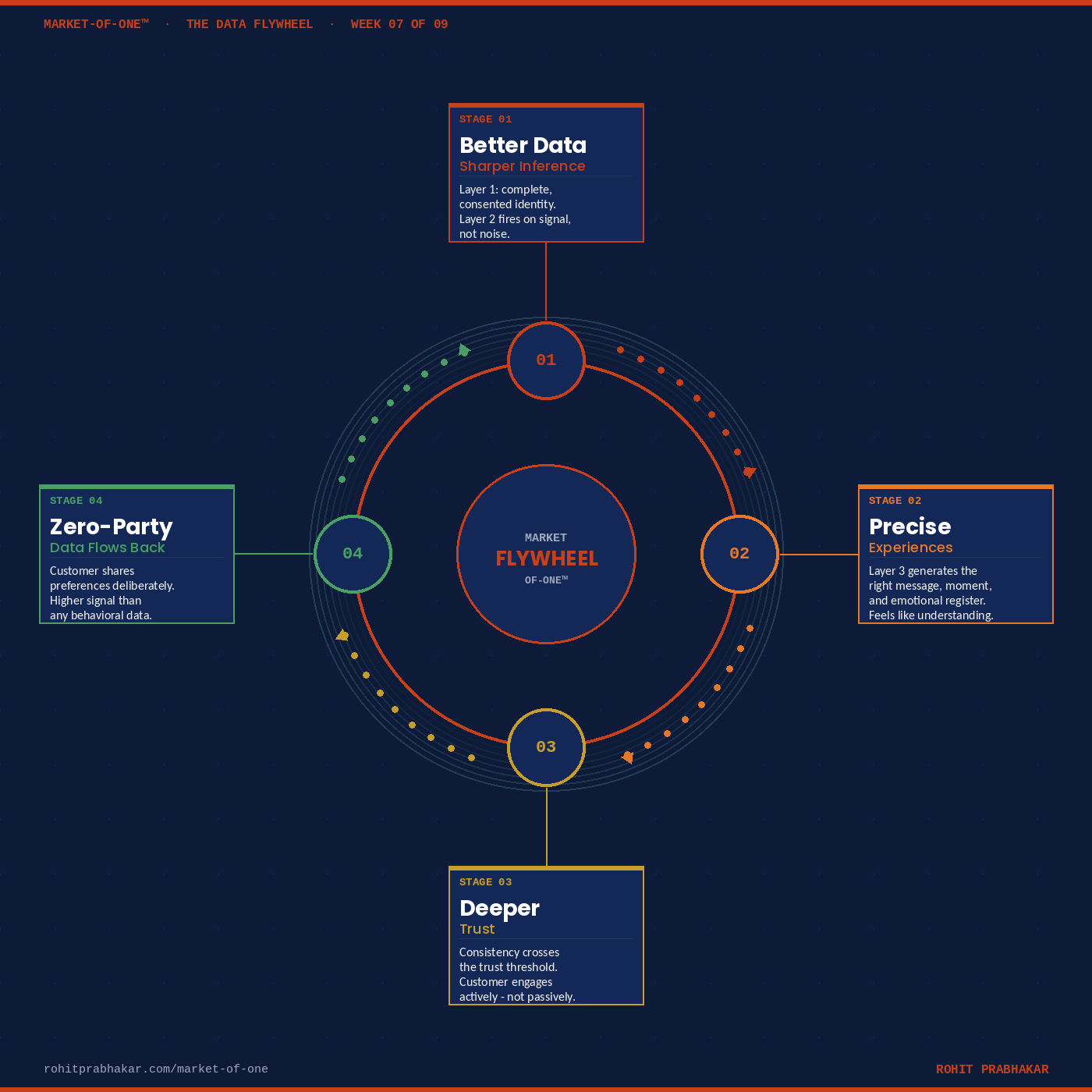
The flywheel has four stages:

The Market-of-One data flywheel - four compounding stages: better data produces sharper inference, sharper inference produces precise experiences, precise experiences build deeper trust, deeper trust generates zero-party data - Rohit Prabhakar Week 07
The Market-of-One™ data flywheel. Each cycle is more accurate than the last. The moat is the compounding inference quality earned over time – not the data itself.

Stage 01

Better Data – Sharper Inference

Layer 1 holds more complete, more consented, more recent customer identity. Layer 2 infers intent with higher accuracy. The system fires on signal, not noise. Fewer false positives. More precise moments of action.

Stage 02

Precise Experiences

Layer 3 generates experiences that are contextually accurate – the right product, the right message, the right moment, the right emotional register. The customer receives something that feels less like marketing and more like understanding.

Stage 03

Deeper Trust

A customer who consistently receives experiences that reflect their actual needs builds a different relationship with the brand than one who receives well-crafted campaigns. Trust is the accumulation of times the system got it right without being asked.

Stage 04 – The Loop Closes

Zero-Party Data Flows Back

A customer who trusts the system shares preferences deliberately. They tell you what they want. They set preferences. They complete profiles. This stated data flows back into Layer 1, sharpening the next cycle. A competitor starting today is not just behind on data. They are behind on trust. That gap widens with every cycle.

The Numbers That Make This a Board Conversation

5%

of organizations capturing AI value at scale right now

EY Global AI Study 2026

1.7x

higher revenue growth at AI-leading organizations vs peers

BCG AI at Scale 2026

3.6x

greater total shareholder return for flywheel leaders

BCG AI at Scale 2026

The 5% number is the one boards need to sit with. It is not a technology adoption curve. It is a flywheel gap. 95% of organizations are running AI experiments. 5% have the flywheel running. The 5% are pulling ahead at 1.7x revenue growth and 3.6x total shareholder return. That gap is not closing on its own – it widens with every quarterly cycle the flywheel completes.

The board question this demands is not “how many AI use cases do we have?” That is a technology adoption question. The board question is: is our flywheel running – and at what stage? If the honest answer is Stage 1 or Stage 2, you are not yet building a moat. You are building infrastructure. Infrastructure is necessary but not sufficient. The moat only forms when the loop closes – when Stage 4 feeds back into Stage 1 with real zero-party data from real customers who earned their trust with your organization specifically.

Why the Moat Is Harder to Build Than Most Strategies Acknowledge

I want to be honest about something here, because most strategy writing on this topic is too optimistic about the timeline.

The flywheel does not run from day one. It runs from the day the customer trust threshold is crossed – the day the customer’s experience of your system is good enough, consistent enough, and transparent enough that they begin to engage with it rather than tolerate it. That threshold is different for every customer, every category, and every brand. And reaching it requires getting Stage 2 and Stage 3 right repeatedly, over time, before Stage 4 activates.

Most organizations I work with are stuck between Stage 2 and Stage 3. The inference is working. The experiences are better than they were. But the trust threshold has not been crossed yet – because the system still makes enough mistakes, or still feels enough like surveillance rather than understanding, that customers are not sharing deliberately. They are not filling in preference profiles. They are not engaging with personalization features. They are receiving personalized content and accepting it passively.

Passive acceptance is not the flywheel. The flywheel requires active trust. And active trust requires three things that most personalization investments skip.

Transparency about what the system knows and why. The customer who understands that your recommendation is based on their stated preference and purchase history responds differently than the customer who does not know why they are seeing what they are seeing. The latter feels watched. The former feels understood. The difference is not technology. It is design – the explicit choice to show your work.

Consistent accuracy over time, not peak accuracy on demos. A customer who receives one precisely timed, perfectly relevant experience and then a week of noise does not cross the trust threshold. Consistency is what builds trust. Consistency requires the adjacent processes, the operational budget, and the executive ownership we covered in Week 5 and Week 6. The flywheel cannot run on a pilot. It runs on a production system, governed by someone accountable for its outputs every day.

A consent architecture that earns, not extracts. The zero-party data that powers Stage 4 of the flywheel only flows when the customer believes their data is being used for their benefit, not the brand’s. The architecture that produces that belief is not a compliance checkbox. It is a design choice that runs through every layer of the system. I will go deeper on this in Week 8.

The Organizations Already Running It

The flywheel is not theoretical. It is visible in the performance data of the organizations that built the three-layer architecture first and most completely.

Netflix built it on content. 80% of content watched on Netflix comes from its recommendation system, which generates over $1 billion in annual value through reduced churn. The inference quality – built on viewing behavior, stated ratings, and explicit preference signals – is what makes that number possible. The moat is not Netflix’s content library. Competitors can build content libraries. The moat is the inference quality built on 300 million subscribers’ viewing patterns over two decades. That is not replicable in a quarter.

Amazon built it on commerce. The recommendation engine drives an estimated 35% of total revenue. But the deeper moat is not the recommendation engine itself – it is the flywheel beneath it: purchase history feeds inference, inference drives discovery, discovery produces purchase, purchase updates history, history sharpens inference. Amazon Prime is the trust layer that closes the loop: customers who trust Amazon enough to pre-pay for the relationship share dramatically more zero-party data – search queries, wish lists, reviews, Alexa requests – that feeds every subsequent cycle.

Starbucks built it on service. Their Deep Brew AI personalization system identified that 43% of customers who purchased unsweetened iced tea had never been offered a food pairing – a gap invisible to segment-level analysis, visible only with individual-level inference. Starbucks’ moat is not its app. It is 30 million active Rewards members whose preferences, purchase patterns, and responses to personalization have been accumulating in the flywheel for years.

None of these advantages were built in a quarter. They were built over years of consistent, accurate, trustworthy experience delivery that crossed the trust threshold for enough customers to activate Stage 4 at scale. The organizations that understand this are not asking “how do we use AI in customer experience?” They are asking “how do we accelerate the flywheel’s next cycle?” Those are not the same question.

The Investor Lens

BCG’s research shows 1.7x revenue growth and 3.6x total shareholder return for AI leaders versus peers – and those numbers compound. The organizations showing 3.6x TSR are not growing linearly. They are growing faster each year because the flywheel is accelerating. For the board and for investors, the strategic question is not whether the organization has deployed AI. It is whether the flywheel is running – and what stage it is at. An organization at Stage 4 with the loop closed is worth fundamentally more than an organization at Stage 1 with impressive infrastructure, because Stage 4 produces an asset – compounding proprietary intelligence – that does not depreciate and cannot be easily replicated. BCG’s research also shows the top 5% of AI value capturers are 50% more likely to have shared business-IT AI ownership. Stage 4 does not run without the governance structure described in Week 6. The flywheel and the mandate are the same investment.

What It Takes to Actually Build This

I want to be specific about what “building the flywheel” actually requires operationally, because most strategy writing treats it as inevitable once you have the architecture. It is not. The architecture is necessary but not sufficient. Three things determine whether the loop closes.

The consent architecture has to be designed for trust, not compliance. Most organizations build consent frameworks that satisfy legal requirements. That is the floor. The ceiling is a consent architecture that the customer experiences as respectful – that explains in plain language what is collected, for what purpose, with what benefit to them, and with what right to withdraw. The organization that hits the ceiling gets zero-party data. The one that hits the floor gets passive tolerance. Only one of those closes Stage 4.

The measurement framework has to track trust, not just conversion. The flywheel is not visible in campaign metrics. It is visible in customer lifetime value trends, in the ratio of zero-party to third-party data, in preference profile completion rates, in the frequency with which customers engage with personalization features rather than ignoring them. Most organizations are not measuring these things. If you cannot measure the flywheel, you cannot manage it, and you cannot tell the board whether it is running.

The governance has to run faster than the cycle. The flywheel turns in real time. The governance that catches errors in real time – experiences that cross ethical boundaries, inference that manufactures urgency rather than removes friction, generation that feels manipulative rather than helpful – has to be equally real-time. The CMO-CDO-CIO triad from Week 6 is the governance structure. The flywheel is what it is governing. If governance runs quarterly, the flywheel’s errors compound before they are caught.

My Take for the CEO and Board

The competitive question for the next five years is not who has the best AI models. The models are commoditizing. The competitive question is who has the deepest flywheel – the most proprietary inference quality, built on the most trusted customer relationship, compounding at the fastest rate. That is a strategic asset question, not a technology question. It belongs on the board agenda, not the technology committee agenda. The organization that builds the deepest flywheel first does not just win more customers. It builds an advantage that widens with every interaction cycle, in a way that no amount of competitor investment can quickly reverse. Three years from now, the gap between the organizations that closed the loop in 2024 and 2025 and the ones that are still running pilots will not be measured in percentage points. It will be measured in customer lifetime value multiples. The time to start is not when the gap is obvious. It is now, when closing the loop is still possible before the leaders pull permanently out of reach.

Frequently Asked Questions

What is a data flywheel in AI personalization?

A data flywheel in AI personalization is a self-reinforcing cycle where better data produces sharper inference, sharper inference produces more precise experiences, more precise experiences build customer trust, and deeper trust generates more zero-party data that feeds back into the system. In the Market-of-One™ framework, the flywheel runs across all three layers: Layer 1 (data and consent), Layer 2 (inference), and Layer 3 (experience generation). Each cycle is more accurate than the last.

Is data really a competitive moat for enterprises?

Data alone is not a durable moat. Research from a16z shows that incremental data has diminishing returns, and competitors can often replicate datasets with sufficient investment. The durable competitive advantage is the inference quality built on proprietary data over time – specifically, the quality that accumulates when customer trust generates zero-party data that competitors cannot access because the trust relationship was built with you, not them.

How long does it take to build a data flywheel moat?

The flywheel moat takes 18-36 months to reach the stage where it provides defensible competitive advantage. The time-to-moat depends on how quickly the consent architecture is designed for trust, how consistently the experience delivery crosses the customer trust threshold, and how effectively zero-party data is captured and recycled into the inference layer. Organizations that began building in 2024 are already 18-24 months ahead of those starting in 2026.

What is zero-party data and why does it matter for the flywheel?

Zero-party data is information a customer shares deliberately and proactively – stated preferences, explicit feedback, completed profiles, deliberate engagement with personalization features. It is more valuable than behavioral data because it reflects stated intent rather than inferred behavior. In the flywheel model, zero-party data is the fuel for Stage 4: it flows back into Layer 1 with higher signal quality than any third-party or first-party behavioral data. It only flows when the customer trusts the system enough to engage with it actively – which is why the trust architecture is the prerequisite for a true flywheel moat.

The competitive advantage is not the data you own. It is the inference quality you have earned, compounding on the trust your customers chose to give you, in a loop your competitors cannot replicate because they were not there when the trust was built.

Next week – Week 08: The Privacy Covenant. The flywheel only runs if the customer trusts you with their individuality. That trust is earned before personalization begins – not as a result of it. Week 8 is about the consent architecture that makes the flywheel possible, the difference between compliance and covenant, and why “consent is the new data strategy” is the structural prerequisite for everything this series has argued.


Rohit Prabhakar is a Fortune 50 CMO and CDO with $1.7B+ in measurable business value across Visa, McKesson, Thomson Reuters, and FIS. Creator of the Market-of-One™ framework. MARKET-OF-ONE is a registered trademark, Serial No. 99757619.

This article was developed in partnership with AI – used as a research, brainstorming, and authoring collaborator. All frameworks, positions, strategic perspectives, and opinions are Rohit Prabhakar’s own. AI was the tool. The thinking is mine.

Filed Under: Market-of-One Tagged With: AI competitive advantage, CDO, CMO, data flywheel, Personalization, zero-party data

The Mandate: Customer Experience AI Ownership and the CMO-CDO-CIO Triad

April 29, 2026 by Rohit Leave a Comment

Customer Experience AI ownership is the most consequential org design question executives are getting wrong in 2026. The three-layer architecture works. The pilot proves it. Then the question becomes: who actually owns it? Most companies have a champion. A champion advocates. They do not carry weight. The reason 80% of customer experience AI investments stall is structural – the absence of clear customer experience AI ownership at the executive level. Here is the structure that works for the Market-of-One, where the Chief AI Officer fits in the AI ownership model, and why that role is likely to merge into hybrid C-suite titles rather than survive standalone.

In Week 5, I argued that 95% of AI pilots fail to scale because the org around them is designed for the work that existed before the pilot, not the work the pilot proves is now possible. This week, I want to name the org design decision that determines whether your customer experience AI investments produce a transformation or produce a museum piece.

The decision is who owns the customer experience AI agenda. Not who runs it. Not who sponsors it. Not who funds it. Who owns it, which means who is personally accountable when the system makes a decision that costs the company a customer, a quarter, or a regulatory finding.

One housekeeping note before I go further. In this article, “CDO” means Chief Data Officer. I will spell out “Chief Digital Officer” in full when I refer to that separate role, because the two get confused constantly and the distinction matters for the argument I am making.

I also want to be precise about scope. Enterprise AI is not one thing. Finance runs AI for fraud detection, treasury automation, and forecasting. Operations runs AI for supply chain and logistics. HR runs AI for talent matching and workforce planning. Service runs AI for case routing and resolution.

Each of those AI domains has its own AI ownership structure, its own data, its own risk profile, and its own success metric. This piece is not about all of them. It is about one specific domain: the customer-facing experience system, the Market-of-One architecture this series has been building for five weeks.

The structural argument I make here applies cleanly to that domain. Other domains need their own equivalent AI ownership triads. I will return to that distinction when I introduce the Chief AI Officer’s role below.

A champion advocates. An owner is accountable. The 80% failure rate on AI investments is the gap between those two words made visible at scale.

The Harvard Business Review opened its March 2026 cover essay on AI ownership with the now-familiar version of this scene: a Fortune 500 insurance CEO convened his senior team in January 2026 to settle AI ownership of the company’s AI initiatives.

The CIO claimed agentic AI rolled up to her. The COO countered that an agentic workforce was the definition of operations. The CFO noted an AI system was already making underwriting decisions with direct P&L impact. The Chief Risk Officer pointed to autonomous decision-making as a major risk exposure. The CHRO claimed AI agents as functionally equivalent to workers. The Chief Data Officer reminded everyone that the entire system depended on data permissions she controlled.

Six executives, six legitimate claims, no resolution. The meeting ended without an owner.

I have watched some version of that meeting play out at multiple organizations over the last six months. The pattern is identical. Six executives walk in with legitimate claims to AI ownership. Six executives walk out with no resolution. The CEO retreats to “we will appoint a Chief AI Officer to coordinate” or “we have a champion driving this” or, most often, silence. The pilot keeps running. The accountability stays diffused. Two quarters later, the pilot fails to scale. Nobody is fired, because nobody owned the decision.

The reason these meetings end without resolution is that the AI ownership decision is structural, not interpersonal. You cannot pick a winner from among six legitimate claims for the entire enterprise’s AI agenda, because the enterprise’s AI agenda is not one agenda. It is multiple domain-specific agendas with different owners. What you can do, and must do, is name the right AI ownership structure for each domain. This piece is about doing that for the customer experience domain.

Why customer experience AI Ownership Requires Three Executives, Not One

The three-layer architecture I introduced in Week 2 is not a metaphor. It is a description of three distinct categories of work, each with its own dependencies, governance requirements, and failure modes. No single executive has the depth across all three to govern them well. Anyone who tells you otherwise is either selling consulting or has never run all three at scale.

Layer 1 is identity, consent, and customer data infrastructure. The work is plumbing: making sure the right data, with the right permissions, gets to the right system at the right time, governed by enforceable policy. For the customer experience domain, this work belongs to the Chief Data Officer or the equivalent function. Sometimes the CIO holds it, depending on org design history.

Layer 2 is inference, models, and engineering at scale. The work is technical infrastructure: making sure the AI systems actually run reliably in production, integrate with legacy systems, scale without breaking, and fail safely when they fail. This work belongs to the Chief Information Officer or the equivalent function.

Layer 3 is generation, experience, and brand judgment. The work is commercial: making sure what the system produces reflects the brand, drives commercial outcomes, respects emotional context, and earns customer trust. For the customer experience domain, this work belongs to the Chief Marketing Officer, or Chief Customer Officer or Chief Growth Officer depending on title conventions. I want to be explicit: the CMO is the outcome owner for the customer experience system, not for the enterprise’s entire AI portfolio. Finance AI has a different outcome owner. Service AI has a different outcome owner. The triad is domain-specific, not enterprise-universal.

Three layers. Three accountable executives. One customer experience outcome. The structure is not a committee. Committees do not own outcomes. It is a triad with explicit decision rights at each layer’s boundary and shared accountability for the system’s commercial result. This is the AI ownership model that the data says works.

This is not a new idea I am proposing. It is the customer experience AI ownership structure that the data already supports. BCG’s research on the top 5% of companies deriving significant AI bottom-line value found they are 50% more likely to have shared business-IT ownership of AI operating models, with clear decision rights and accountability at each boundary. Not IT ownership. Not business ownership alone. Shared. With clarity on who decides what, and who is accountable when the system produces something it should not.

Where the Chief AI Officer Fits in the AI Ownership Model

I want to address the Chief AI Officer directly because the CAIO is the elephant in every boardroom right now, and the role is being treated as the answer to the AI ownership question. The role is being appointed at a record pace. Twenty-six percent of organizations globally now have a CAIO, up from 11% just two years ago. Forty-eight percent of the FTSE 100 have appointed one, with 65% of those appointments made in the past two years. JPMorgan, Walmart, Pfizer, Siemens, SAP, GE HealthCare. The list is growing every month.

Here is my honest take on the role, and I will say it plainly because most of the consulting class is being too polite about it.

The CAIO has a legitimate orchestration role across the multiple AI domains an enterprise runs. If your company has customer experience AI, finance AI, operations AI, service AI, and HR AI all running in parallel, which is most large enterprises by mid-2026, somebody needs to ensure standards align across domains. Somebody needs to make sure data is not duplicated five different ways, that procurement is coherent, that the EU AI Act and NIST AI Risk Management Framework get implemented consistently, and that learnings from one domain inform the others.

That is real work. The CAIO can do that work. In that role, the CAIO is a cross-domain coordinator who orchestrates triads like the customer experience one I am describing in this piece, alongside the equivalent triads in finance, operations, service, and HR. They are a peer to the domain owners, not above them. They have orchestration authority on standards, governance, and shared infrastructure. They do not have outcome authority over any single domain.

But the CAIO does not own the customer experience triad’s outcome. Nor any other domain triad’s outcome. When CAIOs are given outcome authority over a specific domain, the most common version being “drive AI strategy across the customer-facing business,” the role fails. It fails because the CAIO does not have the operational authority over the domain’s data layer, infrastructure layer, or commercial layer to make decisions stick.

They produce strategy decks. They host steering committees. They convene the same six executives the CEO already convened, who reach the same lack of resolution. Within eighteen months, the CAIO leaves or the role is restructured. Bernard Marr documented the pattern explicitly: companies create CAIO positions as standalone silos, disconnected from existing digital and data initiatives. At one financial services firm, the Chief AI Officer and Chief Data Officer independently developed competing strategies for the same business problems. Duplicated effort. Inconsistent approaches. Wasted resources.

And the role itself, as a standalone C-suite title, is unlikely to last. Not because AI fades. Because horizontal coordinator titles tend to merge or absorb rather than survive as standalone C-suite roles for long. We have seen this with the Chief Digital Officer wave of 2014 to 2018. Russell Reynolds’ 2024 Fortune 500 analysis showed the Chief Digital Officer did not vanish. It merged. Hybrid titles like Chief Digital and Information Officer or Chief Strategy and Transformation Officer now hold 19% of top tech leadership seats, while pure CIO share dropped from 68% to 49% over five years. Fifty-four percent of new tech leadership appointments since the start of 2024 carry hybrid titles. The pattern is absorption-via-merger, not disappearance. The standalone “Chief Digital Officer” peaked, then got folded into broader hybrid roles where digital became one responsibility among several.

The CAIO is on a similar trajectory. The standalone CAIO role peaks in 2026 to 2028 as enterprises feel they need a dedicated AI sponsor. By 2029 to 2031, my read is the title largely merges into hybrid roles: Chief Information and AI Officer, Chief Technology and AI Officer, or absorbed entirely into a broader transformation mandate. The orchestration function persists. The standalone title likely does not. The companies that recognize this trajectory now will design their AI ownership structure around the domain triads, with CAIO orchestration as a function rather than a permanent standalone role.

My take for the board: if your CEO is about to appoint a CAIO and the role’s charter says “drive AI strategy” with no defined cross-domain orchestration scope, you are about to spend a million dollars on a presenter who will be powerless within twelve months. Two questions to test the appointment. First, does this role have orchestration authority across the multiple AI domains the enterprise runs (customer experience, finance, operations, service, HR), or domain ownership over one specific domain? If the answer is domain ownership, restructure the role. That domain needs a triad, not a CAIO. Second, when the CAIO’s tenure ends in three to five years, which existing C-suite role will absorb the orchestration function? If you cannot answer that today, you have not designed for the role’s lifecycle. You have hired for the moment.

The Four Failure Modes of Single-Owner customer experience AI Ownership

The reason boards keep defaulting to a single-owner model for customer experience AI ownership, whether that owner is the CIO, the CDO, the CMO, or a newly appointed CAIO, is that single ownership feels cleaner. One throat to choke. One person to fire if it fails. The instinct is understandable. It is also wrong, and the failure data tells you why.

80% of AI initiatives fail to deliver intended business value (RAND Corporation, 2,400+ initiatives). 77% of AI project failures are organizational, not technical (RAND / Folio3 analysis 2026). 84% of failures are driven by leadership issues: sponsorship, alignment, and accountability gaps (industry consensus, 2026). The technology is not the bottleneck. The org design around the technology is.

Here are the four failure modes I have watched destroy more customer experience AI investments than any technology problem.

  1. Failure mode one: the CIO-only model.

    When IT owns the customer experience AI alone, the system gets built to technical specifications and runs reliably, and produces outputs that nobody in the business is accountable for. The customer experience suffers because no one with commercial judgment governs Layer 3. The brand voice is inconsistent. The emotional register is wrong. The system technically works and the business does not benefit.

  2. Failure mode two: the CDO-only model.

    When data owns the customer experience AI alone, the system gets built around what the data permits and ignores what the business needs. The data layer is pristine. Layer 2 inference is brittle because no engineering owner pushed for production-grade infrastructure. Layer 3 generation is generic because no commercial owner defined the parameters. The data is right and nothing happens.

  3. Failure mode three: the CMO-only model.

    When marketing owns the customer experience AI alone, the system gets built for the campaign calendar and the data layer is held together with duct tape. Gartner finds 65% of CMOs believe AI will dramatically transform their role within two years. Many of them respond by buying martech and standing up an AI team inside marketing, which works for a sprint and fails at scale because Layer 1 and Layer 2 are not under their authority. The pilot succeeds. The pilot does not generalize. The CMO gets blamed. The actual problem was that the CMO never had the authority over data and infrastructure to make it generalize.

  4. Failure mode four: the CAIO-as-domain-owner model.

    The most expensive failure mode I see right now. The board appoints a CAIO and gives them outcome authority over the customer experience domain (“drive AI-led customer experience” or “own the personalization transformation”). The CAIO has no operational authority over the marketing technology stack, the customer data infrastructure, or the production AI engineering. They can convene. They cannot decide. The actual decisions are still made by the CDO, the CIO, and the CMO independently, now with the added friction of a CAIO who has the title but not the authority. Within eighteen months, the role is restructured.

The investor lens: for PE and VC analyzing portfolio companies’ customer experience AI investments, the diligence question is not “do you have a CAIO?” The right question is “show me the decision rights and accountability matrix for your customer experience AI across CMO, CDO, and CIO.” If the answer is a single name with no peer accountability, the investment is at risk regardless of the technology stack. If the answer is three names with overlapping but undefined boundaries, the investment is at risk regardless of how good each leader is individually. If the answer is three names, three explicit charters, one shared P&L line, and one accountable CEO sponsor, the investment has a chance. Fortune’s March 2026 reporting found that 76% of companies with CFO-led AI got “great value” from it, but only 2% of companies do it that way. The broader point is that ownership structure, not title, predicts outcome.

The Triad in Practice: How the Boundaries Actually Work

The triad model is only useful if the boundaries between the three roles are explicit. “Shared accountability” without explicit boundaries is just three people watching each other and pointing fingers when it fails. Here is the boundary map I use when organizations stand this up for the customer experience domain.

What customer data are we allowed to use, with what consent, for what purpose? The CDO decides. The CMO and CIO are consulted. Legal is a partner, not a tiebreaker.

Which AI models run in production, on what infrastructure, with what failover and monitoring? The CIO decides. The CDO and CMO are consulted on input and output requirements.

What is the system allowed to say to the customer, in what tone, in what context, against what business metric? The CMO decides. The CDO and CIO build to those parameters, not around them.

When does a model get retrained, retired, or escalated? What triggers a stop? The CIO decides on technical thresholds. The CMO decides on commercial thresholds. The CDO decides on data thresholds. Three triggers, any one stops the system.

Who is accountable to the board when the system produces an outcome it should not have? All three. Joint accountability with one named CEO-level sponsor, typically the COO or CEO directly.

What is the single P&L metric the customer experience AI is accountable to? One number. Owned by the CMO. Tied to a commercial outcome (LTV, NRR, cost-to-serve), not a vanity metric.

If a CAIO exists, what do they decide? Cross-domain standards, shared governance, AI Act compliance, procurement coherence. Not customer experience outcome.

The discipline of this matrix is what most organizations skip. They name three executives, hold a kickoff meeting, declare shared ownership, and then watch the boundaries dissolve within a quarter. The boundaries dissolve because nobody wrote them down with the specificity required to enforce them. The triad model only works if the CEO writes the matrix down, signs it, and uses it to settle the first three boundary disputes that come up. Because there will be three boundary disputes in the first ninety days.

Why AI Ownership Is a CEO Decision, Not a CMO/CDO/CIO Decision

Here is the part that most boards are missing. The customer experience triad is not an AI ownership decision the three executives can make on their own. It requires a CEO mandate because it requires redistributing decision rights that currently sit in one of three places, and the loser of that redistribution will resist unless the CEO is the one making the call.

If the CIO currently controls the data infrastructure budget and the CDO needs explicit decision rights over data permissions for the customer experience system, the CIO is going to push back unless the CEO has signed off. If the CMO controls the marketing technology budget and the CIO needs decision rights over the marketing AI stack to ensure operational reliability, the CMO is going to push back. If Legal currently approves data use case-by-case and the CDO is taking a structural authority over consent architecture, Legal is going to push back. None of these pushbacks are illegitimate. They are the predictable consequence of any redistribution of authority.

The CEO’s job is to make the AI ownership redistribution explicit, defend it publicly, and intervene when the boundaries are tested in the first ninety days. McKinsey’s April 2026 AI Transformation Manifesto stated the requirement directly: there is no success story where senior business leaders were not in the driver’s seat. The CEO is the senior business leader in the driver’s seat for the AI ownership decision. Not the CAIO. Not a steering committee. The CEO.

You can delegate the work of building the AI architecture. You cannot delegate the AI ownership decision. That decision is the most consequential customer experience org design decision a CEO will make in the next three years.

The reason this matters now, with urgency, is that the cost of getting it wrong is compounding. Every quarter the triad is not in place is a quarter where customer experience AI pilots are running without a structure that can absorb their lessons. The pilots burn budget. The pilots produce demos. The pilots do not produce transformation. Hyperscalers are on track to spend $675 billion on AI infrastructure in 2026, up 63% from the prior year. Virtually every major enterprise in America is buying AI. The question almost none of them can answer is whether it is working. The reason most cannot answer is that nobody owns the answer. The triad is the structural decision that creates an answer.

The Three AI Ownership Decisions a CEO Must Make

If you are a CEO reading this, here is the practical customer experience AI ownership action. Three decisions, in this order.

Decision one: name the customer experience triad publicly. Not in a memo. In an all-hands. Three names, three layers, one shared customer experience outcome. The public commitment is what forces the org to take it seriously. A private decision communicated through HR will be ignored within a quarter. A public commitment with three named executives is harder to walk away from when the first boundary dispute hits.

Decision two: write the boundaries. The matrix above is the starting point. Customize it for your business. Have each of the three executives sign it. The signature is not symbolic. It is the artifact you go back to when one of them tries to expand their authority into another’s domain. Without a signed matrix, you do not have a triad. You have three executives with overlapping ambitions.

Decision three: tie one P&L metric to the triad. Not three metrics. One. Customer lifetime value, or net revenue retention, or cost-to-serve, whichever metric most directly reflects the value of the customer experience AI investment in your business model. All three executives are accountable to that one number. Gartner’s April 2026 research on AI ROI failures found that the 20% who succeed share one trait: they embed AI into the systems and processes people already use, with one accountable owner per use case and a single business metric tied to outcome. Without a single shared metric, the triad will optimize three different things and the system will incoherently drift.

My recommended first 90 days. Weeks 1 to 2: CEO names the customer experience triad publicly. Weeks 3 to 4: triad members and Legal/HR draft the decision rights matrix. Weeks 5 to 6: CEO signs the matrix. All three triad members sign. Distributed to direct reports of all three. Weeks 7 to 8: one commercial P&L metric agreed and locked. The current customer experience AI pilots are mapped against the matrix; any pilot that does not have a clear owner under the new structure is paused, restructured, or killed. Weeks 9 to 12: first boundary dispute happens (it will). CEO uses the signed matrix to settle it publicly. That settlement is the moment the triad becomes real. Without that moment, you have a memo, not a structure.

What the Triad Is Not

Three clarifications, because I have seen all three misinterpreted.

First, the triad is not a permanent committee structure. It is an accountability and decision-rights structure. The three executives do not need to meet weekly. They need clear boundaries, a shared metric, and a CEO who enforces both. The work happens inside each function. The coordination happens at the boundary disputes, which should be infrequent if the matrix is well-written.

Second, the triad is not a denial of the CAIO role. It is a clarification of where the CAIO does and does not have AI ownership authority. If your enterprise has a CAIO, that role orchestrates standards across the multiple AI domains (customer experience, finance, operations, service, HR) and ensures coherence on governance, compliance, and shared infrastructure. The CAIO is a peer to the customer experience triad’s three members, not above them. They do not own the customer experience outcome. The CMO does.

Third, the triad is not a universal enterprise AI ownership model. It is the right structure for the customer experience domain, the Market-of-One architecture this series has built. Other AI domains in your enterprise need their own equivalent triads, with different owners suited to their specific layer responsibilities. Finance AI ownership will look different. Operations AI ownership will look different. Service AI ownership will look different. The principle (three accountable executives, explicit decision rights, one shared outcome metric, one CEO sponsor) is the same. The named roles are not.

Why the Next Two Years of AI Ownership Decisions Matter More Than the Last Twenty

The customer experience triad is the most consequential customer experience AI ownership decision a CEO makes in the next three years because it is the decision that determines whether the customer experience AI investments of 2024 to 2026 produce a competitive advantage in 2027 to 2029, or produce a balance sheet write-down and a strategy reset.

The companies that get this AI ownership decision right will spend the next two years compounding learning. Their pilots will scale. Their data will accumulate. Their models will improve. Their experience generation will get sharper. The flywheel I described in Week 4 will start turning, and it compounds. Better data produces better inference produces better generation produces more trust produces more zero-party data produces sharper inference. That loop, running for two years inside an organization that has the AI ownership triad in place, produces a moat that competitors cannot close in a sprint.

The companies that get this AI ownership decision wrong will spend the same two years stuck in pilot purgatory. They will have written checks for AI infrastructure they cannot operationalize, hired CAIOs whose mandates expire before their tenure does, and accumulated organizational scar tissue from boundary disputes that nobody had the authority to settle. By 2028, the gap between the two groups will be the topic of every business school case study and every board postmortem.

That gap is the moat I will write about next week.

The AI Ownership Mandate, In One Sentence

Every company has a champion for customer experience AI. Almost none have a triad with the customer experience AI ownership decision rights to redesign the customer-facing operating model around it. That single AI ownership decision is what separates the 20% that capture customer experience AI value from the 80% that write it off.

Next Week, Week 07

The New Moat. For thirty years, the strategic question has been “what data do you own?” In the Market-of-One, that question is obsolete. The moat is no longer data. It is understanding, the system that turns data into individual context fast enough that competitors cannot replicate it. Week 7 is about why the next decade’s defensible advantages will not look like the last decade’s, and what the architecture of a real moat actually contains.

This article was developed in partnership with AI, used as a research, brainstorming, and authoring collaborator. All frameworks, positions, strategic perspectives, and opinions are Rohit Prabhakar’s own. AI was the tool. The thinking is mine.

Filed Under: Market-of-One Tagged With: AI accountability, AI governance, AI org design, AI ownership, AI transformation, CAIO, CDO, Chief AI Officer, CIO, CMO, customer experience AI ownership, Market-of-One

Why AI Pilots Fail to Scale – And What Has to Change

April 21, 2026 by Rohit Leave a Comment

Why AI pilots fail is one of the most important questions enterprise leaders are not asking correctly. The technology works. What fails is everything the organization never changed around it.

The three-layer architecture works. The pilot proves it. Then nothing happens. Here is why, and what has to change before anything else can.

Most enterprises have a Market-of-One pilot sitting in a lab somewhere. The data layer works. The inference layer works. The generation layer works. And the business impact is zero. The problem is never the technology. It is everything the technology touches that nobody changed.

Every enterprise I walk into has a pilot. Sometimes three. Occasionally ten.

A small team built something impressive. The demo is genuinely good. The data shows meaningful lift: conversion up 23 percent, churn signals caught earlier, content engagement significantly higher. The executive sponsor presents it to the leadership team. Heads nod. Everyone agrees it is promising. And then the pilot sits exactly where it is for the next eighteen months while the organization debates scale, budget, ownership, and governance.

I have seen this pattern so many times that I have stopped calling it bad luck. It is not bad luck. It is a structural consequence of how most enterprises deploy AI, and it has a specific, diagnosable cause.

The technology worked. What failed was everything around the technology. And that failure was predictable from day one, because nobody asked what had to change before the pilot could scale.

This week I want to be specific about why pilots fail, not in the vague “change management is hard” sense, but in the precise sense of naming the exact failure points that kill personalization at scale. Because understanding the failure modes is the prerequisite to avoiding them.

The Pilot Is Not the Problem

The first thing to understand is that the pilot usually does work. That is not sarcasm. The technology genuinely functions. The three-layer architecture I have been describing across this series, Know the customer, Understand the moment, Build for them, is executable today. The tools exist. The talent exists. The data infrastructure, while imperfect, is sufficient to demonstrate real outcomes in a controlled environment.

The pilot works because pilots are optimized for working. They have dedicated teams, protected budget, executive attention, reduced operational friction, and a narrow enough scope that the surrounding organizational complexity does not interfere. The pilot is a laboratory. Laboratories produce results that laboratories produce, results that do not automatically transfer when you take the experiment outside the lab.

McKinsey’s research across hundreds of large-scale technology transformations found the root cause with unusual precision in their April 2026 AI Transformation Manifesto: “Adoption often fails because adjacent upstream and downstream processes are left unchanged. An AI solution may predict equipment failures days in advance, but if maintenance still follows calendar-based scheduling, nothing happens.”

That sentence deserves to be read twice. The AI worked. The prediction was accurate. The failure was that the process surrounding the AI was never redesigned to act on what the AI produced. The insight died at the last mile, not because the insight was wrong, but because the system that was supposed to receive it was not built to do anything with it.

This pattern appears identically across every function. The AI surfaces a buying signal, and the sales team is still running a weekly call cadence. The AI predicts a churn risk, and the service team is still triaging tickets by queue order. The AI infers a feature gap from behavioral data, and the product team is still locked in a quarterly roadmap cycle. The technology fires. The organization does not move. The adjacent process problem is not a marketing problem. It is an organizational design problem that shows up in every function that touches the customer.

This is the pilot trap. Not that the technology fails. That the organization was never restructured to use what the technology produces.

The Six Reasons Pilots Do Not Scale

I am going to name these precisely because vague diagnosis leads to vague remedies. Each of these is a distinct failure mode with a distinct fix.

  1. 01

    The adjacent processes were never redesigned.

    The AI generates a real-time signal. The sales team is still running a weekly cadence. The marketing team is still operating a campaign calendar. The service team is still triaging tickets by queue order. Nobody connected the output of the AI to the operating rhythm of the humans who are supposed to act on it. The signal fires into a void.

  2. 02

    The data infrastructure was scoped for the pilot, not for scale.

    The pilot ran on a curated dataset, a clean extract, a carefully managed subset of real customer data. Production data is messier, slower, less complete, and governed by privacy rules the pilot team worked around. Scaling means confronting the real data estate, and most organizations discover at that point that Layer 1 of the architecture is not ready for what Layer 2 and Layer 3 require of it.

  3. 03

    Nobody owns it at the executive level.

    The pilot had a champion. Champions are not owners. When the pilot becomes a production system, it needs a single executive who is accountable for what the system produces at scale, not just a steering committee and a project sponsor. In the organizations that scale successfully, that person is the CMO or CDO. In the ones that stall, ownership is diffuse and accountability is unclear. Diffuse accountability produces diffuse results.

  4. 04

    The budget model is wrong for the work.

    Pilots get project budgets. Scaling requires operational budgets. These are different things managed by different people on different cycles. The pilot team requests a new project budget to scale and enters a procurement and approval cycle that takes six months. By the time budget is approved, the team has dispersed, the momentum is gone, and a new leadership priority has arrived. The organization mistakes the end of the pilot for the end of the initiative.

  5. 05

    The measurement framework measures the wrong things.

    The pilot measured what the pilot could measure, usually engagement metrics, session metrics, or narrow conversion metrics within the pilot scope. Scaling requires a measurement framework that connects the architecture’s outputs to business outcomes that the CFO and CEO care about: revenue per customer, retention rate, lifetime value, cost to serve. If the pilot cannot show that connection, the organization has no basis for investment decisions at scale.

  6. 06

    The pilot was not designed to scale. (This is the root of all the above.)

    Most pilots are designed to prove the technology works, not to prove the organization can run it. A well-designed pilot builds the governance model, the ownership structure, the adjacent process redesign, and the measurement framework into the pilot itself, so that scaling is an expansion of something already working, not a reinvention from scratch.

The Data I Keep Coming Back To

95%of enterprise GenAI pilots fail to deliver measurable P&L impactMIT GenAI Divide Study 2025
40%of agentic AI projects will be cancelled by end of 2027Gartner, June 2025
20%average EBITDA uplift at companies that scaled AI beyond pilotsMcKinsey AI Transformation Manifesto 2026

The 95 percent figure is the one people cite most. I want to reframe it. It is not evidence that the technology does not work. It is evidence that 95 percent of enterprises built a pilot and called it a transformation. The 5 percent that delivered P&L impact did something different: they treated the pilot as the first step in an organizational redesign, not as an end in itself.

The 20 percent EBITDA uplift number is the one I keep coming back to, because it answers the question that boards and CFOs actually ask: what is the return on this investment at scale? McKinsey’s data across 20 companies that successfully scaled AI transformation shows an average 20 percent EBITDA improvement, breakeven in one to two years, and $3 of incremental EBITDA for every $1 invested. That is not a marginal improvement. That is a fundamental shift in the economics of the business.

The gap between 95 percent failure and 20 percent EBITDA improvement is not a technology gap. It is a transformation gap. The organizations that achieved 20 percent EBITDA improvement built their organizations around the AI system. The 95 percent that failed built the AI system and left their organizations unchanged.

What a Well-Designed Pilot Actually Looks Like

I want to be practical here because most of what I read on this topic stops at the diagnosis. The diagnosis is not the hard part. The design is.

A pilot designed to scale is built differently from a pilot designed to prove. It has four properties that the standard pilot does not have.

First: The adjacent process redesign is in scope from day one. Before the pilot team writes a single line of code or configures a single data pipeline, they map the process that will receive the AI’s output. What is the current state of that process? What decisions does it make, and how? What has to change in that process for the AI’s output to actually be acted on? That redesign is part of the pilot’s work, not a follow-on project.

Second: The pilot runs with production data, not a curated extract. This is harder and slower and more frustrating. It surfaces the data quality problems earlier, the privacy constraints earlier, the governance gaps earlier. It also means that when the pilot works, it works on the same data estate that the scaled system will run on. No surprises at scale.

Third: The measurement framework is designed before the pilot starts. What business metric will prove this worked? Not what engagement metric. Not what session metric. What business metric that the CFO tracks and the board reviews? Customer lifetime value. Net revenue retention. Cost to serve per customer. The pilot team commits to moving that metric, and the measurement is in place before the first experiment runs.

Fourth: The executive owner is identified and accountable before the pilot starts. Not the champion. The owner. The person who will be held responsible for what the system produces at scale. That person’s involvement in the pilot design is not optional, because they are the person who will have to defend the investment decision when it comes to the board.

My Take: What I Tell Every Leadership Team

If your pilot does not have a named executive owner, a redesigned adjacent process, production data, and a business metric committed before you start, you do not have a pilot. You have an experiment. Experiments are valuable. They are not transformations. Know which one you are running, because the investment required and the organizational commitment required are completely different. And do not let anyone present an experiment to the board as evidence that you are transforming. That is how you lose board confidence in the technology and in the leadership team simultaneously.

The Organizational Changes No One Wants to Make

Here is where I will say something that is uncomfortable but necessary: the organizational changes required to scale the Market-of-One architecture are more difficult than the technical changes. The technical architecture is solvable. The organizational architecture is politically hard.

Scaling requires three organizational changes that most enterprises resist, and all three apply across Product, Marketing, Sales, and Service equally.

The operating rhythm has to expand, not be replaced. The campaign calendar is not going away, nor should it. Campaigns will continue to serve important functions: product launches, seasonal moments, brand storytelling at scale. What has to change is the assumption that the campaign calendar is the only way the organization reaches customers. The three-layer architecture runs continuously between, around, and inside campaigns. It responds to individual signals in real time while the campaign runs in the background. The organizational shift is not from campaigns to personalization. It is from campaigns alone to campaigns plus a continuously running individual experience system. The teams that resist this are usually the ones who interpret “continuous” as “more work.” It is actually a different kind of work. Fewer big production cycles. More governance and system design. Different skills required, not more volume.

Data capability has to move inside the business, not sit beside it. In most enterprises, data is a service function. Marketing requests a model. Sales requests a propensity score. Service requests a churn prediction. The data team builds it, hands it back, and the business team implements it on whatever cycle their process runs. This model is too slow for real-time individual experience. It is also the wrong model for Product, Sales, and Service, all of which need data capability embedded in the team, not assigned from a central function. The organizational change is not firing the central data team. It is embedding data practitioners directly inside each business function while maintaining shared infrastructure centrally. Most organizations resist this because it looks like headcount growth. It is actually a reallocation, and the productivity gain from embedded capability far exceeds the coordination cost of the service model it replaces.

Budget has to shift from project-based to product-based funding. The three-layer architecture is not a project. It is a product, a living system that improves over time as the data flywheel compounds. Products require sustained operational funding, not project budgets that expire after twelve months. This applies whether the system is owned by Marketing, Product, Sales Operations, or Service. The conversation with finance and the board about how AI infrastructure is categorized and funded is the same conversation regardless of which function initiates it. Most executives avoid it because it is easier to request another project budget than to restructure the funding model. The organizations that scale are the ones whose leaders initiated that conversation early, before they needed the money, not after the project budget ran out.

The Board Lens

The question every board should be asking is not “how many AI pilots do we have running?” It is “how many of our AI pilots have redesigned the adjacent process, moved to production data, committed to a business metric, and identified a named executive owner?” In most enterprises, the honest answer to that question is zero or one. That is the real state of your AI transformation, not the number of pilots, but the number that are actually designed to scale. McKinsey’s data is unambiguous: companies that concentrated AI efforts on one to three business domains and reinvented them end-to-end delivered 20 percent EBITDA uplift. Companies that ran many pilots across many domains delivered PowerPoint slides.

The One Question That Changes Everything

After everything I have described, the six failure reasons, the measurement gaps, the organizational changes, the funding model, there is one question that I use to distinguish enterprises that will scale from those that will not.

It is not: do you have a pilot? Everyone has a pilot.

It is not: is your technology working? The technology almost always works.

The question is: what has already changed in your organization, in the processes, the roles, the budgets, and the accountability structures, as a direct consequence of what your pilot learned?

If the answer is nothing, the pilot is an experiment. A valuable experiment, potentially. But not a transformation.

If the answer is something specific, we redesigned the sales follow-up process, we moved two data engineers into the marketing team, we shifted our Q3 budget from campaign production to platform operations, we named a CDO accountable for the system’s outcomes, then you are in the early stages of actual transformation.

The technology is not the barrier. The willingness to change everything around the technology is.

Frequently Asked Questions

Why do most AI personalization pilots fail to scale?

Most AI personalization pilots fail to scale because the adjacent processes that are supposed to act on the AI’s output are never redesigned. The technology works. What fails is the sales cadence still running weekly when the AI fires a real-time buying signal, the service team still triaging by queue when the AI predicts churn, the product team still on a quarterly roadmap when the AI surfaces a behavioral insight. The pilot is protected from organizational friction. Scaling is not.

What is the difference between an AI pilot and an AI transformation?

An AI pilot proves the technology works in a controlled environment. An AI transformation redesigns the organization to operate around what the technology produces. The distinction is whether the adjacent processes, ownership structures, data infrastructure, and budget models were changed as a direct consequence of what the pilot learned. Most organizations run pilots. Very few initiate the organizational redesign that turns a pilot into a transformation.

How should enterprises measure AI personalization ROI?

AI personalization ROI should be measured against business metrics the CFO and CEO track: customer lifetime value, net revenue retention, cost to serve per customer. Not engagement metrics or session metrics. McKinsey’s 2026 research across 20 companies that successfully scaled AI transformation shows an average 20 percent EBITDA improvement and $3 of incremental EBITDA for every $1 invested. The measurement framework should be designed before the pilot starts, not after results need to be reported.

Does Market-of-One personalization apply only to marketing?

No. The Market-of-One framework applies across Product, Marketing, Sales, and Service. The adjacent process failure pattern that kills pilots is identical in all four functions. Sales AI fires a buying signal into a weekly cadence. Service AI predicts churn into a queue-based triage process. Product AI surfaces a feature gap into a quarterly roadmap cycle. Marketing AI generates a real-time signal into a campaign calendar. The architecture is function-agnostic. The organizational changes required to act on it are the same regardless of which team owns the pilot.

Why Pilots Fail, In One Sentence

The pilot works because it is protected from the organization. Scaling fails because the organization was never changed to work with the system.

Next Week, Week 06

The Mandate. If pilots fail because of organizational design, the question becomes: who in the organization is actually responsible for fixing it? Week 6 is about the leadership mandate: who owns the AI agenda, what that ownership actually requires, and why the CMO-CDO-CIO triad is the most important organizational design decision a CEO will make in the next three years.

This article was developed in partnership with AI, used as a research, brainstorming, and authoring collaborator. All frameworks, positions, strategic perspectives, and opinions are Rohit Prabhakar’s own. AI was the tool. The thinking is mine.

Filed Under: Market-of-One Tagged With: Agentic AI, AI transformation, CDO, CMO, enterprise AI, Market-of-One, personalization at scale, pilot failure

The Inversion: The Three-Layer Architecture Changes What Marketing Is

April 14, 2026 by Rohit Leave a Comment

The CMO role AI transformation is not gradual. It is structural. Here is what the new job actually requires.

The three-layer architecture does not just change what marketing does. It changes what marketing is.

When Layer 3 generates the content, Layer 2 selects the moment, and Layer 1 holds the identity and consent, the marketer’s job description inverts. Here is what it actually becomes, why most organizations are not ready for it, and what the ones that get it right will build that no competitor can replicate.

I want to start with a question I get asked in every boardroom I walk into right now: “How do we use AI in marketing?”

It is the wrong question. And the fact that it is being asked everywhere, by everyone, at the C-suite level, tells me most organizations are about to spend significant capital in the wrong direction.

The right question is: when AI generates the experience, infers the intent, and holds the customer relationship in real time, what does the marketing leader’s job actually become?

Because those are not the same question. The first is a technology procurement question. The second is an organizational design question, a talent question, an accountability question, and an ethical question, all at once. Most enterprises are answering the first one and ignoring the second. That is why the failure rate on personalization investments remains as high as it does, and why the organizations that are actually winning with AI look structurally different from the ones that are not.

The Market-of-One framework changes more than the technology stack. It changes the nature of the job. This is what I call the inversion.

What the Inversion Actually Is

For thirty years, the marketer’s job was sequential and approval-based. You briefed an agency. The agency created. You approved. The data team built segments. You selected which segments to target. The technology team ran the platform. You measured results after campaigns closed.

In that model, the marketer was fundamentally a content producer and a selector. They chose from options that humans upstream had prepared.

The three-layer architecture breaks every one of those boundaries. Layer 3 generates the content. Layer 2 selects the moment and the signal. Layer 1 holds the consent architecture and identity. When all three work as a system, the marketer is no longer choosing from options. They are defining the rules by which options are generated, in real time, for each individual customer, at scale.

You are not selecting the experience. You are writing the logic that produces it. That is a different job with a different skill set, a different accountability structure, and a different category of ethical obligation.

This shift is not gradual. It is structural. And it is happening faster than most marketing organizations have recognized because the surface appearance of the work has not changed much yet. Teams are still running “campaigns.” Leaders are still reviewing “content.” The vocabulary of the old job is masking the reality of the new one. But underneath, the dependency chain has already inverted.

  1. 01

    From approver to architect.

    Old: Approve creative produced by agencies. New: Define the parameters within which Layer 3 generates creative autonomously.

  2. 02

    From selector to rule-writer.

    Old: Select which segments to target. New: Set the inference logic that determines who receives what, when, and why.

  3. 03

    From chooser to system owner.

    Old: Choose from a content library. New: Own the system that generates the library in real time for each individual.

  4. 04

    From post-hoc measurer to live governor.

    Old: Measure campaign performance after it closes. New: Govern the system that adapts the experience while the customer is still in it.

  5. 05

    From reviewed-output accountability to system-behavior accountability.

    Old: Accountable for outputs you directly approved. New: Accountable for millions of experiences you never individually reviewed.

  6. 06

    From data consumer to consent owner.

    Old: Data is a targeting input managed by another team. New: Consent architecture is a foundational obligation you personally own.

That last row is the one that changes the governance model entirely. When Layer 3 produces experiences at machine speed and machine scale, the CMO or CDO is accountable for the system’s behavior, not just the outputs they reviewed. That accountability cannot be delegated to IT, to legal, or to a vendor. It sits with the person who owns the architecture.

Why Most Organizations Are Not Ready for This

The evidence of unreadiness is consistent across every major research source in 2026. But here is my interpretation of what the data actually means, because most people are reading these statistics as technology adoption metrics. They are not. They are organizational design failures.

65%of CMOs say AI will dramatically transform their role within 2 yearsGartner, 402 CMOs surveyed
3xmore likely to capture AI value when senior leaders personally own the agendaMcKinsey, March 2026
1 in 6organizations has no clear C-suite owner of AI at allMcKinsey State of Organizations 2026

65 percent of CMOs believe AI will dramatically transform their role. My observation: the other 35 percent are either deluded or they have already completed the transformation and are not counting themselves in the same category. The transformation is not optional. It is the job description now.

3x more likely to capture AI value when senior leaders personally own the AI agenda. This is the finding people cite most and act on least. “Own” does not mean sponsor a project. It does not mean review quarterly dashboards. It means architecting the dependency chain personally, understanding how Layer 1 feeds Layer 2 feeds Layer 3, and being the person who decides what the system is allowed to do at each boundary.

1 in 6 organizations has no clear C-suite owner of AI at all. This is the one that should alarm every board reading this. It means the system generating customer experiences in those organizations has no accountable human at the executive level. The experiences are running. The accountability is not.

Gartner’s Ewan McIntyre put the job change as directly as anyone in senior research has: “The CMO role is evolving from influencer to designer of business impact.” His colleague Sharon Cantor Ceurvorst named the binary choice: “Bolt AI onto legacy systems and risk irrelevance, or embrace the opportunity to build what comes next.” BCG’s Jessica Apotheker and Janet Balis named the destination: the CMO-turned-growth architect. And McKinsey’s April 2026 AI Transformation Manifesto stated the foundational requirement with unusual directness: “We do not have a single success story where senior business leaders were not in the driver’s seat.”

All of this converges on the same point: the experience architect is not a new title. It is the old CMO job done the way the three-layer architecture demands it be done. Most current CMOs were not hired for it, were not trained for it, and are not being evaluated on it. That is the talent gap.

The Six Skills the New Job Actually Requires

I am going to be specific here because most of what I read on this topic is vague. “AI fluency.” “Data literacy.” “Systems thinking.” These are categories, not skills. Here is what the experience architect’s job actually requires in practice.

  1. 01

    Dependency chain thinking.

    Understanding that the quality of Layer 3 output is determined entirely by Layer 2 inference quality, which is determined entirely by Layer 1 data quality. Optimizing any single layer in isolation produces the failure modes mapped in Week 3. This is systems thinking applied to experience architecture. It was never required when campaigns had clear start and end dates.

  2. 02

    Consent architecture ownership.

    The CMO must own, not delegate, the framework that determines what Layer 1 can collect, from whom, under what legal basis, for what declared purpose, with what retention period. This is not a compliance function. It is a marketing function, because it determines what the entire system can know and act on. The GDPR and EU AI Act make this personal accountability, not organizational accountability.

  3. 03

    Inference parameter design.

    Defining what signals Layer 2 is permitted to read and act on. Not every behavioral signal should be used simply because it can be. The governing principle I apply: inference should remove friction for the customer, never manufacture it. The marketer who cannot articulate this boundary for their own system does not understand what their system is doing.

  4. 04

    Generative boundary setting.

    Defining what Layer 3 cannot produce without human review, regardless of what the model is capable of generating. Brand voice. Emotional register. Sensitive topics. Accessibility requirements. The marketer is no longer approving content after it is created. They are writing the rules by which content is created before any individual experience is generated. Professor Mohanbir Sawhney at Kellogg calls this governing the system’s Insight Gap, the strategic judgment that only humans can provide.

  5. 05

    Scale accountability.

    When Layer 3 generates millions of experiences simultaneously, the experience architect is accountable for all of them, including the ones that went wrong at 2am without anyone’s awareness. This requires a fundamentally different relationship to risk than campaign-era marketing. You are accountable for the system’s behavior across every individual it touches, whether you saw that experience or not.

  6. 06

    Flywheel governance.

    Understanding that the data generated by Layer 3 experiences flows back into Layer 1 and sharpens Layer 2 inference over time. This compounding loop, the data flywheel, is where the durable competitive advantage lives. Governing it means understanding how the system learns, what it reinforces, and how to prevent early biases from amplifying across millions of future experiences.

Wharton’s Stefano Puntoni added a seventh dimension I would not have named a year ago: the experience architect is now building for two different kinds of customers. Humans, yes. But also AI agents that are beginning to shop and transact on behalf of humans. His February 2026 HBR piece calls this “marketing to a machine with its own decision logic.” The skill required is understanding that the experience rules you write will be evaluated by systems that do not respond to emotional register, brand storytelling, or urgency triggers. Accuracy, trust signals, and structured data become the currency. That is a new design constraint the experience architect must own.

The Three Ethical Obligations Nobody Is Talking About

Here is where I will say something that most thought leadership in this space avoids, because it is uncomfortable.

When you go from selecting experiences to setting the rules that generate experiences at scale, you acquire a different category of ethical obligation. Not a marketing ethics obligation. A system ethics obligation.

There is a meaningful difference between being responsible for a bad advertisement (which a human reviewed, approved, and deployed) and being responsible for a system that generated ten thousand psychologically targeted variations simultaneously, each one tailored to the individual vulnerability profile of the person it reached.

The Gartner finding that personalized customers are 3.2 times more likely to regret their purchase is not a measurement of bad technology. It is a measurement of what happens when the power to build for individuals operates without adequate ethical architecture underneath it. The system is working. The ethics are not.

I believe the experience architect carries three ethical obligations that do not exist in the campaign-era job description.

Consent ethics. Was the data informing this experience collected with the customer’s informed understanding of how it would be used? Not legal compliance, which is a floor, not a ceiling. Informed understanding. This is the difference between a customer who feels known and a customer who feels surveilled.

Inference ethics. Is Layer 2 using behavioral signals to remove friction, or to manufacture urgency, exploit decision fatigue, or create artificial scarcity? This distinction is the line between personalization that serves the customer and personalization that serves the conversion metric at the customer’s expense. I have seen both deployed under the same architecture. The difference is the governing principle, and the governing principle is the CMO’s responsibility to set.

Generation ethics. Does the experience Layer 3 produced reflect the values of the organization, including its commitments to accessibility, transparency, and emotional appropriateness across every customer state and context? AI can fake intimacy. The ethical architect’s job is to ensure the system earns trust instead of simulating it.

My Take for the Board

The board that does not ask its CMO or CDO whether they personally own the consent architecture, inference parameters, and generative boundaries of the personalization system is the board that discovers the exposure through a regulatory finding or a brand crisis. Not before it. McKinsey’s April 2026 data is unambiguous: one in six organizations has no C-suite AI owner at all. If your organization is in that one in six, you have a governance gap, not a technology gap. The question to ask in your next executive session is not “what AI tools are we deploying?” It is “who is personally accountable for what those tools produce at scale?”

What This Means for Org Design

The inversion creates an organizational design problem that most enterprises are avoiding because the answer is politically difficult.

If the CMO or CDO owns the three-layer experience architecture, they own decisions that currently sit in IT (data infrastructure), Legal (consent), Analytics (inference logic), and Product (experience generation). That is not a turf grab. It is a structural consequence of what the architecture requires. Someone has to own the dependency chain. If no one does, the chain breaks, and the failure modes mapped in Week 3 are the result.

The shared ownership model is what works. BCG’s research found that the top 5 percent of companies deriving significant AI bottom-line value are 50 percent more likely to have shared business-IT ownership of AI operating models, with clear decision rights and accountability at each boundary. Not IT ownership. Not business ownership alone. Shared ownership with clarity on who decides what, and who is accountable when the system produces something it should not.

My view from having run this across Visa, McKesson, and Thomson Reuters: the right structural model is the CMO or CDO as the accountable executive for the three-layer architecture, with deep cross-functional authority across consent (legal partnership), data infrastructure (IT/CDO partnership), inference design (analytics partnership), and generative boundaries (brand/product partnership). The functions do not move. The decision rights do.

Gartner’s data shows marketers are currently accountable for five functions on average. That number is projected to reach eight by 2027 to 2029, with customer experience, commercial alignment, and product strategy the top three areas of expanding accountability. The functions are expanding while budgets are not. The only way to govern a larger accountability surface with the same resources is better architecture: systems that run correctly by design, not by review. That is the business case for the experience architect role being owned by a single, empowered leader.

The Investor Lens

Sequoia Capital declared in January 2026 that “the AI applications of 2023 and 2024 were talkers. The AI applications of 2026 and 2027 will be doers.” When Layer 3 becomes a doer, generating and delivering experiences autonomously, the CMO is accountable for what the system did, not what they reviewed. a16z’s Sarah Wang framed the commercial thesis: “The concierge, intimate, proactive, personalized, continuous, becomes the default for all commerce.” That is the Market-of-One. And a16z’s Big Ideas 2026 named the investment thesis directly: “The biggest companies of the next century will win by finding the individual inside the average.” McKinsey’s research shows that organizations with a single integrated customer-centric executive grow 2.3 times faster than those without one. The compounding data flywheel only compounds when someone owns the whole chain.

My Vision for the Marketing Organization of 2028

Let me close with what I believe the best marketing organizations will look like in two years, because I think it is worth being specific about the destination rather than just diagnosing the current state.

The marketing organization of 2028 does not have a campaign calendar. It has a system that runs continuously, learns from every individual interaction, and generates experiences that compound in quality over time as the data flywheel accelerates.

The CMO or CDO does not approve creative. They govern the parameters within which creative is generated: the brand voice constraints, the emotional register rules, the ethical boundaries, the accessibility standards. Creative output is reviewed by exception, not by default.

The team does not have a “data team” and a “creative team” and a “technology team.” Those silos belong to the campaign era. The team has architects: people who understand the dependency chain end to end and can govern each layer’s inputs and outputs with both technical fluency and commercial judgment.

The customer does not receive a campaign. They receive a continuous relationship: experiences that are aware of their history, responsive to their current context, and generated by a system that has been designed with their trust as the foundational constraint, not an afterthought.

And the organization that builds this architecture first, the one that gets the consent architecture right, the inference parameters right, the generative boundaries right, the flywheel governance right, builds something that no competitor can replicate quickly. Because the flywheel compounds. The data the system generates makes the inference better. The better inference makes the generation more precise. The more precise generation builds more trust. The more trust generates more zero-party data. The better data makes the inference sharper. That loop, running correctly at scale, is the moat.

The Inversion, In One Sentence

The marketer’s job has inverted from selecting experiences to architecting the system that generates them, and most organizations are staffed, structured, and governed for the job that no longer exists.

This article was developed in partnership with AI, used as a research, brainstorming, and authoring collaborator. All frameworks, positions, strategic perspectives, and opinions are Rohit Prabhakar’s own. AI was the tool. The thinking is mine.

Filed Under: Market-of-One Tagged With: Agentic AI, AI marketing, CDO, CMO, experience architect, Market-of-One, marketing transformation, Personalization

Know. Understand. Build – Why the Sequence Is Not Optional

April 8, 2026 by Rohit Leave a Comment

Most personalization systems fail not because of bad technology — but because of an incomplete architecture. This article maps the five personalization failure modes that occur when enterprises deploy one or two layers of a three-layer system, and what the complete architecture produces.

Why the sequence is not optional.

Gartner’s June 2025 survey of 1,464 enterprise buyers produced a finding that should have stopped every personalization budget review in its tracks: customers who receive personalized experiences are 3.2 times more likely to regret their purchase. Not less likely. More. The technology is deployed. The intent is real. The outcome is negative. This is the anatomy of both.

The personalization industry has a problem it does not want to name. Enterprises have spent a combined $200 billion on marketing technology over the past decade. They have built data lakes and customer data platforms, deployed machine learning models and real-time decision engines, and most recently begun layering generative AI on top. By every input measure, the infrastructure exists.

And yet: Gartner finds personalized customers are 3.2 times more likely to regret a purchase and 44 percent less likely to buy again. McKinsey finds that 61 percent of brands claim they personalize while only 43 percent of consumers recognize any of it as personal. MIT’s 2025 GenAI Divide study found that 95 percent of enterprise generative AI pilots fail to deliver measurable P&L impact.

The conventional diagnosis blames execution: poor data quality, organizational silos, change management failures. Those are real. But they are symptoms. The root cause is architectural. Most enterprises are deploying one or two layers of a three-layer system and discovering that partial deployment does not produce partial results. It produces specific, nameable failure modes that are, in many documented cases, measurably worse than doing nothing.

One Prerequisite Before the Failure Modes

If you have not read Week 2, the short version is this: the Market-of-One framework requires three interdependent layers, Know, Understand, Build, in that sequence. Each layer’s output is the next layer’s input. What matters for this article is not what each layer does. It is what happens when one is missing.

What Makes This an Architecture, Not a Checklist

There is a distinction most enterprise technology programs miss. It is the distinction that explains every failure mode in this article.

A checklist is modular. You complete items in any order. Each item is independent. If you skip one, you get a partial result. Two-thirds completed produces two-thirds of the value.

An architecture is a dependency chain. You cannot understand what you have not collected. You cannot generate for an individual you have not understood. The sequence is not a preference. It is a technical constraint. Each layer requires the previous layer as its input. Remove Layer 1 and Layer 2 has no grounded signal to interpret. Remove Layer 2 and Layer 3 has no contextual intelligence to act on. Remove Layer 3 and the combined understanding of Layers 1 and 2 dies at the last mile, unacted on.

This is what enterprises consistently misread. They treat the three layers as a procurement checklist (buy a CDP, deploy a real-time decisioning engine, add a generative model) and expect the sum to function. It does not. Because the value is not in the tools. It is in the dependency chain between them. A CDP without inference is a filing cabinet. Inference without a data foundation produces hallucinated conclusions. Generative AI without either is a confident machine producing content for a customer it does not know.

The clinical term for this is incomplete architecture. The business consequence is not underperformance. It is specific, measurable failure, in some cases worse than deploying nothing at all.

The Five Failure Modes

There are five ways the dependency chain breaks. Each produces a different failure mode with a specific mechanism, a specific cost, and, increasingly, a specific regulatory exposure.

  1. 01

    Digital Taxidermy. L1 only: Know Them without Understanding or Building.

    The enterprise invests in a Customer Data Platform. It unifies customer records, builds segments, and produces dashboards. The data exists. The profiles look sophisticated. Nothing moves in real time because the CDP processes in batch cycles, typically 3 to 6 hours between customer action and segment re-qualification. The customer who just purchased continues to receive ads for the product they bought. The cart abandoner receives a recovery email the following morning, after purchasing from a competitor. This is Digital Taxidermy: the preserved representation of a customer that looks alive but cannot respond to a living person’s changing state. 67 percent of enterprise data platforms now operate on batch cycles that make real-time personalization structurally impossible.

    Documented consequence: Gartner’s 2025 Magic Quadrant found that CDPs have entered the trough of disillusionment. 10 of 12 assessed vendors regressed in their positions. Only 17 percent of marketers reported high utilization of their CDP despite 67 percent adoption rates.

    Privacy exposure: L1-only architectures typically rely on third-party and harvested behavioral data because they lack real-time consent signal processing. LinkedIn’s EUR 310 million fine (October 2024) and Amazon’s EUR 746 million fine were both rooted in L1 data being used without proper consent infrastructure. The data that feeds most CDPs today is the data regulators are eliminating.

  2. 02

    Hallucinated Intent. L2 only: Understand Them without Knowing or Building.

    The enterprise deploys real-time AI inference without a solid data foundation underneath. The model reads behavioral signals (scroll depth, hover time, click patterns) and draws conclusions. But without a reliable history of who this person is, the inference layer has no baseline against which to validate its conclusions. It fabricates confidence from incomplete context. Gartner’s February 2025 analysis found that through 2026, organizations will abandon 60 percent of AI projects that lack AI-ready data foundations.

    Documented case: UnitedHealth’s nH Predict algorithm recommended ending nursing home coverage for a 91-year-old patient with a fractured leg, predicting recovery timelines based on population data without accounting for individual medical context. The algorithm had no meaningful Layer 1 patient history integrated into its real-time inference. The family was forced to pay $12,000 per month out of pocket. The case became landmark litigation defining AI liability in healthcare.

    Privacy exposure: L2 inference without L1 consent architecture creates automated decision-making with no consent record, precisely what GDPR Article 22 prohibits. The CJEU SCHUFA ruling (December 2023) established that automated scoring constitutes a prohibited decision even when a human formally makes the final call. Real-time inference without consent documentation is regulatory exposure at scale.

  3. 03

    Firing Blind. L3 only: Build For Them without Knowing or Understanding.

    This is the failure mode accelerating fastest in 2025 and 2026 as enterprises rush to deploy generative AI for personalization without building the data and inference foundations beneath it. A generative model produces content confidently, at speed, at scale, and with no grounding in who the customer is or what they actually need in this moment. AI hallucinations occur in up to 20 percent of generative outputs (Salesforce, 2025). In a personalization context, this means confident, fast, scalable, wrong. Gartner predicts over 40 percent of agentic AI projects will be cancelled by end of 2027, the majority are L3-only deployments firing without L1 or L2 underneath.

    Documented cases: A GM dealership’s AI chatbot agreed to sell a 2024 Chevrolet Tahoe for $1. Air Canada’s chatbot invented a bereavement discount policy that did not exist; a Canadian tribunal ruled the airline liable for the fabrication. The National Eating Disorders Association deployed chatbot Tessa as a hotline replacement; it recommended calorie counting and weight reduction to people with eating disorders and was taken offline within weeks.

    Accessibility exposure: Generative content produced without accessibility parameters is inaccessible by default. AI-generated images produce vague or absent alt text. AI-generated HTML uses visual styling without semantic markup. 95.9 percent of websites already fail basic WCAG 2.1 AA tests (WebAIM). Generative AI at scale, without accessibility as a generation parameter, multiplies this failure at machine speed.

  4. 04

    Perfect Intelligence, Zero Action. L1 plus L2 without L3: Know and Understand without Building.

    This is the most expensive frustration in marketing technology. The enterprise has built the data foundation. It has deployed real-time inference. It knows who the customer is historically and understands what they need right now with genuine precision. And then it routes them to a pre-built content segment because there is no generation layer to act on the intelligence. Optimizely’s 2024 executive survey named this explicitly: true 1 to 1 personalization was the strategy most teams wanted and could not execute. The data existed. The intent existed. The capacity did not.

    The structural ceiling: Without Layer 3, personalization is bounded by content library size. A team with 50 content variants can personalize across 50 segments regardless of how sophisticated their inference engine becomes. The ceiling is not intelligence. It is production capacity. Adding Layer 3 removes that ceiling entirely.

    Privacy exposure: Enterprises building increasingly sophisticated inference without the generation capability to act on it often compensate by sharing the inferred data with third parties who do have generation capacity. Data sharing as a substitute for architectural completeness is one of the primary paths to GDPR and CCPA violations.

  5. 05

    The Uncanny Valley. L1 plus L3 without L2: Know and Build without Understanding.

    This is the most psychologically damaging failure mode, and the hardest to diagnose, because the system appears to be working. The enterprise knows the customer’s historical profile and can generate content for them. But it has no real-time inference layer. It delivers the right message to the right person at the wrong moment, and near-miss personalization is measurably worse than no personalization at all. A 2025 peer-reviewed study in Behavioral Sciences (Kim and Han, N=360) provided causal evidence for a personalization backfire effect: under high privacy concern conditions, highly personalized experiences produced outcomes no better than generic messages. Attentive’s 2025 survey found that 81 percent of consumers actively ignore irrelevant personalized marketing, and 48 percent unsubscribe after receiving a single irrelevant personalized communication. The damage is permanent.

    Documented cases: Adidas sent “congratulations on surviving” messages to Boston Marathon runners, delivered on the anniversary of the 2013 bombing. Pinterest sent “you are getting married” emails to women who had saved wedding images without any wedding plans. Amazon sent baby registry promotion emails to women managing infertility. Each case represents accurate historical data (L1), compelling content generation (L3), and absent real-time emotional and contextual inference (L2 missing).

    Accessibility exposure: L1 contains demographic and preference data but typically does not capture assistive technology use, accessibility needs, or cognitive load signals. L3 generates content without those parameters. The result is personalized content that is inaccessible to the specific individual it was generated for, a failure more damaging than a generic experience because it signals the system knows the customer but did not account for their full humanity.

The Aggregate Cost

These five failure modes are not theoretical. They are the current operating state of most enterprise personalization programs. The cumulative cost is measurable.

$2Trevenue shift to personalization leaders over next 5 yearsBCG 2024
95%of enterprise generative AI pilots fail to deliver P&L impactMIT 2025
40%of agentic AI projects will be cancelled by end of 2027Gartner 2025

BCG’s Personalization Index finds that leaders grow revenue 10 percentage points faster annually than laggards. McKinsey estimates a $1 trillion value opportunity in US industries alone. The gap between these numbers and the failure rates above is not explained by technology quality. It is explained by architectural completeness.

The CMO Lens

Before approving any personalization budget line, ask which failure mode the investment addresses. A CDP renewal that does not add real-time inference is FM 01. A generative AI pilot that does not connect to a consented data foundation is FM 03. A real-time decisioning engine that has no generation capability downstream is FM 04. The question is not whether to invest in personalization. It is whether the investment completes the architecture or extends a partial system that is currently producing negative outcomes at scale.

What Completeness Actually Produces

The business case for completeness is not theoretical. Based on publicly available research and published case studies, these three companies show what architectural completeness produces in measurable outcomes. What they share is this: they built the full stack, and the full stack compounds in ways that partial deployment cannot.

Netflix

80 percent of content watched comes from recommendations. $1 billion in annual retention savings. Monthly churn of 2.3 to 2.4 percent versus a 5 to 7 percent industry average. Netflix built this by unifying 270 million subscriber histories, running real-time ranking across 1,300 recommendation clusters, and generating multiple personalized thumbnail variants per title for each individual user. Its published engineering architecture documents how each capability depends on the others: the historical layer produces signals, the inference layer ranks content, and the generative layer constructs the visual presentation that converts interest into a click. None of the three produces this outcome independently.

Starbucks

A reported 30 percent ROI on AI investments. Two new product lines from a single data insight. Starbucks’ Deep Brew system spans 75 million Rewards member profiles, real-time demand forecasting per location, and true 1 to 1 email personalization for every member. The insight that 43 percent of tea drinkers add no sugar required all three capabilities working together: historical data showed the pattern, real-time inference confirmed it at the individual level, and generative production tested it at scale. That specific finding could not have emerged from any single capability deployed in isolation.

Stitch Fix

13 million new outfit combinations generated daily. 4.5 billion textual data points informing every recommendation. Stitch Fix built its system across three interdependent capabilities: 90 intake variables and ongoing client feedback as the historical foundation; real-time mixed-effects modeling scoring probability of purchase per SKU per individual; and generative production creating outfit combinations and visual previews at scale. Founder Katrina Lake’s guiding principle, documented across multiple published interviews, was that human stylists and algorithms compound each other, producing outcomes neither achieves alone.

The Investor Lens

The data flywheel only compounds when all three layers are present. Netflix’s L2 inference improves as L3 generation produces more engagement signals, which feed back into L1 data quality. Starbucks’ L3 content production generates behavioral responses that sharpen L2 inference models. Stitch Fix’s human-in-the-loop L3 generation produces explicit preference signals that continuously improve L1 data richness. Partial architectures do not build this flywheel. They consume resources without generating the compounding signal that makes market leaders structurally difficult to displace. The 10 percentage point annual revenue growth gap BCG identifies between personalization leaders and laggards is not a technology gap. It is a flywheel gap.

The Sequence Is Not Optional

This article’s title is a declaration, not a suggestion. Know. Understand. Build. The sequence matters because each layer’s output is the next layer’s input. Remove any one and the chain breaks. There is no shortcut that does not produce one of the five failure modes above.

The regulatory environment is now enforcing this architectural reality through fines. The EU AI Act’s high-risk system obligations take full effect August 2, 2026. Under Article 14, human oversight mechanisms are required for high-risk AI systems. Under Article 86, individuals have a right to explanation of AI decisions that affect them. Neither requirement can be met by organizations that cannot trace a generated experience back through the inference that produced it to the consented data that grounded it. The three layers are not just good architecture. They are the architecture that makes compliance documentable.

The Regulatory Test

For any personalization system currently in production, ask three questions. Layer 1, Consent: Can you demonstrate that the data informing each experience was actively consented to by the individual? Layer 2, Inference: Can you explain the real-time inference that determined this specific individual needed this specific experience at this exact moment? Layer 3, Generation: Can you show that the generated content met WCAG 2.2 AA accessibility standards before delivery? If the answer to any of these is no, the architecture has a missing layer, and the regulatory exposure is compounding as enforcement accelerates.

The technology is in place but not integrated. The data exists but is not actionable. The teams are committed but not coordinated. (PwC, Closing the Personalization Gap, 2025.) This is a description of a partial architecture. Every word of it describes a missing layer.
The Architectural Imperative

Partial deployment does not produce partial results. It produces specific failure modes that are measurably worse than no deployment at all: false confidence, amplified errors, regulatory exposure, and compounded trust erosion. The sequence is Know, then Understand, then Build, in that order, with all three present. That is the only architecture that produces the outcomes the industry has been promising for thirty years.

This article was developed in partnership with AI, used as a research, brainstorming, and authoring collaborator. All frameworks, positions, strategic perspectives, and opinions are Rohit Prabhakar’s own. AI was the tool. The thinking is mine.

Filed Under: Market-of-One Tagged With: AI, CDO, CMO, customer data platform, Generative AI, hyper-personalization, Market-of-One, Personalization

  • « Previous Page
  • 1
  • 2

Copyright © 2026 · Genesis Framework · WordPress · Log in