The data flywheel competitive advantage is the only AI moat that compounds over time – and most enterprises are not building it correctly.
Week 07 of 09 · Market-of-One™ Series · The competitive advantage built by the three-layer architecture is not the technology. It is what the technology learns about your customers that no competitor can replicate.
Key Takeaways
- Data alone is not a moat. The a16z research is correct: incremental data has diminishing returns and a well-funded competitor can replicate most datasets. The moat is the inference quality built on proprietary data – and that takes time and trust to accumulate.
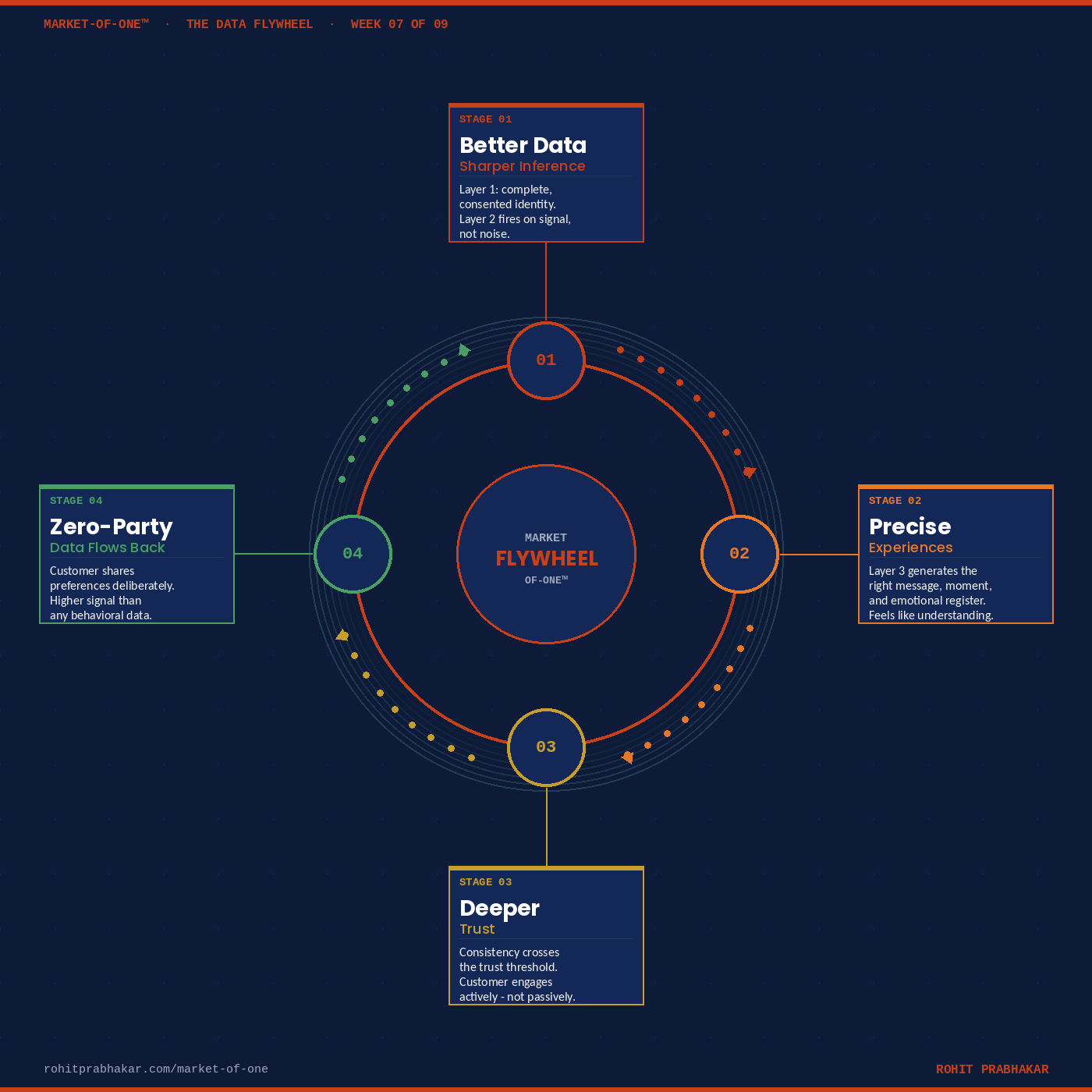
- The Market-of-One™ flywheel has four compounding stages: better data produces sharper inference, sharper inference produces more precise experiences, more precise experiences build deeper trust, deeper trust generates more zero-party data.
- Only 5% of organizations are capturing AI value at scale (EY, 2026). Those organizations show 1.7x higher revenue growth and 3.6x greater total shareholder return than peers (BCG). This is the gap between having the architecture and running the flywheel.
- The flywheel moat is time-dependent and experience-dependent. It cannot be bought. A competitor starting today is 18-24 months behind an organization that began building in 2024 – and the gap widens with every interaction cycle.
- The board question is not “what AI tools are we using?” It is “is our flywheel running – and do we have the governance to ensure it compounds correctly?”
I want to start with something that seems contrarian but is actually correct: data is not your moat.
This is not what most AI strategy presentations say. Most of them argue that the company with the most customer data wins – that first-party data is the new oil, that proprietary datasets create defensible competitive advantage, that the enterprise which builds the biggest data lake builds the deepest moat.
The research does not support that argument cleanly. Andreessen Horowitz made this point directly: for enterprise businesses, the cost of adding unique data to your corpus may actually go up while the value of incremental data goes down. A competitor with a smaller, higher-quality dataset and better inference logic can outperform an organization with a data warehouse ten times larger but built without architectural coherence.
So if data alone is not the moat, what is?
The moat is not what you know about your customers. It is what your system learns about them – over time, with their trust, through interactions that your architecture is designed to compound. That is not a dataset. It is a flywheel. And flywheels are earned, not acquired.
This distinction matters enormously for how you build, invest, and govern. An organization that believes data is the moat will spend on data acquisition. An organization that understands the flywheel is the moat will invest in inference quality, consent architecture, and the trust relationship that feeds zero-party data back into the system. Those are not the same investment. They do not produce the same result.
What the Data Flywheel Moat Actually Is
The three-layer architecture I introduced in Week 2 does something that most organizations have not fully reckoned with: it creates a self-reinforcing system where the output of Layer 3 becomes an input to Layer 1, which sharpens Layer 2, which improves Layer 3. The loop runs continuously. Each interaction makes the next one more precise. Each more precise experience builds incremental trust. Each increment of trust makes the customer more willing to share data deliberately – zero-party data that is more valuable than any behavioral signal, because it is stated preference rather than inferred behavior.
That loop – run correctly, governed properly, at scale – is the moat. Not because it produces better content. Because it produces compounding intelligence about your specific customers that no competitor has, because your customers did not build that trust relationship with your competitor. They built it with you.
The flywheel has four stages:
The Numbers That Make This a Board Conversation
The 5% number is the one boards need to sit with. It is not a technology adoption curve. It is a flywheel gap. 95% of organizations are running AI experiments. 5% have the flywheel running. The 5% are pulling ahead at 1.7x revenue growth and 3.6x total shareholder return. That gap is not closing on its own – it widens with every quarterly cycle the flywheel completes.
The board question this demands is not “how many AI use cases do we have?” That is a technology adoption question. The board question is: is our flywheel running – and at what stage? If the honest answer is Stage 1 or Stage 2, you are not yet building a moat. You are building infrastructure. Infrastructure is necessary but not sufficient. The moat only forms when the loop closes – when Stage 4 feeds back into Stage 1 with real zero-party data from real customers who earned their trust with your organization specifically.
Why the Moat Is Harder to Build Than Most Strategies Acknowledge
I want to be honest about something here, because most strategy writing on this topic is too optimistic about the timeline.
The flywheel does not run from day one. It runs from the day the customer trust threshold is crossed – the day the customer’s experience of your system is good enough, consistent enough, and transparent enough that they begin to engage with it rather than tolerate it. That threshold is different for every customer, every category, and every brand. And reaching it requires getting Stage 2 and Stage 3 right repeatedly, over time, before Stage 4 activates.
Most organizations I work with are stuck between Stage 2 and Stage 3. The inference is working. The experiences are better than they were. But the trust threshold has not been crossed yet – because the system still makes enough mistakes, or still feels enough like surveillance rather than understanding, that customers are not sharing deliberately. They are not filling in preference profiles. They are not engaging with personalization features. They are receiving personalized content and accepting it passively.
Passive acceptance is not the flywheel. The flywheel requires active trust. And active trust requires three things that most personalization investments skip.
Transparency about what the system knows and why. The customer who understands that your recommendation is based on their stated preference and purchase history responds differently than the customer who does not know why they are seeing what they are seeing. The latter feels watched. The former feels understood. The difference is not technology. It is design – the explicit choice to show your work.
Consistent accuracy over time, not peak accuracy on demos. A customer who receives one precisely timed, perfectly relevant experience and then a week of noise does not cross the trust threshold. Consistency is what builds trust. Consistency requires the adjacent processes, the operational budget, and the executive ownership we covered in Week 5 and Week 6. The flywheel cannot run on a pilot. It runs on a production system, governed by someone accountable for its outputs every day.
A consent architecture that earns, not extracts. The zero-party data that powers Stage 4 of the flywheel only flows when the customer believes their data is being used for their benefit, not the brand’s. The architecture that produces that belief is not a compliance checkbox. It is a design choice that runs through every layer of the system. I will go deeper on this in Week 8.
The Organizations Already Running It
The flywheel is not theoretical. It is visible in the performance data of the organizations that built the three-layer architecture first and most completely.
Netflix built it on content. 80% of content watched on Netflix comes from its recommendation system, which generates over $1 billion in annual value through reduced churn. The inference quality – built on viewing behavior, stated ratings, and explicit preference signals – is what makes that number possible. The moat is not Netflix’s content library. Competitors can build content libraries. The moat is the inference quality built on 300 million subscribers’ viewing patterns over two decades. That is not replicable in a quarter.
Amazon built it on commerce. The recommendation engine drives an estimated 35% of total revenue. But the deeper moat is not the recommendation engine itself – it is the flywheel beneath it: purchase history feeds inference, inference drives discovery, discovery produces purchase, purchase updates history, history sharpens inference. Amazon Prime is the trust layer that closes the loop: customers who trust Amazon enough to pre-pay for the relationship share dramatically more zero-party data – search queries, wish lists, reviews, Alexa requests – that feeds every subsequent cycle.
Starbucks built it on service. Their Deep Brew AI personalization system identified that 43% of customers who purchased unsweetened iced tea had never been offered a food pairing – a gap invisible to segment-level analysis, visible only with individual-level inference. Starbucks’ moat is not its app. It is 30 million active Rewards members whose preferences, purchase patterns, and responses to personalization have been accumulating in the flywheel for years.
None of these advantages were built in a quarter. They were built over years of consistent, accurate, trustworthy experience delivery that crossed the trust threshold for enough customers to activate Stage 4 at scale. The organizations that understand this are not asking “how do we use AI in customer experience?” They are asking “how do we accelerate the flywheel’s next cycle?” Those are not the same question.
The Investor Lens
BCG’s research shows 1.7x revenue growth and 3.6x total shareholder return for AI leaders versus peers – and those numbers compound. The organizations showing 3.6x TSR are not growing linearly. They are growing faster each year because the flywheel is accelerating. For the board and for investors, the strategic question is not whether the organization has deployed AI. It is whether the flywheel is running – and what stage it is at. An organization at Stage 4 with the loop closed is worth fundamentally more than an organization at Stage 1 with impressive infrastructure, because Stage 4 produces an asset – compounding proprietary intelligence – that does not depreciate and cannot be easily replicated. BCG’s research also shows the top 5% of AI value capturers are 50% more likely to have shared business-IT AI ownership. Stage 4 does not run without the governance structure described in Week 6. The flywheel and the mandate are the same investment.
What It Takes to Actually Build This
I want to be specific about what “building the flywheel” actually requires operationally, because most strategy writing treats it as inevitable once you have the architecture. It is not. The architecture is necessary but not sufficient. Three things determine whether the loop closes.
The consent architecture has to be designed for trust, not compliance. Most organizations build consent frameworks that satisfy legal requirements. That is the floor. The ceiling is a consent architecture that the customer experiences as respectful – that explains in plain language what is collected, for what purpose, with what benefit to them, and with what right to withdraw. The organization that hits the ceiling gets zero-party data. The one that hits the floor gets passive tolerance. Only one of those closes Stage 4.
The measurement framework has to track trust, not just conversion. The flywheel is not visible in campaign metrics. It is visible in customer lifetime value trends, in the ratio of zero-party to third-party data, in preference profile completion rates, in the frequency with which customers engage with personalization features rather than ignoring them. Most organizations are not measuring these things. If you cannot measure the flywheel, you cannot manage it, and you cannot tell the board whether it is running.
The governance has to run faster than the cycle. The flywheel turns in real time. The governance that catches errors in real time – experiences that cross ethical boundaries, inference that manufactures urgency rather than removes friction, generation that feels manipulative rather than helpful – has to be equally real-time. The CMO-CDO-CIO triad from Week 6 is the governance structure. The flywheel is what it is governing. If governance runs quarterly, the flywheel’s errors compound before they are caught.
My Take for the CEO and Board
The competitive question for the next five years is not who has the best AI models. The models are commoditizing. The competitive question is who has the deepest flywheel – the most proprietary inference quality, built on the most trusted customer relationship, compounding at the fastest rate. That is a strategic asset question, not a technology question. It belongs on the board agenda, not the technology committee agenda. The organization that builds the deepest flywheel first does not just win more customers. It builds an advantage that widens with every interaction cycle, in a way that no amount of competitor investment can quickly reverse. Three years from now, the gap between the organizations that closed the loop in 2024 and 2025 and the ones that are still running pilots will not be measured in percentage points. It will be measured in customer lifetime value multiples. The time to start is not when the gap is obvious. It is now, when closing the loop is still possible before the leaders pull permanently out of reach.
Frequently Asked Questions
What is a data flywheel in AI personalization?
A data flywheel in AI personalization is a self-reinforcing cycle where better data produces sharper inference, sharper inference produces more precise experiences, more precise experiences build customer trust, and deeper trust generates more zero-party data that feeds back into the system. In the Market-of-One™ framework, the flywheel runs across all three layers: Layer 1 (data and consent), Layer 2 (inference), and Layer 3 (experience generation). Each cycle is more accurate than the last.
Is data really a competitive moat for enterprises?
Data alone is not a durable moat. Research from a16z shows that incremental data has diminishing returns, and competitors can often replicate datasets with sufficient investment. The durable competitive advantage is the inference quality built on proprietary data over time – specifically, the quality that accumulates when customer trust generates zero-party data that competitors cannot access because the trust relationship was built with you, not them.
How long does it take to build a data flywheel moat?
The flywheel moat takes 18-36 months to reach the stage where it provides defensible competitive advantage. The time-to-moat depends on how quickly the consent architecture is designed for trust, how consistently the experience delivery crosses the customer trust threshold, and how effectively zero-party data is captured and recycled into the inference layer. Organizations that began building in 2024 are already 18-24 months ahead of those starting in 2026.
What is zero-party data and why does it matter for the flywheel?
Zero-party data is information a customer shares deliberately and proactively – stated preferences, explicit feedback, completed profiles, deliberate engagement with personalization features. It is more valuable than behavioral data because it reflects stated intent rather than inferred behavior. In the flywheel model, zero-party data is the fuel for Stage 4: it flows back into Layer 1 with higher signal quality than any third-party or first-party behavioral data. It only flows when the customer trusts the system enough to engage with it actively – which is why the trust architecture is the prerequisite for a true flywheel moat.
The competitive advantage is not the data you own. It is the inference quality you have earned, compounding on the trust your customers chose to give you, in a loop your competitors cannot replicate because they were not there when the trust was built.
Next week – Week 08: The Privacy Covenant. The flywheel only runs if the customer trusts you with their individuality. That trust is earned before personalization begins – not as a result of it. Week 8 is about the consent architecture that makes the flywheel possible, the difference between compliance and covenant, and why “consent is the new data strategy” is the structural prerequisite for everything this series has argued.
Rohit Prabhakar is a Fortune 50 CMO and CDO with $1.7B+ in measurable business value across Visa, McKesson, Thomson Reuters, and FIS. Creator of the Market-of-One™ framework. MARKET-OF-ONE is a registered trademark, Serial No. 99757619.
This article was developed in partnership with AI – used as a research, brainstorming, and authoring collaborator. All frameworks, positions, strategic perspectives, and opinions are Rohit Prabhakar’s own. AI was the tool. The thinking is mine.