Rohit Prabhakar

I build agentic revenue systems for Fortune 50 companies

  • Digital Transformation
  • Leadership
  • Marketing
  • Writing
  • Home
  • Privacy Policy

The New Moat: Why the Data Flywheel Is the Only AI Competitive Advantage That Compounds

May 5, 2026 by Rohit Leave a Comment

The data flywheel competitive advantage is the only AI moat that compounds over time – and most enterprises are not building it correctly.

Week 07 of 09 · Market-of-One™ Series · The competitive advantage built by the three-layer architecture is not the technology. It is what the technology learns about your customers that no competitor can replicate.

Key Takeaways

  • Data alone is not a moat. The a16z research is correct: incremental data has diminishing returns and a well-funded competitor can replicate most datasets. The moat is the inference quality built on proprietary data – and that takes time and trust to accumulate.
  • The Market-of-One™ flywheel has four compounding stages: better data produces sharper inference, sharper inference produces more precise experiences, more precise experiences build deeper trust, deeper trust generates more zero-party data.
  • Only 5% of organizations are capturing AI value at scale (EY, 2026). Those organizations show 1.7x higher revenue growth and 3.6x greater total shareholder return than peers (BCG). This is the gap between having the architecture and running the flywheel.
  • The flywheel moat is time-dependent and experience-dependent. It cannot be bought. A competitor starting today is 18-24 months behind an organization that began building in 2024 – and the gap widens with every interaction cycle.
  • The board question is not “what AI tools are we using?” It is “is our flywheel running – and do we have the governance to ensure it compounds correctly?”

I want to start with something that seems contrarian but is actually correct: data is not your moat.

This is not what most AI strategy presentations say. Most of them argue that the company with the most customer data wins – that first-party data is the new oil, that proprietary datasets create defensible competitive advantage, that the enterprise which builds the biggest data lake builds the deepest moat.

The research does not support that argument cleanly. Andreessen Horowitz made this point directly: for enterprise businesses, the cost of adding unique data to your corpus may actually go up while the value of incremental data goes down. A competitor with a smaller, higher-quality dataset and better inference logic can outperform an organization with a data warehouse ten times larger but built without architectural coherence.

So if data alone is not the moat, what is?

The moat is not what you know about your customers. It is what your system learns about them – over time, with their trust, through interactions that your architecture is designed to compound. That is not a dataset. It is a flywheel. And flywheels are earned, not acquired.

This distinction matters enormously for how you build, invest, and govern. An organization that believes data is the moat will spend on data acquisition. An organization that understands the flywheel is the moat will invest in inference quality, consent architecture, and the trust relationship that feeds zero-party data back into the system. Those are not the same investment. They do not produce the same result.

What the Data Flywheel Moat Actually Is

The three-layer architecture I introduced in Week 2 does something that most organizations have not fully reckoned with: it creates a self-reinforcing system where the output of Layer 3 becomes an input to Layer 1, which sharpens Layer 2, which improves Layer 3. The loop runs continuously. Each interaction makes the next one more precise. Each more precise experience builds incremental trust. Each increment of trust makes the customer more willing to share data deliberately – zero-party data that is more valuable than any behavioral signal, because it is stated preference rather than inferred behavior.

That loop – run correctly, governed properly, at scale – is the moat. Not because it produces better content. Because it produces compounding intelligence about your specific customers that no competitor has, because your customers did not build that trust relationship with your competitor. They built it with you.

The flywheel has four stages:
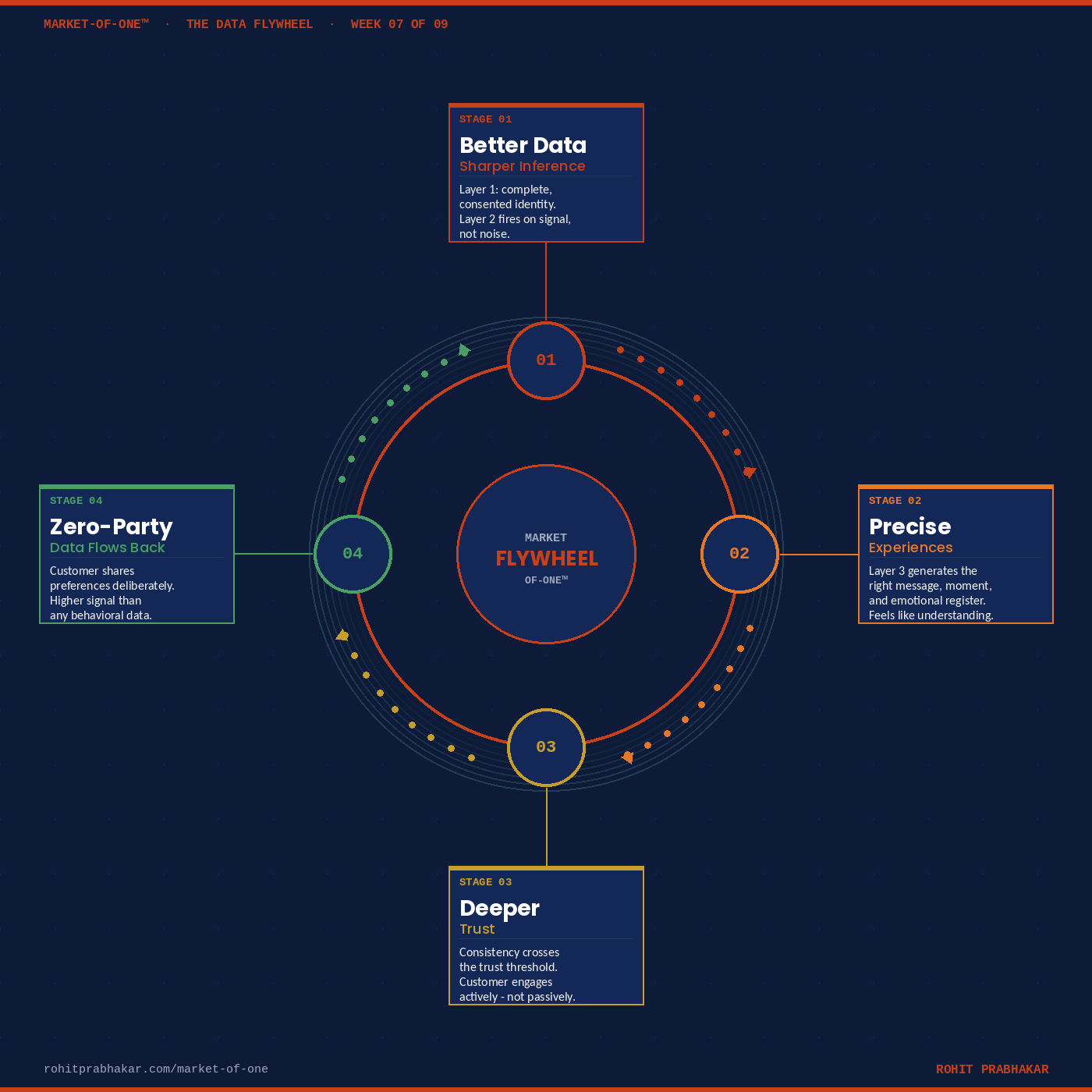
The Market-of-One data flywheel - four compounding stages: better data produces sharper inference, sharper inference produces precise experiences, precise experiences build deeper trust, deeper trust generates zero-party data - Rohit Prabhakar Week 07
The Market-of-One™ data flywheel. Each cycle is more accurate than the last. The moat is the compounding inference quality earned over time – not the data itself.

Stage 01

Better Data – Sharper Inference

Layer 1 holds more complete, more consented, more recent customer identity. Layer 2 infers intent with higher accuracy. The system fires on signal, not noise. Fewer false positives. More precise moments of action.

Stage 02

Precise Experiences

Layer 3 generates experiences that are contextually accurate – the right product, the right message, the right moment, the right emotional register. The customer receives something that feels less like marketing and more like understanding.

Stage 03

Deeper Trust

A customer who consistently receives experiences that reflect their actual needs builds a different relationship with the brand than one who receives well-crafted campaigns. Trust is the accumulation of times the system got it right without being asked.

Stage 04 – The Loop Closes

Zero-Party Data Flows Back

A customer who trusts the system shares preferences deliberately. They tell you what they want. They set preferences. They complete profiles. This stated data flows back into Layer 1, sharpening the next cycle. A competitor starting today is not just behind on data. They are behind on trust. That gap widens with every cycle.

The Numbers That Make This a Board Conversation

5%

of organizations capturing AI value at scale right now

EY Global AI Study 2026

1.7x

higher revenue growth at AI-leading organizations vs peers

BCG AI at Scale 2026

3.6x

greater total shareholder return for flywheel leaders

BCG AI at Scale 2026

The 5% number is the one boards need to sit with. It is not a technology adoption curve. It is a flywheel gap. 95% of organizations are running AI experiments. 5% have the flywheel running. The 5% are pulling ahead at 1.7x revenue growth and 3.6x total shareholder return. That gap is not closing on its own – it widens with every quarterly cycle the flywheel completes.

The board question this demands is not “how many AI use cases do we have?” That is a technology adoption question. The board question is: is our flywheel running – and at what stage? If the honest answer is Stage 1 or Stage 2, you are not yet building a moat. You are building infrastructure. Infrastructure is necessary but not sufficient. The moat only forms when the loop closes – when Stage 4 feeds back into Stage 1 with real zero-party data from real customers who earned their trust with your organization specifically.

Why the Moat Is Harder to Build Than Most Strategies Acknowledge

I want to be honest about something here, because most strategy writing on this topic is too optimistic about the timeline.

The flywheel does not run from day one. It runs from the day the customer trust threshold is crossed – the day the customer’s experience of your system is good enough, consistent enough, and transparent enough that they begin to engage with it rather than tolerate it. That threshold is different for every customer, every category, and every brand. And reaching it requires getting Stage 2 and Stage 3 right repeatedly, over time, before Stage 4 activates.

Most organizations I work with are stuck between Stage 2 and Stage 3. The inference is working. The experiences are better than they were. But the trust threshold has not been crossed yet – because the system still makes enough mistakes, or still feels enough like surveillance rather than understanding, that customers are not sharing deliberately. They are not filling in preference profiles. They are not engaging with personalization features. They are receiving personalized content and accepting it passively.

Passive acceptance is not the flywheel. The flywheel requires active trust. And active trust requires three things that most personalization investments skip.

Transparency about what the system knows and why. The customer who understands that your recommendation is based on their stated preference and purchase history responds differently than the customer who does not know why they are seeing what they are seeing. The latter feels watched. The former feels understood. The difference is not technology. It is design – the explicit choice to show your work.

Consistent accuracy over time, not peak accuracy on demos. A customer who receives one precisely timed, perfectly relevant experience and then a week of noise does not cross the trust threshold. Consistency is what builds trust. Consistency requires the adjacent processes, the operational budget, and the executive ownership we covered in Week 5 and Week 6. The flywheel cannot run on a pilot. It runs on a production system, governed by someone accountable for its outputs every day.

A consent architecture that earns, not extracts. The zero-party data that powers Stage 4 of the flywheel only flows when the customer believes their data is being used for their benefit, not the brand’s. The architecture that produces that belief is not a compliance checkbox. It is a design choice that runs through every layer of the system. I will go deeper on this in Week 8.

The Organizations Already Running It

The flywheel is not theoretical. It is visible in the performance data of the organizations that built the three-layer architecture first and most completely.

Netflix built it on content. 80% of content watched on Netflix comes from its recommendation system, which generates over $1 billion in annual value through reduced churn. The inference quality – built on viewing behavior, stated ratings, and explicit preference signals – is what makes that number possible. The moat is not Netflix’s content library. Competitors can build content libraries. The moat is the inference quality built on 300 million subscribers’ viewing patterns over two decades. That is not replicable in a quarter.

Amazon built it on commerce. The recommendation engine drives an estimated 35% of total revenue. But the deeper moat is not the recommendation engine itself – it is the flywheel beneath it: purchase history feeds inference, inference drives discovery, discovery produces purchase, purchase updates history, history sharpens inference. Amazon Prime is the trust layer that closes the loop: customers who trust Amazon enough to pre-pay for the relationship share dramatically more zero-party data – search queries, wish lists, reviews, Alexa requests – that feeds every subsequent cycle.

Starbucks built it on service. Their Deep Brew AI personalization system identified that 43% of customers who purchased unsweetened iced tea had never been offered a food pairing – a gap invisible to segment-level analysis, visible only with individual-level inference. Starbucks’ moat is not its app. It is 30 million active Rewards members whose preferences, purchase patterns, and responses to personalization have been accumulating in the flywheel for years.

None of these advantages were built in a quarter. They were built over years of consistent, accurate, trustworthy experience delivery that crossed the trust threshold for enough customers to activate Stage 4 at scale. The organizations that understand this are not asking “how do we use AI in customer experience?” They are asking “how do we accelerate the flywheel’s next cycle?” Those are not the same question.

The Investor Lens

BCG’s research shows 1.7x revenue growth and 3.6x total shareholder return for AI leaders versus peers – and those numbers compound. The organizations showing 3.6x TSR are not growing linearly. They are growing faster each year because the flywheel is accelerating. For the board and for investors, the strategic question is not whether the organization has deployed AI. It is whether the flywheel is running – and what stage it is at. An organization at Stage 4 with the loop closed is worth fundamentally more than an organization at Stage 1 with impressive infrastructure, because Stage 4 produces an asset – compounding proprietary intelligence – that does not depreciate and cannot be easily replicated. BCG’s research also shows the top 5% of AI value capturers are 50% more likely to have shared business-IT AI ownership. Stage 4 does not run without the governance structure described in Week 6. The flywheel and the mandate are the same investment.

What It Takes to Actually Build This

I want to be specific about what “building the flywheel” actually requires operationally, because most strategy writing treats it as inevitable once you have the architecture. It is not. The architecture is necessary but not sufficient. Three things determine whether the loop closes.

The consent architecture has to be designed for trust, not compliance. Most organizations build consent frameworks that satisfy legal requirements. That is the floor. The ceiling is a consent architecture that the customer experiences as respectful – that explains in plain language what is collected, for what purpose, with what benefit to them, and with what right to withdraw. The organization that hits the ceiling gets zero-party data. The one that hits the floor gets passive tolerance. Only one of those closes Stage 4.

The measurement framework has to track trust, not just conversion. The flywheel is not visible in campaign metrics. It is visible in customer lifetime value trends, in the ratio of zero-party to third-party data, in preference profile completion rates, in the frequency with which customers engage with personalization features rather than ignoring them. Most organizations are not measuring these things. If you cannot measure the flywheel, you cannot manage it, and you cannot tell the board whether it is running.

The governance has to run faster than the cycle. The flywheel turns in real time. The governance that catches errors in real time – experiences that cross ethical boundaries, inference that manufactures urgency rather than removes friction, generation that feels manipulative rather than helpful – has to be equally real-time. The CMO-CDO-CIO triad from Week 6 is the governance structure. The flywheel is what it is governing. If governance runs quarterly, the flywheel’s errors compound before they are caught.

My Take for the CEO and Board

The competitive question for the next five years is not who has the best AI models. The models are commoditizing. The competitive question is who has the deepest flywheel – the most proprietary inference quality, built on the most trusted customer relationship, compounding at the fastest rate. That is a strategic asset question, not a technology question. It belongs on the board agenda, not the technology committee agenda. The organization that builds the deepest flywheel first does not just win more customers. It builds an advantage that widens with every interaction cycle, in a way that no amount of competitor investment can quickly reverse. Three years from now, the gap between the organizations that closed the loop in 2024 and 2025 and the ones that are still running pilots will not be measured in percentage points. It will be measured in customer lifetime value multiples. The time to start is not when the gap is obvious. It is now, when closing the loop is still possible before the leaders pull permanently out of reach.

Frequently Asked Questions

What is a data flywheel in AI personalization?

A data flywheel in AI personalization is a self-reinforcing cycle where better data produces sharper inference, sharper inference produces more precise experiences, more precise experiences build customer trust, and deeper trust generates more zero-party data that feeds back into the system. In the Market-of-One™ framework, the flywheel runs across all three layers: Layer 1 (data and consent), Layer 2 (inference), and Layer 3 (experience generation). Each cycle is more accurate than the last.

Is data really a competitive moat for enterprises?

Data alone is not a durable moat. Research from a16z shows that incremental data has diminishing returns, and competitors can often replicate datasets with sufficient investment. The durable competitive advantage is the inference quality built on proprietary data over time – specifically, the quality that accumulates when customer trust generates zero-party data that competitors cannot access because the trust relationship was built with you, not them.

How long does it take to build a data flywheel moat?

The flywheel moat takes 18-36 months to reach the stage where it provides defensible competitive advantage. The time-to-moat depends on how quickly the consent architecture is designed for trust, how consistently the experience delivery crosses the customer trust threshold, and how effectively zero-party data is captured and recycled into the inference layer. Organizations that began building in 2024 are already 18-24 months ahead of those starting in 2026.

What is zero-party data and why does it matter for the flywheel?

Zero-party data is information a customer shares deliberately and proactively – stated preferences, explicit feedback, completed profiles, deliberate engagement with personalization features. It is more valuable than behavioral data because it reflects stated intent rather than inferred behavior. In the flywheel model, zero-party data is the fuel for Stage 4: it flows back into Layer 1 with higher signal quality than any third-party or first-party behavioral data. It only flows when the customer trusts the system enough to engage with it actively – which is why the trust architecture is the prerequisite for a true flywheel moat.

The competitive advantage is not the data you own. It is the inference quality you have earned, compounding on the trust your customers chose to give you, in a loop your competitors cannot replicate because they were not there when the trust was built.

Next week – Week 08: The Privacy Covenant. The flywheel only runs if the customer trusts you with their individuality. That trust is earned before personalization begins – not as a result of it. Week 8 is about the consent architecture that makes the flywheel possible, the difference between compliance and covenant, and why “consent is the new data strategy” is the structural prerequisite for everything this series has argued.


Rohit Prabhakar is a Fortune 50 CMO and CDO with $1.7B+ in measurable business value across Visa, McKesson, Thomson Reuters, and FIS. Creator of the Market-of-One™ framework. MARKET-OF-ONE is a registered trademark, Serial No. 99757619.

This article was developed in partnership with AI – used as a research, brainstorming, and authoring collaborator. All frameworks, positions, strategic perspectives, and opinions are Rohit Prabhakar’s own. AI was the tool. The thinking is mine.

Filed Under: Market-of-One Tagged With: AI competitive advantage, CDO, CMO, data flywheel, Personalization, zero-party data

The Inversion: The Three-Layer Architecture Changes What Marketing Is

April 14, 2026 by Rohit Leave a Comment

The CMO role AI transformation is not gradual. It is structural. Here is what the new job actually requires.

The three-layer architecture does not just change what marketing does. It changes what marketing is.

When Layer 3 generates the content, Layer 2 selects the moment, and Layer 1 holds the identity and consent, the marketer’s job description inverts. Here is what it actually becomes, why most organizations are not ready for it, and what the ones that get it right will build that no competitor can replicate.

I want to start with a question I get asked in every boardroom I walk into right now: “How do we use AI in marketing?”

It is the wrong question. And the fact that it is being asked everywhere, by everyone, at the C-suite level, tells me most organizations are about to spend significant capital in the wrong direction.

The right question is: when AI generates the experience, infers the intent, and holds the customer relationship in real time, what does the marketing leader’s job actually become?

Because those are not the same question. The first is a technology procurement question. The second is an organizational design question, a talent question, an accountability question, and an ethical question, all at once. Most enterprises are answering the first one and ignoring the second. That is why the failure rate on personalization investments remains as high as it does, and why the organizations that are actually winning with AI look structurally different from the ones that are not.

The Market-of-One framework changes more than the technology stack. It changes the nature of the job. This is what I call the inversion.

What the Inversion Actually Is

For thirty years, the marketer’s job was sequential and approval-based. You briefed an agency. The agency created. You approved. The data team built segments. You selected which segments to target. The technology team ran the platform. You measured results after campaigns closed.

In that model, the marketer was fundamentally a content producer and a selector. They chose from options that humans upstream had prepared.

The three-layer architecture breaks every one of those boundaries. Layer 3 generates the content. Layer 2 selects the moment and the signal. Layer 1 holds the consent architecture and identity. When all three work as a system, the marketer is no longer choosing from options. They are defining the rules by which options are generated, in real time, for each individual customer, at scale.

You are not selecting the experience. You are writing the logic that produces it. That is a different job with a different skill set, a different accountability structure, and a different category of ethical obligation.

This shift is not gradual. It is structural. And it is happening faster than most marketing organizations have recognized because the surface appearance of the work has not changed much yet. Teams are still running “campaigns.” Leaders are still reviewing “content.” The vocabulary of the old job is masking the reality of the new one. But underneath, the dependency chain has already inverted.

  1. 01

    From approver to architect.

    Old: Approve creative produced by agencies. New: Define the parameters within which Layer 3 generates creative autonomously.

  2. 02

    From selector to rule-writer.

    Old: Select which segments to target. New: Set the inference logic that determines who receives what, when, and why.

  3. 03

    From chooser to system owner.

    Old: Choose from a content library. New: Own the system that generates the library in real time for each individual.

  4. 04

    From post-hoc measurer to live governor.

    Old: Measure campaign performance after it closes. New: Govern the system that adapts the experience while the customer is still in it.

  5. 05

    From reviewed-output accountability to system-behavior accountability.

    Old: Accountable for outputs you directly approved. New: Accountable for millions of experiences you never individually reviewed.

  6. 06

    From data consumer to consent owner.

    Old: Data is a targeting input managed by another team. New: Consent architecture is a foundational obligation you personally own.

That last row is the one that changes the governance model entirely. When Layer 3 produces experiences at machine speed and machine scale, the CMO or CDO is accountable for the system’s behavior, not just the outputs they reviewed. That accountability cannot be delegated to IT, to legal, or to a vendor. It sits with the person who owns the architecture.

Why Most Organizations Are Not Ready for This

The evidence of unreadiness is consistent across every major research source in 2026. But here is my interpretation of what the data actually means, because most people are reading these statistics as technology adoption metrics. They are not. They are organizational design failures.

65%of CMOs say AI will dramatically transform their role within 2 yearsGartner, 402 CMOs surveyed
3xmore likely to capture AI value when senior leaders personally own the agendaMcKinsey, March 2026
1 in 6organizations has no clear C-suite owner of AI at allMcKinsey State of Organizations 2026

65 percent of CMOs believe AI will dramatically transform their role. My observation: the other 35 percent are either deluded or they have already completed the transformation and are not counting themselves in the same category. The transformation is not optional. It is the job description now.

3x more likely to capture AI value when senior leaders personally own the AI agenda. This is the finding people cite most and act on least. “Own” does not mean sponsor a project. It does not mean review quarterly dashboards. It means architecting the dependency chain personally, understanding how Layer 1 feeds Layer 2 feeds Layer 3, and being the person who decides what the system is allowed to do at each boundary.

1 in 6 organizations has no clear C-suite owner of AI at all. This is the one that should alarm every board reading this. It means the system generating customer experiences in those organizations has no accountable human at the executive level. The experiences are running. The accountability is not.

Gartner’s Ewan McIntyre put the job change as directly as anyone in senior research has: “The CMO role is evolving from influencer to designer of business impact.” His colleague Sharon Cantor Ceurvorst named the binary choice: “Bolt AI onto legacy systems and risk irrelevance, or embrace the opportunity to build what comes next.” BCG’s Jessica Apotheker and Janet Balis named the destination: the CMO-turned-growth architect. And McKinsey’s April 2026 AI Transformation Manifesto stated the foundational requirement with unusual directness: “We do not have a single success story where senior business leaders were not in the driver’s seat.”

All of this converges on the same point: the experience architect is not a new title. It is the old CMO job done the way the three-layer architecture demands it be done. Most current CMOs were not hired for it, were not trained for it, and are not being evaluated on it. That is the talent gap.

The Six Skills the New Job Actually Requires

I am going to be specific here because most of what I read on this topic is vague. “AI fluency.” “Data literacy.” “Systems thinking.” These are categories, not skills. Here is what the experience architect’s job actually requires in practice.

  1. 01

    Dependency chain thinking.

    Understanding that the quality of Layer 3 output is determined entirely by Layer 2 inference quality, which is determined entirely by Layer 1 data quality. Optimizing any single layer in isolation produces the failure modes mapped in Week 3. This is systems thinking applied to experience architecture. It was never required when campaigns had clear start and end dates.

  2. 02

    Consent architecture ownership.

    The CMO must own, not delegate, the framework that determines what Layer 1 can collect, from whom, under what legal basis, for what declared purpose, with what retention period. This is not a compliance function. It is a marketing function, because it determines what the entire system can know and act on. The GDPR and EU AI Act make this personal accountability, not organizational accountability.

  3. 03

    Inference parameter design.

    Defining what signals Layer 2 is permitted to read and act on. Not every behavioral signal should be used simply because it can be. The governing principle I apply: inference should remove friction for the customer, never manufacture it. The marketer who cannot articulate this boundary for their own system does not understand what their system is doing.

  4. 04

    Generative boundary setting.

    Defining what Layer 3 cannot produce without human review, regardless of what the model is capable of generating. Brand voice. Emotional register. Sensitive topics. Accessibility requirements. The marketer is no longer approving content after it is created. They are writing the rules by which content is created before any individual experience is generated. Professor Mohanbir Sawhney at Kellogg calls this governing the system’s Insight Gap, the strategic judgment that only humans can provide.

  5. 05

    Scale accountability.

    When Layer 3 generates millions of experiences simultaneously, the experience architect is accountable for all of them, including the ones that went wrong at 2am without anyone’s awareness. This requires a fundamentally different relationship to risk than campaign-era marketing. You are accountable for the system’s behavior across every individual it touches, whether you saw that experience or not.

  6. 06

    Flywheel governance.

    Understanding that the data generated by Layer 3 experiences flows back into Layer 1 and sharpens Layer 2 inference over time. This compounding loop, the data flywheel, is where the durable competitive advantage lives. Governing it means understanding how the system learns, what it reinforces, and how to prevent early biases from amplifying across millions of future experiences.

Wharton’s Stefano Puntoni added a seventh dimension I would not have named a year ago: the experience architect is now building for two different kinds of customers. Humans, yes. But also AI agents that are beginning to shop and transact on behalf of humans. His February 2026 HBR piece calls this “marketing to a machine with its own decision logic.” The skill required is understanding that the experience rules you write will be evaluated by systems that do not respond to emotional register, brand storytelling, or urgency triggers. Accuracy, trust signals, and structured data become the currency. That is a new design constraint the experience architect must own.

The Three Ethical Obligations Nobody Is Talking About

Here is where I will say something that most thought leadership in this space avoids, because it is uncomfortable.

When you go from selecting experiences to setting the rules that generate experiences at scale, you acquire a different category of ethical obligation. Not a marketing ethics obligation. A system ethics obligation.

There is a meaningful difference between being responsible for a bad advertisement (which a human reviewed, approved, and deployed) and being responsible for a system that generated ten thousand psychologically targeted variations simultaneously, each one tailored to the individual vulnerability profile of the person it reached.

The Gartner finding that personalized customers are 3.2 times more likely to regret their purchase is not a measurement of bad technology. It is a measurement of what happens when the power to build for individuals operates without adequate ethical architecture underneath it. The system is working. The ethics are not.

I believe the experience architect carries three ethical obligations that do not exist in the campaign-era job description.

Consent ethics. Was the data informing this experience collected with the customer’s informed understanding of how it would be used? Not legal compliance, which is a floor, not a ceiling. Informed understanding. This is the difference between a customer who feels known and a customer who feels surveilled.

Inference ethics. Is Layer 2 using behavioral signals to remove friction, or to manufacture urgency, exploit decision fatigue, or create artificial scarcity? This distinction is the line between personalization that serves the customer and personalization that serves the conversion metric at the customer’s expense. I have seen both deployed under the same architecture. The difference is the governing principle, and the governing principle is the CMO’s responsibility to set.

Generation ethics. Does the experience Layer 3 produced reflect the values of the organization, including its commitments to accessibility, transparency, and emotional appropriateness across every customer state and context? AI can fake intimacy. The ethical architect’s job is to ensure the system earns trust instead of simulating it.

My Take for the Board

The board that does not ask its CMO or CDO whether they personally own the consent architecture, inference parameters, and generative boundaries of the personalization system is the board that discovers the exposure through a regulatory finding or a brand crisis. Not before it. McKinsey’s April 2026 data is unambiguous: one in six organizations has no C-suite AI owner at all. If your organization is in that one in six, you have a governance gap, not a technology gap. The question to ask in your next executive session is not “what AI tools are we deploying?” It is “who is personally accountable for what those tools produce at scale?”

What This Means for Org Design

The inversion creates an organizational design problem that most enterprises are avoiding because the answer is politically difficult.

If the CMO or CDO owns the three-layer experience architecture, they own decisions that currently sit in IT (data infrastructure), Legal (consent), Analytics (inference logic), and Product (experience generation). That is not a turf grab. It is a structural consequence of what the architecture requires. Someone has to own the dependency chain. If no one does, the chain breaks, and the failure modes mapped in Week 3 are the result.

The shared ownership model is what works. BCG’s research found that the top 5 percent of companies deriving significant AI bottom-line value are 50 percent more likely to have shared business-IT ownership of AI operating models, with clear decision rights and accountability at each boundary. Not IT ownership. Not business ownership alone. Shared ownership with clarity on who decides what, and who is accountable when the system produces something it should not.

My view from having run this across Visa, McKesson, and Thomson Reuters: the right structural model is the CMO or CDO as the accountable executive for the three-layer architecture, with deep cross-functional authority across consent (legal partnership), data infrastructure (IT/CDO partnership), inference design (analytics partnership), and generative boundaries (brand/product partnership). The functions do not move. The decision rights do.

Gartner’s data shows marketers are currently accountable for five functions on average. That number is projected to reach eight by 2027 to 2029, with customer experience, commercial alignment, and product strategy the top three areas of expanding accountability. The functions are expanding while budgets are not. The only way to govern a larger accountability surface with the same resources is better architecture: systems that run correctly by design, not by review. That is the business case for the experience architect role being owned by a single, empowered leader.

The Investor Lens

Sequoia Capital declared in January 2026 that “the AI applications of 2023 and 2024 were talkers. The AI applications of 2026 and 2027 will be doers.” When Layer 3 becomes a doer, generating and delivering experiences autonomously, the CMO is accountable for what the system did, not what they reviewed. a16z’s Sarah Wang framed the commercial thesis: “The concierge, intimate, proactive, personalized, continuous, becomes the default for all commerce.” That is the Market-of-One. And a16z’s Big Ideas 2026 named the investment thesis directly: “The biggest companies of the next century will win by finding the individual inside the average.” McKinsey’s research shows that organizations with a single integrated customer-centric executive grow 2.3 times faster than those without one. The compounding data flywheel only compounds when someone owns the whole chain.

My Vision for the Marketing Organization of 2028

Let me close with what I believe the best marketing organizations will look like in two years, because I think it is worth being specific about the destination rather than just diagnosing the current state.

The marketing organization of 2028 does not have a campaign calendar. It has a system that runs continuously, learns from every individual interaction, and generates experiences that compound in quality over time as the data flywheel accelerates.

The CMO or CDO does not approve creative. They govern the parameters within which creative is generated: the brand voice constraints, the emotional register rules, the ethical boundaries, the accessibility standards. Creative output is reviewed by exception, not by default.

The team does not have a “data team” and a “creative team” and a “technology team.” Those silos belong to the campaign era. The team has architects: people who understand the dependency chain end to end and can govern each layer’s inputs and outputs with both technical fluency and commercial judgment.

The customer does not receive a campaign. They receive a continuous relationship: experiences that are aware of their history, responsive to their current context, and generated by a system that has been designed with their trust as the foundational constraint, not an afterthought.

And the organization that builds this architecture first, the one that gets the consent architecture right, the inference parameters right, the generative boundaries right, the flywheel governance right, builds something that no competitor can replicate quickly. Because the flywheel compounds. The data the system generates makes the inference better. The better inference makes the generation more precise. The more precise generation builds more trust. The more trust generates more zero-party data. The better data makes the inference sharper. That loop, running correctly at scale, is the moat.

The Inversion, In One Sentence

The marketer’s job has inverted from selecting experiences to architecting the system that generates them, and most organizations are staffed, structured, and governed for the job that no longer exists.

This article was developed in partnership with AI, used as a research, brainstorming, and authoring collaborator. All frameworks, positions, strategic perspectives, and opinions are Rohit Prabhakar’s own. AI was the tool. The thinking is mine.

Filed Under: Market-of-One Tagged With: Agentic AI, AI marketing, CDO, CMO, experience architect, Market-of-One, marketing transformation, Personalization

Know. Understand. Build – Why the Sequence Is Not Optional

April 8, 2026 by Rohit Leave a Comment

Most personalization systems fail not because of bad technology — but because of an incomplete architecture. This article maps the five personalization failure modes that occur when enterprises deploy one or two layers of a three-layer system, and what the complete architecture produces.

Why the sequence is not optional.

Gartner’s June 2025 survey of 1,464 enterprise buyers produced a finding that should have stopped every personalization budget review in its tracks: customers who receive personalized experiences are 3.2 times more likely to regret their purchase. Not less likely. More. The technology is deployed. The intent is real. The outcome is negative. This is the anatomy of both.

The personalization industry has a problem it does not want to name. Enterprises have spent a combined $200 billion on marketing technology over the past decade. They have built data lakes and customer data platforms, deployed machine learning models and real-time decision engines, and most recently begun layering generative AI on top. By every input measure, the infrastructure exists.

And yet: Gartner finds personalized customers are 3.2 times more likely to regret a purchase and 44 percent less likely to buy again. McKinsey finds that 61 percent of brands claim they personalize while only 43 percent of consumers recognize any of it as personal. MIT’s 2025 GenAI Divide study found that 95 percent of enterprise generative AI pilots fail to deliver measurable P&L impact.

The conventional diagnosis blames execution: poor data quality, organizational silos, change management failures. Those are real. But they are symptoms. The root cause is architectural. Most enterprises are deploying one or two layers of a three-layer system and discovering that partial deployment does not produce partial results. It produces specific, nameable failure modes that are, in many documented cases, measurably worse than doing nothing.

One Prerequisite Before the Failure Modes

If you have not read Week 2, the short version is this: the Market-of-One framework requires three interdependent layers, Know, Understand, Build, in that sequence. Each layer’s output is the next layer’s input. What matters for this article is not what each layer does. It is what happens when one is missing.

What Makes This an Architecture, Not a Checklist

There is a distinction most enterprise technology programs miss. It is the distinction that explains every failure mode in this article.

A checklist is modular. You complete items in any order. Each item is independent. If you skip one, you get a partial result. Two-thirds completed produces two-thirds of the value.

An architecture is a dependency chain. You cannot understand what you have not collected. You cannot generate for an individual you have not understood. The sequence is not a preference. It is a technical constraint. Each layer requires the previous layer as its input. Remove Layer 1 and Layer 2 has no grounded signal to interpret. Remove Layer 2 and Layer 3 has no contextual intelligence to act on. Remove Layer 3 and the combined understanding of Layers 1 and 2 dies at the last mile, unacted on.

This is what enterprises consistently misread. They treat the three layers as a procurement checklist (buy a CDP, deploy a real-time decisioning engine, add a generative model) and expect the sum to function. It does not. Because the value is not in the tools. It is in the dependency chain between them. A CDP without inference is a filing cabinet. Inference without a data foundation produces hallucinated conclusions. Generative AI without either is a confident machine producing content for a customer it does not know.

The clinical term for this is incomplete architecture. The business consequence is not underperformance. It is specific, measurable failure, in some cases worse than deploying nothing at all.

The Five Failure Modes

There are five ways the dependency chain breaks. Each produces a different failure mode with a specific mechanism, a specific cost, and, increasingly, a specific regulatory exposure.

  1. 01

    Digital Taxidermy. L1 only: Know Them without Understanding or Building.

    The enterprise invests in a Customer Data Platform. It unifies customer records, builds segments, and produces dashboards. The data exists. The profiles look sophisticated. Nothing moves in real time because the CDP processes in batch cycles, typically 3 to 6 hours between customer action and segment re-qualification. The customer who just purchased continues to receive ads for the product they bought. The cart abandoner receives a recovery email the following morning, after purchasing from a competitor. This is Digital Taxidermy: the preserved representation of a customer that looks alive but cannot respond to a living person’s changing state. 67 percent of enterprise data platforms now operate on batch cycles that make real-time personalization structurally impossible.

    Documented consequence: Gartner’s 2025 Magic Quadrant found that CDPs have entered the trough of disillusionment. 10 of 12 assessed vendors regressed in their positions. Only 17 percent of marketers reported high utilization of their CDP despite 67 percent adoption rates.

    Privacy exposure: L1-only architectures typically rely on third-party and harvested behavioral data because they lack real-time consent signal processing. LinkedIn’s EUR 310 million fine (October 2024) and Amazon’s EUR 746 million fine were both rooted in L1 data being used without proper consent infrastructure. The data that feeds most CDPs today is the data regulators are eliminating.

  2. 02

    Hallucinated Intent. L2 only: Understand Them without Knowing or Building.

    The enterprise deploys real-time AI inference without a solid data foundation underneath. The model reads behavioral signals (scroll depth, hover time, click patterns) and draws conclusions. But without a reliable history of who this person is, the inference layer has no baseline against which to validate its conclusions. It fabricates confidence from incomplete context. Gartner’s February 2025 analysis found that through 2026, organizations will abandon 60 percent of AI projects that lack AI-ready data foundations.

    Documented case: UnitedHealth’s nH Predict algorithm recommended ending nursing home coverage for a 91-year-old patient with a fractured leg, predicting recovery timelines based on population data without accounting for individual medical context. The algorithm had no meaningful Layer 1 patient history integrated into its real-time inference. The family was forced to pay $12,000 per month out of pocket. The case became landmark litigation defining AI liability in healthcare.

    Privacy exposure: L2 inference without L1 consent architecture creates automated decision-making with no consent record, precisely what GDPR Article 22 prohibits. The CJEU SCHUFA ruling (December 2023) established that automated scoring constitutes a prohibited decision even when a human formally makes the final call. Real-time inference without consent documentation is regulatory exposure at scale.

  3. 03

    Firing Blind. L3 only: Build For Them without Knowing or Understanding.

    This is the failure mode accelerating fastest in 2025 and 2026 as enterprises rush to deploy generative AI for personalization without building the data and inference foundations beneath it. A generative model produces content confidently, at speed, at scale, and with no grounding in who the customer is or what they actually need in this moment. AI hallucinations occur in up to 20 percent of generative outputs (Salesforce, 2025). In a personalization context, this means confident, fast, scalable, wrong. Gartner predicts over 40 percent of agentic AI projects will be cancelled by end of 2027, the majority are L3-only deployments firing without L1 or L2 underneath.

    Documented cases: A GM dealership’s AI chatbot agreed to sell a 2024 Chevrolet Tahoe for $1. Air Canada’s chatbot invented a bereavement discount policy that did not exist; a Canadian tribunal ruled the airline liable for the fabrication. The National Eating Disorders Association deployed chatbot Tessa as a hotline replacement; it recommended calorie counting and weight reduction to people with eating disorders and was taken offline within weeks.

    Accessibility exposure: Generative content produced without accessibility parameters is inaccessible by default. AI-generated images produce vague or absent alt text. AI-generated HTML uses visual styling without semantic markup. 95.9 percent of websites already fail basic WCAG 2.1 AA tests (WebAIM). Generative AI at scale, without accessibility as a generation parameter, multiplies this failure at machine speed.

  4. 04

    Perfect Intelligence, Zero Action. L1 plus L2 without L3: Know and Understand without Building.

    This is the most expensive frustration in marketing technology. The enterprise has built the data foundation. It has deployed real-time inference. It knows who the customer is historically and understands what they need right now with genuine precision. And then it routes them to a pre-built content segment because there is no generation layer to act on the intelligence. Optimizely’s 2024 executive survey named this explicitly: true 1 to 1 personalization was the strategy most teams wanted and could not execute. The data existed. The intent existed. The capacity did not.

    The structural ceiling: Without Layer 3, personalization is bounded by content library size. A team with 50 content variants can personalize across 50 segments regardless of how sophisticated their inference engine becomes. The ceiling is not intelligence. It is production capacity. Adding Layer 3 removes that ceiling entirely.

    Privacy exposure: Enterprises building increasingly sophisticated inference without the generation capability to act on it often compensate by sharing the inferred data with third parties who do have generation capacity. Data sharing as a substitute for architectural completeness is one of the primary paths to GDPR and CCPA violations.

  5. 05

    The Uncanny Valley. L1 plus L3 without L2: Know and Build without Understanding.

    This is the most psychologically damaging failure mode, and the hardest to diagnose, because the system appears to be working. The enterprise knows the customer’s historical profile and can generate content for them. But it has no real-time inference layer. It delivers the right message to the right person at the wrong moment, and near-miss personalization is measurably worse than no personalization at all. A 2025 peer-reviewed study in Behavioral Sciences (Kim and Han, N=360) provided causal evidence for a personalization backfire effect: under high privacy concern conditions, highly personalized experiences produced outcomes no better than generic messages. Attentive’s 2025 survey found that 81 percent of consumers actively ignore irrelevant personalized marketing, and 48 percent unsubscribe after receiving a single irrelevant personalized communication. The damage is permanent.

    Documented cases: Adidas sent “congratulations on surviving” messages to Boston Marathon runners, delivered on the anniversary of the 2013 bombing. Pinterest sent “you are getting married” emails to women who had saved wedding images without any wedding plans. Amazon sent baby registry promotion emails to women managing infertility. Each case represents accurate historical data (L1), compelling content generation (L3), and absent real-time emotional and contextual inference (L2 missing).

    Accessibility exposure: L1 contains demographic and preference data but typically does not capture assistive technology use, accessibility needs, or cognitive load signals. L3 generates content without those parameters. The result is personalized content that is inaccessible to the specific individual it was generated for, a failure more damaging than a generic experience because it signals the system knows the customer but did not account for their full humanity.

The Aggregate Cost

These five failure modes are not theoretical. They are the current operating state of most enterprise personalization programs. The cumulative cost is measurable.

$2Trevenue shift to personalization leaders over next 5 yearsBCG 2024
95%of enterprise generative AI pilots fail to deliver P&L impactMIT 2025
40%of agentic AI projects will be cancelled by end of 2027Gartner 2025

BCG’s Personalization Index finds that leaders grow revenue 10 percentage points faster annually than laggards. McKinsey estimates a $1 trillion value opportunity in US industries alone. The gap between these numbers and the failure rates above is not explained by technology quality. It is explained by architectural completeness.

The CMO Lens

Before approving any personalization budget line, ask which failure mode the investment addresses. A CDP renewal that does not add real-time inference is FM 01. A generative AI pilot that does not connect to a consented data foundation is FM 03. A real-time decisioning engine that has no generation capability downstream is FM 04. The question is not whether to invest in personalization. It is whether the investment completes the architecture or extends a partial system that is currently producing negative outcomes at scale.

What Completeness Actually Produces

The business case for completeness is not theoretical. Based on publicly available research and published case studies, these three companies show what architectural completeness produces in measurable outcomes. What they share is this: they built the full stack, and the full stack compounds in ways that partial deployment cannot.

Netflix

80 percent of content watched comes from recommendations. $1 billion in annual retention savings. Monthly churn of 2.3 to 2.4 percent versus a 5 to 7 percent industry average. Netflix built this by unifying 270 million subscriber histories, running real-time ranking across 1,300 recommendation clusters, and generating multiple personalized thumbnail variants per title for each individual user. Its published engineering architecture documents how each capability depends on the others: the historical layer produces signals, the inference layer ranks content, and the generative layer constructs the visual presentation that converts interest into a click. None of the three produces this outcome independently.

Starbucks

A reported 30 percent ROI on AI investments. Two new product lines from a single data insight. Starbucks’ Deep Brew system spans 75 million Rewards member profiles, real-time demand forecasting per location, and true 1 to 1 email personalization for every member. The insight that 43 percent of tea drinkers add no sugar required all three capabilities working together: historical data showed the pattern, real-time inference confirmed it at the individual level, and generative production tested it at scale. That specific finding could not have emerged from any single capability deployed in isolation.

Stitch Fix

13 million new outfit combinations generated daily. 4.5 billion textual data points informing every recommendation. Stitch Fix built its system across three interdependent capabilities: 90 intake variables and ongoing client feedback as the historical foundation; real-time mixed-effects modeling scoring probability of purchase per SKU per individual; and generative production creating outfit combinations and visual previews at scale. Founder Katrina Lake’s guiding principle, documented across multiple published interviews, was that human stylists and algorithms compound each other, producing outcomes neither achieves alone.

The Investor Lens

The data flywheel only compounds when all three layers are present. Netflix’s L2 inference improves as L3 generation produces more engagement signals, which feed back into L1 data quality. Starbucks’ L3 content production generates behavioral responses that sharpen L2 inference models. Stitch Fix’s human-in-the-loop L3 generation produces explicit preference signals that continuously improve L1 data richness. Partial architectures do not build this flywheel. They consume resources without generating the compounding signal that makes market leaders structurally difficult to displace. The 10 percentage point annual revenue growth gap BCG identifies between personalization leaders and laggards is not a technology gap. It is a flywheel gap.

The Sequence Is Not Optional

This article’s title is a declaration, not a suggestion. Know. Understand. Build. The sequence matters because each layer’s output is the next layer’s input. Remove any one and the chain breaks. There is no shortcut that does not produce one of the five failure modes above.

The regulatory environment is now enforcing this architectural reality through fines. The EU AI Act’s high-risk system obligations take full effect August 2, 2026. Under Article 14, human oversight mechanisms are required for high-risk AI systems. Under Article 86, individuals have a right to explanation of AI decisions that affect them. Neither requirement can be met by organizations that cannot trace a generated experience back through the inference that produced it to the consented data that grounded it. The three layers are not just good architecture. They are the architecture that makes compliance documentable.

The Regulatory Test

For any personalization system currently in production, ask three questions. Layer 1, Consent: Can you demonstrate that the data informing each experience was actively consented to by the individual? Layer 2, Inference: Can you explain the real-time inference that determined this specific individual needed this specific experience at this exact moment? Layer 3, Generation: Can you show that the generated content met WCAG 2.2 AA accessibility standards before delivery? If the answer to any of these is no, the architecture has a missing layer, and the regulatory exposure is compounding as enforcement accelerates.

The technology is in place but not integrated. The data exists but is not actionable. The teams are committed but not coordinated. (PwC, Closing the Personalization Gap, 2025.) This is a description of a partial architecture. Every word of it describes a missing layer.
The Architectural Imperative

Partial deployment does not produce partial results. It produces specific failure modes that are measurably worse than no deployment at all: false confidence, amplified errors, regulatory exposure, and compounded trust erosion. The sequence is Know, then Understand, then Build, in that order, with all three present. That is the only architecture that produces the outcomes the industry has been promising for thirty years.

This article was developed in partnership with AI, used as a research, brainstorming, and authoring collaborator. All frameworks, positions, strategic perspectives, and opinions are Rohit Prabhakar’s own. AI was the tool. The thinking is mine.

Filed Under: Market-of-One Tagged With: AI, CDO, CMO, customer data platform, Generative AI, hyper-personalization, Market-of-One, Personalization

Copyright © 2026 · Genesis Framework · WordPress · Log in