Rohit Prabhakar

I build agentic revenue systems for Fortune 50 companies

  • Digital Transformation
  • Leadership
  • Marketing
  • Writing
  • Home
  • Privacy Policy

The Privacy Covenant: Why Personalization Without Trust Is Surveillance

May 13, 2026 by Rohit Leave a Comment

The Privacy Covenant is the architecture that makes Market-of-One legitimate at enterprise scale. On August 2, 2026, EU AI Act enforcement begins, with fines reaching EUR 35 million or 7% of global revenue. But this article is not about compliance. It is about the hidden cost most enterprises are already paying when they personalize without trust – what I call the Surveillance Tax – and the four-pillar covenant that turns privacy from a constraint into a competitive moat.

In Week 7, I argued that the durable competitive advantage in the AI era is not the model, not the data, and not the talent. It is the compounding loop where each cycle of data, inference, generation, and trust accelerates the next. Trust is the unfakeable input to that loop. Without it, the loop runs once and stalls.

This week is about how that trust is engineered. Not promised. Not claimed in a brand campaign. Engineered into the architecture of how the enterprise interacts with customer data, every day, at every touchpoint.

A countdown clock is ticking in every C-suite I walk into. August 2, 2026. The EU AI Act’s main provisions become applicable, including transparency obligations, governance rules, and the bulk of the regulatory framework. Maximum fines: EUR 35 million or 7% of global annual turnover, whichever is higher. For a company with $30 billion in revenue, that ceiling sits above $2 billion. Meta’s theoretical exposure is roughly $8.5 billion. Google’s $14 billion. Microsoft’s $16 billion. Beyond the fines, market surveillance authorities gain the power to withdraw non-compliant systems from the European market entirely. (Note: per the Council’s May 2026 Digital Omnibus agreement, high-risk AI systems listed in Annex III now apply from December 2, 2027, but the August 2026 enforcement date stands for the rest of the framework, and treating it as binding remains the safe planning assumption.)

The numbers are large. The deadline is real. The penalty regime exceeds even GDPR’s structure.

And yet, if you are reading this as a compliance article, you are missing the actual problem. Compliance is the easy part. Build the documentation, run the conformity assessments, file the impact reports, register the high-risk systems. Expensive, time-consuming, but solvable. The harder problem is the one the deadline forces you to confront: most enterprises personalize without trust, and the cost of that has been hidden in the marketing P&L for a decade.

You can be fully compliant with the EU AI Act and still be in trouble. Because compliance is the floor. Trust is the structure you build on top of it.

The Trust Gap the Deadline Will Expose

Most CMOs and CDOs I talk to are treating the August 2026 deadline as a legal milestone. Their privacy programs are running out of the General Counsel’s office. The IT team is mapping data flows. The compliance team is filing the paperwork. The marketing team is mostly watching from the sidelines, hoping the legal work does not constrain what they can do with customer data.

That posture is the problem.

The August 2026 deadline is forcing organizations to confront a question they have been avoiding since GDPR took effect in 2018: do your customers actually trust you with their data, or have you simply assumed they do because they have not opted out?

The Qualtrics 2026 Consumer Experience Trends Report puts the answer in numbers. Only 39% of consumers believe organizations use their personal information responsibly. Only 33% globally trust companies with their data. 71% are frustrated by impersonal brand experiences. And from CDP.com’s 2026 privacy statistics, 87% of consumers would not do business with a company if they had concerns about its security practices.

This is the trust gap. It is not a regulatory problem. The regulator cannot fix it for you. You can be fully compliant with the EU AI Act, GDPR, and every state privacy law in the United States, and still operate inside this trust gap. The deadline exposes the gap. It does not close it.

The Surveillance Tax

There is a name for what enterprises pay when they personalize without trust. McKinsey first put a number on it: companies operating without a credible privacy strategy spend 10% to 20% more on marketing and sales for the same returns. That is not a compliance line item buried in legal. It is structural drag on every customer acquisition campaign you run.

I call it the Surveillance Tax.

Most CMOs are paying it without realizing it. They see the symptoms – falling CAC efficiency, rising opt-outs, deteriorating attribution accuracy, declining email engagement – and they treat the symptoms with creative refreshes, channel shifts, and incremental budget. The actual disease is structural. Customers do not believe them. Every campaign starts in a deeper hole than it should. Every acquisition costs more than it should. Every retention motion has to overcome a baseline of suspicion that the trust-built competitor is not fighting against.

Academic research published in late 2025 quantified one piece of this. Mobile campaigns perceived by consumers as intrusive showed engagement declines exceeding 50% compared with comparable campaigns perceived as relevant. The same data point that drives a 3x conversion lift when delivered through a trust-based relationship can produce a negative engagement signal when delivered through an extraction-based one.

Compounding it further: regulatory exposure rises every quarter. Enforcement actions have moved from theoretical to operational. Connecticut’s Attorney General settled with TicketNetwork for $85,000 over an unreadable privacy notice and broken opt-out mechanisms, the first publicly announced enforcement under the Connecticut Data Privacy Act and a signal that even small operational failures now carry penalties. Texas secured a $1.375 billion settlement with Google over geolocation tracking, incognito browsing, and biometric data collection – the largest single-state privacy settlement on record. The Irish Data Protection Commission’s TikTok penalty of EUR 530 million for cross-border transfer violations confirmed that non-EU companies face no geographic shield. Twenty US states now have comprehensive privacy laws in effect, and California’s automated decision-making technology rules around algorithmic profiling took effect in January 2026, which catches every personalization engine running on automated decisioning.

The Surveillance Tax is real. It is structural. And it compounds.

What Apple Already Proved

One company already made the trade publicly.

April 2021. Apple released iOS 14.5 with App Tracking Transparency. A single permission dialog. Users choose which apps can track their activity across other companies’ services. The technical mechanism was simple – it gated access to the Identifier for Advertisers that the advertising industry had relied on for cross-app tracking. The market impact was not simple.

Within months, Meta disclosed that App Tracking Transparency would reduce its annual advertising revenue by approximately $10 billion. Snap, Pinterest, and YouTube took smaller but real hits. The mobile advertising industry restructured itself around a single product decision Apple made.

Tim Cook said the quiet part out loud: “We could make a ton of money if we monetized our customer, if our customer was our product. We have elected not to do that.”

Apple did not absorb the privacy cost. They made their competitors pay it. Privacy became the moat, not the constraint. Apple consistently ranks as the most trusted technology brand in consumer surveys. Their customer retention rate exceeds 90% in major markets. Privacy alignment with their business model created a structural advantage that competitors funded by data collection cannot replicate without dismantling their own economics.

The lesson is not “be Apple.” Most enterprises cannot rebuild their entire business model around privacy positioning. The lesson is that privacy, built correctly, is not a tax you pay reluctantly. It is a tax you collect from competitors who chose extraction over covenant.

Addressing the Surveillance Capitalism Counter-Argument

The serious intellectual objection to everything I have written so far comes from Shoshana Zuboff, whose work on surveillance capitalism has shaped this field for a decade. Her argument: privacy has already been extinguished. The economic logic of behavioral data extraction has won. Any framework that pretends companies can voluntarily rebuild trust is corporate theater.

She is partially right.

The dominant trajectory of consumer technology over the past fifteen years has been toward more extraction, less consent, and a widening information asymmetry between platforms and users. Zuboff is describing that trajectory accurately. What her argument leaves out is the strategic choice available to enterprises that are not platform monopolies. A bank, a healthcare system, a retailer, a payments network, an industrial manufacturer – these are not Google or Meta. They do not need behavioral surveillance to generate revenue. They generate revenue by serving customers. The trust they need from those customers is not optional for the business model. It is the business model.

The companies that recognize this and act on it will compound advantage. The companies that import surveillance-platform logic into businesses that were never structured to operate that way will find that the playbook breaks down in markets where the customer relationship is the product.

Zuboff describes the trajectory. She does not describe the only possible position within it.

The Four Pillars of the Covenant

The Privacy Covenant is built on four pillars. Architecture, not legal text. Most enterprises have one or two pillars in place. Some have none. That is the gap August 2, 2026 will expose.

Pillar 01 – Consent as architecture, not as legal text. Consent is built into the product surface, not buried in terms of service. The customer sees what they share, with whom, and when. Not at signup. Continuously. Asymmetric opt-out flows where opting in is easier than opting out have already been ruled unlawful in multiple 2025 enforcement actions. The default is transparency. The default is now. The default is granular.

Pillar 02 – Value exchange visible at every data ask. Every data ask shows the benefit returned. “Tell us your size for better fit recommendations” is a covenant. “Accept all cookies” is extraction. The discipline is harder than it sounds. It requires marketing, product, and data teams to agree on what each data point actually buys the customer – and to drop the asks where the value exchange is not real. Most enterprises will eliminate 30% to 60% of their data collection in this audit. Most should.

Pillar 03 – Data minimization by design, not by exception. Collect only what serves the customer experience. Default to less, never more. Most enterprises have accumulated data they cannot articulate the use case for, which means they cannot defend its collection when asked. Data minimization is now a regulatory requirement in 19 US states, the entire EU, and every major comprehensive privacy law on the books. It is also the discipline that prevents the largest privacy incidents.

Pillar 04 – Reversibility, the relationship has an exit. The customer can withdraw consent and rebuild the relationship. They can leave with their data intact. The covenant assumes a relationship that can end, which is what makes it a covenant rather than a trap. Reversibility is the architectural feature competitors who built on extraction cannot replicate without rebuilding their data infrastructure from scratch. That is its strategic value.

Together these four pillars produce something the surveillance model cannot: a customer who shares more data over time, not less. A customer who recommends you to people they trust. A customer who tells you what they actually want when AI agents ask on their behalf, because they expect you to use it well. This is the unfakeable input to the flywheel I described in Week 7. Without it, the loop runs once and stalls.

The covenant assumes a relationship that can end, which is what makes it a covenant rather than a trap. Surveillance does not have an exit. That is what makes it surveillance.

Surveillance Versus Covenant in Practice

The two models look similar at the surface and produce opposite results downstream. The distinction matters at every touchpoint.

The surveillance model takes data silently from behavior. The covenant model receives data shared knowingly through exchange. The surveillance model buries consent in terms nobody reads. The covenant model makes consent visible at the moment of collection. The surveillance model produces personalization without permission. The covenant model produces personalization built from permission. The surveillance model traps the customer because leaving means losing access. The covenant model lets the customer leave with their data intact. The surveillance model pays the Surveillance Tax. The covenant model compounds trust into the flywheel.

Most enterprises operate in the surveillance column without ever having made the choice. The model was set in the pre-cookie-deprecation era when extraction was the default, and the systems were never redesigned when the regulatory and consumer environment changed. The August 2026 deadline forces the redesign to happen anyway. The choice now is whether to do it deliberately or under regulatory duress.

Why Agentic AI Raises the Stakes

The next phase of the trust problem is already arriving. McKinsey’s 2026 AI Trust Maturity Survey found that 74% of organizations identify inaccuracy and 72% cite cybersecurity as highly relevant risks as AI moves from generative to agentic. PwC’s 2026 Global Digital Trust Insights found that consumers are increasingly comfortable using AI to discover products, but reluctant to let agents complete transactions on their behalf. The question every consumer is asking, often without articulating it: what am I actually getting in exchange for my data?

When AI agents act autonomously on customer data, the trust requirement compounds. A consent given to a recommendation engine in 2022 was specific to that recommendation. A consent given to an agent in 2026 covers a much broader scope of action, with much less predictability about what the agent will do next. The legal frameworks have not caught up. Customer expectations have not stabilized. The companies that build the covenant now will have the architectural foundation to handle agentic AI when it lands. The companies that have not will face a second, harder remediation cycle in 18 months.

This is the structural argument for moving now, not waiting for further regulatory clarity. Compliance reaches a steady state. Customer trust does not.

The 90-Day Plan for CMOs and CDOs

If you are reading this and recognizing that your organization has not built the covenant, here is the practical sequence. None of it requires a regulator to act. All of it improves your competitive position regardless of how the August 2026 deadline plays out.

Days 1 to 30 – Audit the value exchange at every touchpoint. For every data point you collect from a customer, document what the customer gets in return. If the exchange is unclear, the data ask is a violation of the covenant. Most enterprises will identify between 30% and 60% of their data collection in this audit. Most of that should be eliminated.

Days 31 to 60 – Map zero-party data acquisition opportunities. Where can you create explicit value exchanges that invite customers to share preferences, intent, and context directly? Preference centers, in-context surveys, interactive product configurators, account-level personalization controls. Zero-party data is the only data category that grows under a strong covenant. It is also the data type that produces the highest personalization lift.

Days 61 to 90 – Establish the trust metric the triad reports on. The CMO-CDO-CIO triad I described in Week 6 needs a shared accountability signal for the covenant. Candidate metrics: zero-party data velocity (how fast customers volunteer information), consent reversal rate (how often customers withdraw permissions), preference center engagement, transparency dashboard usage. Pick one. Make it shared. Report it to the CEO quarterly.

This is not a compliance project. It is a competitive architecture build. The companies that complete it before August 2026 will spend the rest of the decade compounding trust through their flywheels. The companies that complete only the compliance checklist will spend the rest of the decade paying the Surveillance Tax.

The Question Every Leader Has to Answer

One question to sit with. The same question I have asked every executive I have worked with in the last year.

If your customer could see exactly what you collect about them, exactly how you use it, and exactly who else can access it – would they still do business with you?

If you flinch at that question, you have a covenant problem. Not a compliance problem. A trust problem the regulator cannot fix for you and a competitive vulnerability the next downturn will expose.

If you can answer that question with confidence, you have the foundation for everything Week 9 will describe: the operating system that connects the data architecture, the AI capabilities, the organizational design, and the customer covenant into one growth engine. The closing argument of the Market-of-One series.

August 2, 2026 is the deadline. The covenant is the answer. The Surveillance Tax is what you pay if you treat the deadline as a legal checkbox instead of a strategic forcing function.

Most companies will choose the checkbox. The 5% will not. By the time the gap becomes obvious, it will already be uncatchable.

Next week closes the series. Week 09 – The Operating System. The closing argument. Across eight weeks we have built every component: the broken promise of segment-based marketing, the three-layer architecture, the failure modes, the inversion of the marketing job, the pilot-to-scale gap, the CMO-CDO-CIO triad, the compounding flywheel, and now the covenant that makes the whole system legitimate. Week 9 connects them.


This article was developed in partnership with AI – used as a research, brainstorming, and authoring collaborator. All frameworks, positions, strategic perspectives, and opinions are Rohit Prabhakar’s own. AI was the tool. The thinking is mine.
Filed Under: Market-of-One Tagged With: AI privacy, CDO, CMO, consent architecture, customer trust, data minimization, EU AI Act, Market-of-One, personalization without trust, privacy by design, privacy covenant, surveillance tax, zero-party data

The New Moat: Why the Data Flywheel Is the Only AI Competitive Advantage That Compounds

May 5, 2026 by Rohit Leave a Comment

The data flywheel competitive advantage is the only AI moat that compounds over time – and most enterprises are not building it correctly.

Week 07 of 09 · Market-of-One™ Series · The competitive advantage built by the three-layer architecture is not the technology. It is what the technology learns about your customers that no competitor can replicate.

Key Takeaways

  • Data alone is not a moat. The a16z research is correct: incremental data has diminishing returns and a well-funded competitor can replicate most datasets. The moat is the inference quality built on proprietary data – and that takes time and trust to accumulate.
  • The Market-of-One™ flywheel has four compounding stages: better data produces sharper inference, sharper inference produces more precise experiences, more precise experiences build deeper trust, deeper trust generates more zero-party data.
  • Only 5% of organizations are capturing AI value at scale (EY, 2026). Those organizations show 1.7x higher revenue growth and 3.6x greater total shareholder return than peers (BCG). This is the gap between having the architecture and running the flywheel.
  • The flywheel moat is time-dependent and experience-dependent. It cannot be bought. A competitor starting today is 18-24 months behind an organization that began building in 2024 – and the gap widens with every interaction cycle.
  • The board question is not “what AI tools are we using?” It is “is our flywheel running – and do we have the governance to ensure it compounds correctly?”

I want to start with something that seems contrarian but is actually correct: data is not your moat.

This is not what most AI strategy presentations say. Most of them argue that the company with the most customer data wins – that first-party data is the new oil, that proprietary datasets create defensible competitive advantage, that the enterprise which builds the biggest data lake builds the deepest moat.

The research does not support that argument cleanly. Andreessen Horowitz made this point directly: for enterprise businesses, the cost of adding unique data to your corpus may actually go up while the value of incremental data goes down. A competitor with a smaller, higher-quality dataset and better inference logic can outperform an organization with a data warehouse ten times larger but built without architectural coherence.

So if data alone is not the moat, what is?

The moat is not what you know about your customers. It is what your system learns about them – over time, with their trust, through interactions that your architecture is designed to compound. That is not a dataset. It is a flywheel. And flywheels are earned, not acquired.

This distinction matters enormously for how you build, invest, and govern. An organization that believes data is the moat will spend on data acquisition. An organization that understands the flywheel is the moat will invest in inference quality, consent architecture, and the trust relationship that feeds zero-party data back into the system. Those are not the same investment. They do not produce the same result.

What the Data Flywheel Moat Actually Is

The three-layer architecture I introduced in Week 2 does something that most organizations have not fully reckoned with: it creates a self-reinforcing system where the output of Layer 3 becomes an input to Layer 1, which sharpens Layer 2, which improves Layer 3. The loop runs continuously. Each interaction makes the next one more precise. Each more precise experience builds incremental trust. Each increment of trust makes the customer more willing to share data deliberately – zero-party data that is more valuable than any behavioral signal, because it is stated preference rather than inferred behavior.

That loop – run correctly, governed properly, at scale – is the moat. Not because it produces better content. Because it produces compounding intelligence about your specific customers that no competitor has, because your customers did not build that trust relationship with your competitor. They built it with you.

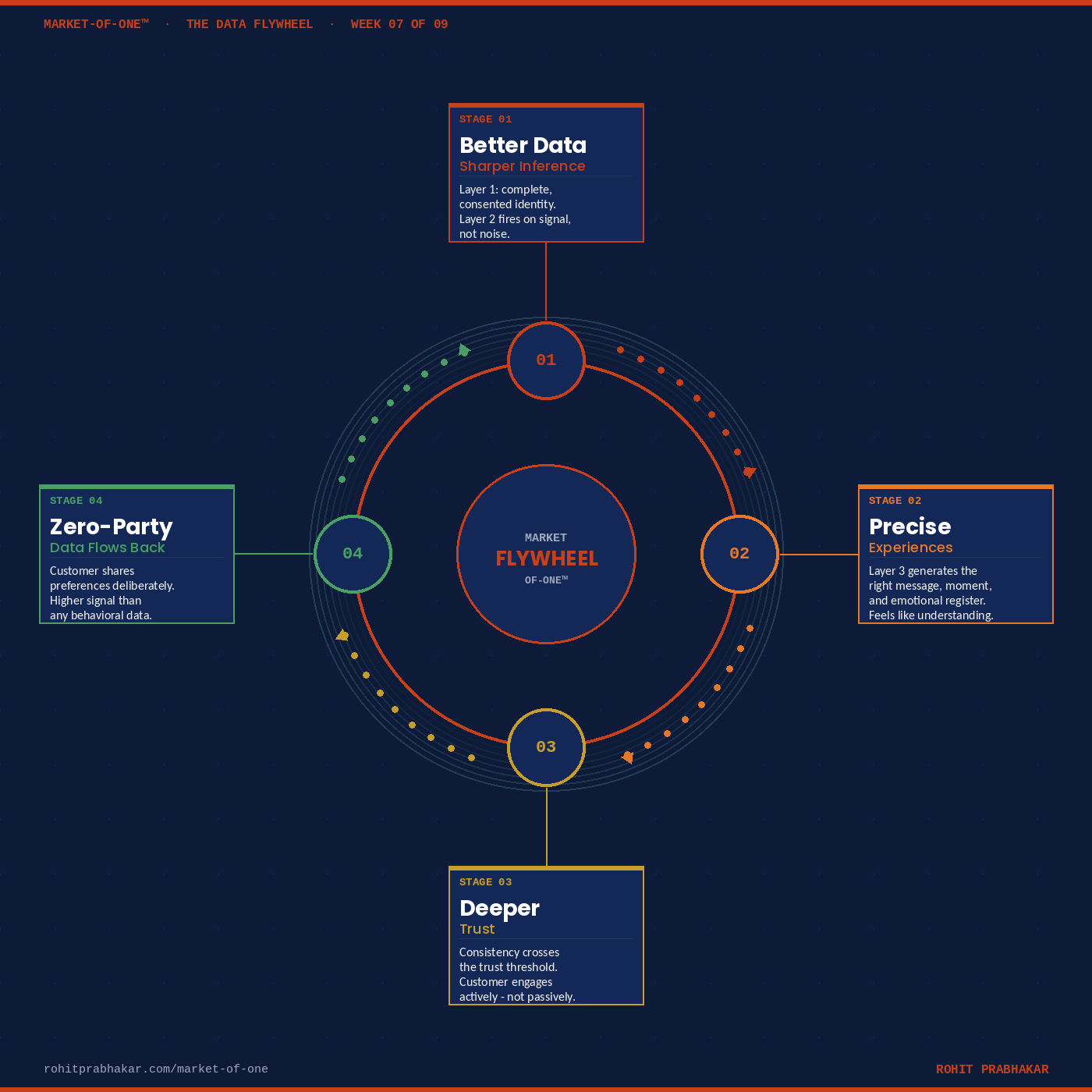
The flywheel has four stages:

The Market-of-One data flywheel - four compounding stages: better data produces sharper inference, sharper inference produces precise experiences, precise experiences build deeper trust, deeper trust generates zero-party data - Rohit Prabhakar Week 07
The Market-of-One™ data flywheel. Each cycle is more accurate than the last. The moat is the compounding inference quality earned over time – not the data itself.

Stage 01

Better Data – Sharper Inference

Layer 1 holds more complete, more consented, more recent customer identity. Layer 2 infers intent with higher accuracy. The system fires on signal, not noise. Fewer false positives. More precise moments of action.

Stage 02

Precise Experiences

Layer 3 generates experiences that are contextually accurate – the right product, the right message, the right moment, the right emotional register. The customer receives something that feels less like marketing and more like understanding.

Stage 03

Deeper Trust

A customer who consistently receives experiences that reflect their actual needs builds a different relationship with the brand than one who receives well-crafted campaigns. Trust is the accumulation of times the system got it right without being asked.

Stage 04 – The Loop Closes

Zero-Party Data Flows Back

A customer who trusts the system shares preferences deliberately. They tell you what they want. They set preferences. They complete profiles. This stated data flows back into Layer 1, sharpening the next cycle. A competitor starting today is not just behind on data. They are behind on trust. That gap widens with every cycle.

The Numbers That Make This a Board Conversation

5%

of organizations capturing AI value at scale right now

EY Global AI Study 2026

1.7x

higher revenue growth at AI-leading organizations vs peers

BCG AI at Scale 2026

3.6x

greater total shareholder return for flywheel leaders

BCG AI at Scale 2026

The 5% number is the one boards need to sit with. It is not a technology adoption curve. It is a flywheel gap. 95% of organizations are running AI experiments. 5% have the flywheel running. The 5% are pulling ahead at 1.7x revenue growth and 3.6x total shareholder return. That gap is not closing on its own – it widens with every quarterly cycle the flywheel completes.

The board question this demands is not “how many AI use cases do we have?” That is a technology adoption question. The board question is: is our flywheel running – and at what stage? If the honest answer is Stage 1 or Stage 2, you are not yet building a moat. You are building infrastructure. Infrastructure is necessary but not sufficient. The moat only forms when the loop closes – when Stage 4 feeds back into Stage 1 with real zero-party data from real customers who earned their trust with your organization specifically.

Why the Moat Is Harder to Build Than Most Strategies Acknowledge

I want to be honest about something here, because most strategy writing on this topic is too optimistic about the timeline.

The flywheel does not run from day one. It runs from the day the customer trust threshold is crossed – the day the customer’s experience of your system is good enough, consistent enough, and transparent enough that they begin to engage with it rather than tolerate it. That threshold is different for every customer, every category, and every brand. And reaching it requires getting Stage 2 and Stage 3 right repeatedly, over time, before Stage 4 activates.

Most organizations I work with are stuck between Stage 2 and Stage 3. The inference is working. The experiences are better than they were. But the trust threshold has not been crossed yet – because the system still makes enough mistakes, or still feels enough like surveillance rather than understanding, that customers are not sharing deliberately. They are not filling in preference profiles. They are not engaging with personalization features. They are receiving personalized content and accepting it passively.

Passive acceptance is not the flywheel. The flywheel requires active trust. And active trust requires three things that most personalization investments skip.

Transparency about what the system knows and why. The customer who understands that your recommendation is based on their stated preference and purchase history responds differently than the customer who does not know why they are seeing what they are seeing. The latter feels watched. The former feels understood. The difference is not technology. It is design – the explicit choice to show your work.

Consistent accuracy over time, not peak accuracy on demos. A customer who receives one precisely timed, perfectly relevant experience and then a week of noise does not cross the trust threshold. Consistency is what builds trust. Consistency requires the adjacent processes, the operational budget, and the executive ownership we covered in Week 5 and Week 6. The flywheel cannot run on a pilot. It runs on a production system, governed by someone accountable for its outputs every day.

A consent architecture that earns, not extracts. The zero-party data that powers Stage 4 of the flywheel only flows when the customer believes their data is being used for their benefit, not the brand’s. The architecture that produces that belief is not a compliance checkbox. It is a design choice that runs through every layer of the system. I will go deeper on this in Week 8.

The Organizations Already Running It

The flywheel is not theoretical. It is visible in the performance data of the organizations that built the three-layer architecture first and most completely.

Netflix built it on content. 80% of content watched on Netflix comes from its recommendation system, which generates over $1 billion in annual value through reduced churn. The inference quality – built on viewing behavior, stated ratings, and explicit preference signals – is what makes that number possible. The moat is not Netflix’s content library. Competitors can build content libraries. The moat is the inference quality built on 300 million subscribers’ viewing patterns over two decades. That is not replicable in a quarter.

Amazon built it on commerce. The recommendation engine drives an estimated 35% of total revenue. But the deeper moat is not the recommendation engine itself – it is the flywheel beneath it: purchase history feeds inference, inference drives discovery, discovery produces purchase, purchase updates history, history sharpens inference. Amazon Prime is the trust layer that closes the loop: customers who trust Amazon enough to pre-pay for the relationship share dramatically more zero-party data – search queries, wish lists, reviews, Alexa requests – that feeds every subsequent cycle.

Starbucks built it on service. Their Deep Brew AI personalization system identified that 43% of customers who purchased unsweetened iced tea had never been offered a food pairing – a gap invisible to segment-level analysis, visible only with individual-level inference. Starbucks’ moat is not its app. It is 30 million active Rewards members whose preferences, purchase patterns, and responses to personalization have been accumulating in the flywheel for years.

None of these advantages were built in a quarter. They were built over years of consistent, accurate, trustworthy experience delivery that crossed the trust threshold for enough customers to activate Stage 4 at scale. The organizations that understand this are not asking “how do we use AI in customer experience?” They are asking “how do we accelerate the flywheel’s next cycle?” Those are not the same question.

The Investor Lens

BCG’s research shows 1.7x revenue growth and 3.6x total shareholder return for AI leaders versus peers – and those numbers compound. The organizations showing 3.6x TSR are not growing linearly. They are growing faster each year because the flywheel is accelerating. For the board and for investors, the strategic question is not whether the organization has deployed AI. It is whether the flywheel is running – and what stage it is at. An organization at Stage 4 with the loop closed is worth fundamentally more than an organization at Stage 1 with impressive infrastructure, because Stage 4 produces an asset – compounding proprietary intelligence – that does not depreciate and cannot be easily replicated. BCG’s research also shows the top 5% of AI value capturers are 50% more likely to have shared business-IT AI ownership. Stage 4 does not run without the governance structure described in Week 6. The flywheel and the mandate are the same investment.

What It Takes to Actually Build This

I want to be specific about what “building the flywheel” actually requires operationally, because most strategy writing treats it as inevitable once you have the architecture. It is not. The architecture is necessary but not sufficient. Three things determine whether the loop closes.

The consent architecture has to be designed for trust, not compliance. Most organizations build consent frameworks that satisfy legal requirements. That is the floor. The ceiling is a consent architecture that the customer experiences as respectful – that explains in plain language what is collected, for what purpose, with what benefit to them, and with what right to withdraw. The organization that hits the ceiling gets zero-party data. The one that hits the floor gets passive tolerance. Only one of those closes Stage 4.

The measurement framework has to track trust, not just conversion. The flywheel is not visible in campaign metrics. It is visible in customer lifetime value trends, in the ratio of zero-party to third-party data, in preference profile completion rates, in the frequency with which customers engage with personalization features rather than ignoring them. Most organizations are not measuring these things. If you cannot measure the flywheel, you cannot manage it, and you cannot tell the board whether it is running.

The governance has to run faster than the cycle. The flywheel turns in real time. The governance that catches errors in real time – experiences that cross ethical boundaries, inference that manufactures urgency rather than removes friction, generation that feels manipulative rather than helpful – has to be equally real-time. The CMO-CDO-CIO triad from Week 6 is the governance structure. The flywheel is what it is governing. If governance runs quarterly, the flywheel’s errors compound before they are caught.

My Take for the CEO and Board

The competitive question for the next five years is not who has the best AI models. The models are commoditizing. The competitive question is who has the deepest flywheel – the most proprietary inference quality, built on the most trusted customer relationship, compounding at the fastest rate. That is a strategic asset question, not a technology question. It belongs on the board agenda, not the technology committee agenda. The organization that builds the deepest flywheel first does not just win more customers. It builds an advantage that widens with every interaction cycle, in a way that no amount of competitor investment can quickly reverse. Three years from now, the gap between the organizations that closed the loop in 2024 and 2025 and the ones that are still running pilots will not be measured in percentage points. It will be measured in customer lifetime value multiples. The time to start is not when the gap is obvious. It is now, when closing the loop is still possible before the leaders pull permanently out of reach.

Frequently Asked Questions

What is a data flywheel in AI personalization?

A data flywheel in AI personalization is a self-reinforcing cycle where better data produces sharper inference, sharper inference produces more precise experiences, more precise experiences build customer trust, and deeper trust generates more zero-party data that feeds back into the system. In the Market-of-One™ framework, the flywheel runs across all three layers: Layer 1 (data and consent), Layer 2 (inference), and Layer 3 (experience generation). Each cycle is more accurate than the last.

Is data really a competitive moat for enterprises?

Data alone is not a durable moat. Research from a16z shows that incremental data has diminishing returns, and competitors can often replicate datasets with sufficient investment. The durable competitive advantage is the inference quality built on proprietary data over time – specifically, the quality that accumulates when customer trust generates zero-party data that competitors cannot access because the trust relationship was built with you, not them.

How long does it take to build a data flywheel moat?

The flywheel moat takes 18-36 months to reach the stage where it provides defensible competitive advantage. The time-to-moat depends on how quickly the consent architecture is designed for trust, how consistently the experience delivery crosses the customer trust threshold, and how effectively zero-party data is captured and recycled into the inference layer. Organizations that began building in 2024 are already 18-24 months ahead of those starting in 2026.

What is zero-party data and why does it matter for the flywheel?

Zero-party data is information a customer shares deliberately and proactively – stated preferences, explicit feedback, completed profiles, deliberate engagement with personalization features. It is more valuable than behavioral data because it reflects stated intent rather than inferred behavior. In the flywheel model, zero-party data is the fuel for Stage 4: it flows back into Layer 1 with higher signal quality than any third-party or first-party behavioral data. It only flows when the customer trusts the system enough to engage with it actively – which is why the trust architecture is the prerequisite for a true flywheel moat.

The competitive advantage is not the data you own. It is the inference quality you have earned, compounding on the trust your customers chose to give you, in a loop your competitors cannot replicate because they were not there when the trust was built.

Next week – Week 08: The Privacy Covenant. The flywheel only runs if the customer trusts you with their individuality. That trust is earned before personalization begins – not as a result of it. Week 8 is about the consent architecture that makes the flywheel possible, the difference between compliance and covenant, and why “consent is the new data strategy” is the structural prerequisite for everything this series has argued.


Rohit Prabhakar is a Fortune 50 CMO and CDO with $1.7B+ in measurable business value across Visa, McKesson, Thomson Reuters, and FIS. Creator of the Market-of-One™ framework. MARKET-OF-ONE is a registered trademark, Serial No. 99757619.

This article was developed in partnership with AI – used as a research, brainstorming, and authoring collaborator. All frameworks, positions, strategic perspectives, and opinions are Rohit Prabhakar’s own. AI was the tool. The thinking is mine.

Filed Under: Market-of-One Tagged With: AI competitive advantage, CDO, CMO, data flywheel, Personalization, zero-party data

Copyright © 2026 · Genesis Framework · WordPress · Log in