

Customer Experience AI ownership is the most consequential org design question executives are getting wrong in 2026. The three-layer architecture works. The pilot proves it. Then the question becomes: who actually owns it? Most companies have a champion. A champion advocates. They do not carry weight. The reason 80% of customer experience AI investments stall is structural – the absence of clear customer experience AI ownership at the executive level. Here is the structure that works for the Market-of-One, where the Chief AI Officer fits in the AI ownership model, and why that role is likely to merge into hybrid C-suite titles rather than survive standalone.
In Week 5, I argued that 95% of AI pilots fail to scale because the org around them is designed for the work that existed before the pilot, not the work the pilot proves is now possible. This week, I want to name the org design decision that determines whether your customer experience AI investments produce a transformation or produce a museum piece.
The decision is who owns the customer experience AI agenda. Not who runs it. Not who sponsors it. Not who funds it. Who owns it, which means who is personally accountable when the system makes a decision that costs the company a customer, a quarter, or a regulatory finding.
One housekeeping note before I go further. In this article, “CDO” means Chief Data Officer. I will spell out “Chief Digital Officer” in full when I refer to that separate role, because the two get confused constantly and the distinction matters for the argument I am making.
I also want to be precise about scope. Enterprise AI is not one thing. Finance runs AI for fraud detection, treasury automation, and forecasting. Operations runs AI for supply chain and logistics. HR runs AI for talent matching and workforce planning. Service runs AI for case routing and resolution.
Each of those AI domains has its own AI ownership structure, its own data, its own risk profile, and its own success metric. This piece is not about all of them. It is about one specific domain: the customer-facing experience system, the Market-of-One architecture this series has been building for five weeks.
The structural argument I make here applies cleanly to that domain. Other domains need their own equivalent AI ownership triads. I will return to that distinction when I introduce the Chief AI Officer’s role below.
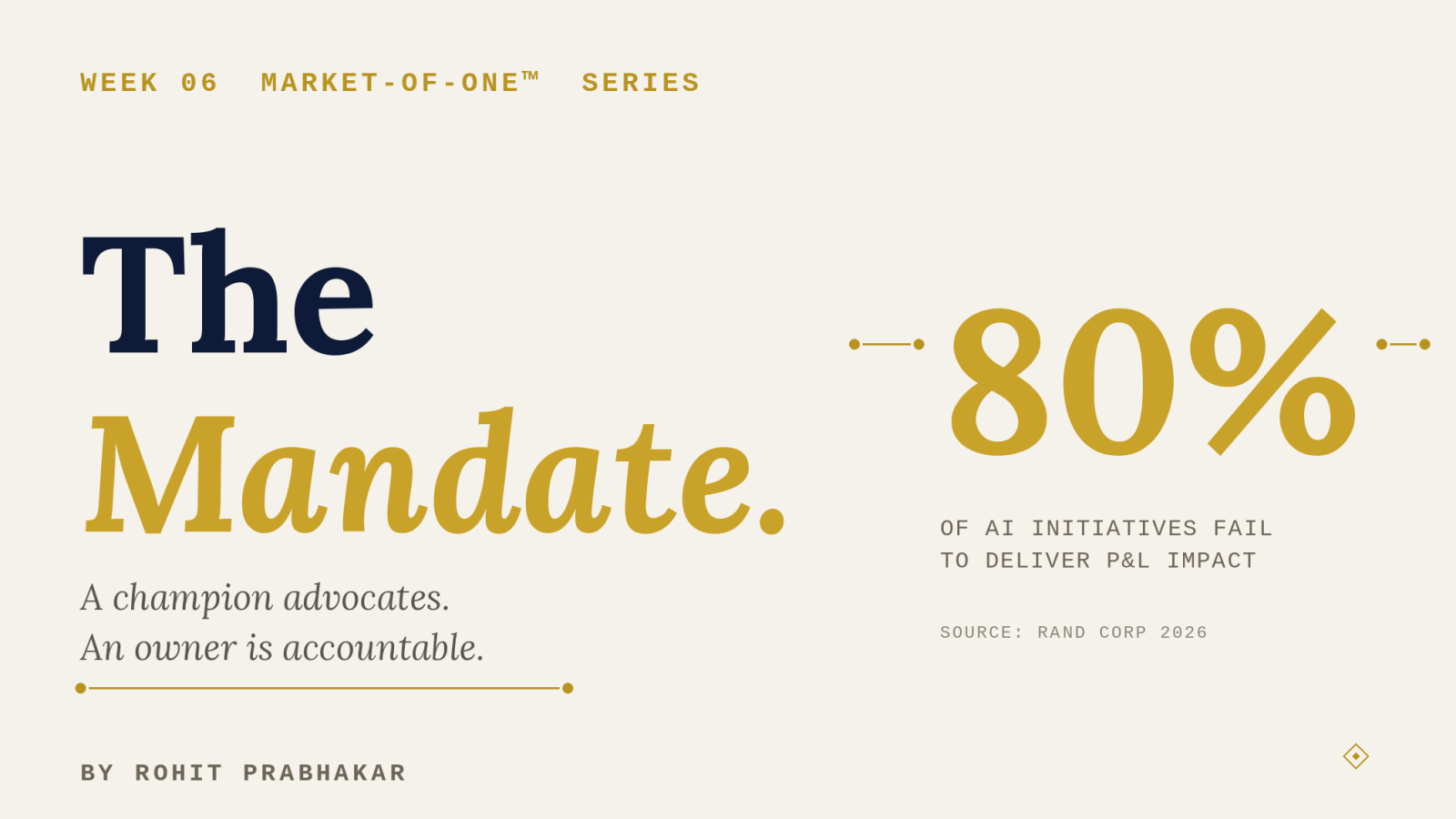
A champion advocates. An owner is accountable. The 80% failure rate on AI investments is the gap between those two words made visible at scale.
The Harvard Business Review opened its March 2026 cover essay on AI ownership with the now-familiar version of this scene: a Fortune 500 insurance CEO convened his senior team in January 2026 to settle AI ownership of the company’s AI initiatives.
The CIO claimed agentic AI rolled up to her. The COO countered that an agentic workforce was the definition of operations. The CFO noted an AI system was already making underwriting decisions with direct P&L impact. The Chief Risk Officer pointed to autonomous decision-making as a major risk exposure. The CHRO claimed AI agents as functionally equivalent to workers. The Chief Data Officer reminded everyone that the entire system depended on data permissions she controlled.
Six executives, six legitimate claims, no resolution. The meeting ended without an owner.
I have watched some version of that meeting play out at multiple organizations over the last six months. The pattern is identical. Six executives walk in with legitimate claims to AI ownership. Six executives walk out with no resolution. The CEO retreats to “we will appoint a Chief AI Officer to coordinate” or “we have a champion driving this” or, most often, silence. The pilot keeps running. The accountability stays diffused. Two quarters later, the pilot fails to scale. Nobody is fired, because nobody owned the decision.
The reason these meetings end without resolution is that the AI ownership decision is structural, not interpersonal. You cannot pick a winner from among six legitimate claims for the entire enterprise’s AI agenda, because the enterprise’s AI agenda is not one agenda. It is multiple domain-specific agendas with different owners. What you can do, and must do, is name the right AI ownership structure for each domain. This piece is about doing that for the customer experience domain.
Why customer experience AI Ownership Requires Three Executives, Not One
The three-layer architecture I introduced in Week 2 is not a metaphor. It is a description of three distinct categories of work, each with its own dependencies, governance requirements, and failure modes. No single executive has the depth across all three to govern them well. Anyone who tells you otherwise is either selling consulting or has never run all three at scale.
Layer 1 is identity, consent, and customer data infrastructure. The work is plumbing: making sure the right data, with the right permissions, gets to the right system at the right time, governed by enforceable policy. For the customer experience domain, this work belongs to the Chief Data Officer or the equivalent function. Sometimes the CIO holds it, depending on org design history.
Layer 2 is inference, models, and engineering at scale. The work is technical infrastructure: making sure the AI systems actually run reliably in production, integrate with legacy systems, scale without breaking, and fail safely when they fail. This work belongs to the Chief Information Officer or the equivalent function.
Layer 3 is generation, experience, and brand judgment. The work is commercial: making sure what the system produces reflects the brand, drives commercial outcomes, respects emotional context, and earns customer trust. For the customer experience domain, this work belongs to the Chief Marketing Officer, or Chief Customer Officer or Chief Growth Officer depending on title conventions. I want to be explicit: the CMO is the outcome owner for the customer experience system, not for the enterprise’s entire AI portfolio. Finance AI has a different outcome owner. Service AI has a different outcome owner. The triad is domain-specific, not enterprise-universal.
Three layers. Three accountable executives. One customer experience outcome. The structure is not a committee. Committees do not own outcomes. It is a triad with explicit decision rights at each layer’s boundary and shared accountability for the system’s commercial result. This is the AI ownership model that the data says works.
This is not a new idea I am proposing. It is the customer experience AI ownership structure that the data already supports. BCG’s research on the top 5% of companies deriving significant AI bottom-line value found they are 50% more likely to have shared business-IT ownership of AI operating models, with clear decision rights and accountability at each boundary. Not IT ownership. Not business ownership alone. Shared. With clarity on who decides what, and who is accountable when the system produces something it should not.
Where the Chief AI Officer Fits in the AI Ownership Model
I want to address the Chief AI Officer directly because the CAIO is the elephant in every boardroom right now, and the role is being treated as the answer to the AI ownership question. The role is being appointed at a record pace. Twenty-six percent of organizations globally now have a CAIO, up from 11% just two years ago. Forty-eight percent of the FTSE 100 have appointed one, with 65% of those appointments made in the past two years. JPMorgan, Walmart, Pfizer, Siemens, SAP, GE HealthCare. The list is growing every month.
Here is my honest take on the role, and I will say it plainly because most of the consulting class is being too polite about it.
The CAIO has a legitimate orchestration role across the multiple AI domains an enterprise runs. If your company has customer experience AI, finance AI, operations AI, service AI, and HR AI all running in parallel, which is most large enterprises by mid-2026, somebody needs to ensure standards align across domains. Somebody needs to make sure data is not duplicated five different ways, that procurement is coherent, that the EU AI Act and NIST AI Risk Management Framework get implemented consistently, and that learnings from one domain inform the others.
That is real work. The CAIO can do that work. In that role, the CAIO is a cross-domain coordinator who orchestrates triads like the customer experience one I am describing in this piece, alongside the equivalent triads in finance, operations, service, and HR. They are a peer to the domain owners, not above them. They have orchestration authority on standards, governance, and shared infrastructure. They do not have outcome authority over any single domain.
But the CAIO does not own the customer experience triad’s outcome. Nor any other domain triad’s outcome. When CAIOs are given outcome authority over a specific domain, the most common version being “drive AI strategy across the customer-facing business,” the role fails. It fails because the CAIO does not have the operational authority over the domain’s data layer, infrastructure layer, or commercial layer to make decisions stick.
They produce strategy decks. They host steering committees. They convene the same six executives the CEO already convened, who reach the same lack of resolution. Within eighteen months, the CAIO leaves or the role is restructured. Bernard Marr documented the pattern explicitly: companies create CAIO positions as standalone silos, disconnected from existing digital and data initiatives. At one financial services firm, the Chief AI Officer and Chief Data Officer independently developed competing strategies for the same business problems. Duplicated effort. Inconsistent approaches. Wasted resources.
And the role itself, as a standalone C-suite title, is unlikely to last. Not because AI fades. Because horizontal coordinator titles tend to merge or absorb rather than survive as standalone C-suite roles for long. We have seen this with the Chief Digital Officer wave of 2014 to 2018. Russell Reynolds’ 2024 Fortune 500 analysis showed the Chief Digital Officer did not vanish. It merged. Hybrid titles like Chief Digital and Information Officer or Chief Strategy and Transformation Officer now hold 19% of top tech leadership seats, while pure CIO share dropped from 68% to 49% over five years. Fifty-four percent of new tech leadership appointments since the start of 2024 carry hybrid titles. The pattern is absorption-via-merger, not disappearance. The standalone “Chief Digital Officer” peaked, then got folded into broader hybrid roles where digital became one responsibility among several.
The CAIO is on a similar trajectory. The standalone CAIO role peaks in 2026 to 2028 as enterprises feel they need a dedicated AI sponsor. By 2029 to 2031, my read is the title largely merges into hybrid roles: Chief Information and AI Officer, Chief Technology and AI Officer, or absorbed entirely into a broader transformation mandate. The orchestration function persists. The standalone title likely does not. The companies that recognize this trajectory now will design their AI ownership structure around the domain triads, with CAIO orchestration as a function rather than a permanent standalone role.
My take for the board: if your CEO is about to appoint a CAIO and the role’s charter says “drive AI strategy” with no defined cross-domain orchestration scope, you are about to spend a million dollars on a presenter who will be powerless within twelve months. Two questions to test the appointment. First, does this role have orchestration authority across the multiple AI domains the enterprise runs (customer experience, finance, operations, service, HR), or domain ownership over one specific domain? If the answer is domain ownership, restructure the role. That domain needs a triad, not a CAIO. Second, when the CAIO’s tenure ends in three to five years, which existing C-suite role will absorb the orchestration function? If you cannot answer that today, you have not designed for the role’s lifecycle. You have hired for the moment.
The Four Failure Modes of Single-Owner customer experience AI Ownership
The reason boards keep defaulting to a single-owner model for customer experience AI ownership, whether that owner is the CIO, the CDO, the CMO, or a newly appointed CAIO, is that single ownership feels cleaner. One throat to choke. One person to fire if it fails. The instinct is understandable. It is also wrong, and the failure data tells you why.
80% of AI initiatives fail to deliver intended business value (RAND Corporation, 2,400+ initiatives). 77% of AI project failures are organizational, not technical (RAND / Folio3 analysis 2026). 84% of failures are driven by leadership issues: sponsorship, alignment, and accountability gaps (industry consensus, 2026). The technology is not the bottleneck. The org design around the technology is.
Here are the four failure modes I have watched destroy more customer experience AI investments than any technology problem.
Failure mode one: the CIO-only model.
When IT owns the customer experience AI alone, the system gets built to technical specifications and runs reliably, and produces outputs that nobody in the business is accountable for. The customer experience suffers because no one with commercial judgment governs Layer 3. The brand voice is inconsistent. The emotional register is wrong. The system technically works and the business does not benefit.
Failure mode two: the CDO-only model.
When data owns the customer experience AI alone, the system gets built around what the data permits and ignores what the business needs. The data layer is pristine. Layer 2 inference is brittle because no engineering owner pushed for production-grade infrastructure. Layer 3 generation is generic because no commercial owner defined the parameters. The data is right and nothing happens.
Failure mode three: the CMO-only model.
When marketing owns the customer experience AI alone, the system gets built for the campaign calendar and the data layer is held together with duct tape. Gartner finds 65% of CMOs believe AI will dramatically transform their role within two years. Many of them respond by buying martech and standing up an AI team inside marketing, which works for a sprint and fails at scale because Layer 1 and Layer 2 are not under their authority. The pilot succeeds. The pilot does not generalize. The CMO gets blamed. The actual problem was that the CMO never had the authority over data and infrastructure to make it generalize.
Failure mode four: the CAIO-as-domain-owner model.
The most expensive failure mode I see right now. The board appoints a CAIO and gives them outcome authority over the customer experience domain (“drive AI-led customer experience” or “own the personalization transformation”). The CAIO has no operational authority over the marketing technology stack, the customer data infrastructure, or the production AI engineering. They can convene. They cannot decide. The actual decisions are still made by the CDO, the CIO, and the CMO independently, now with the added friction of a CAIO who has the title but not the authority. Within eighteen months, the role is restructured.
The investor lens: for PE and VC analyzing portfolio companies’ customer experience AI investments, the diligence question is not “do you have a CAIO?” The right question is “show me the decision rights and accountability matrix for your customer experience AI across CMO, CDO, and CIO.” If the answer is a single name with no peer accountability, the investment is at risk regardless of the technology stack. If the answer is three names with overlapping but undefined boundaries, the investment is at risk regardless of how good each leader is individually. If the answer is three names, three explicit charters, one shared P&L line, and one accountable CEO sponsor, the investment has a chance. Fortune’s March 2026 reporting found that 76% of companies with CFO-led AI got “great value” from it, but only 2% of companies do it that way. The broader point is that ownership structure, not title, predicts outcome.
The Triad in Practice: How the Boundaries Actually Work
The triad model is only useful if the boundaries between the three roles are explicit. “Shared accountability” without explicit boundaries is just three people watching each other and pointing fingers when it fails. Here is the boundary map I use when organizations stand this up for the customer experience domain.
What customer data are we allowed to use, with what consent, for what purpose? The CDO decides. The CMO and CIO are consulted. Legal is a partner, not a tiebreaker.
Which AI models run in production, on what infrastructure, with what failover and monitoring? The CIO decides. The CDO and CMO are consulted on input and output requirements.
What is the system allowed to say to the customer, in what tone, in what context, against what business metric? The CMO decides. The CDO and CIO build to those parameters, not around them.
When does a model get retrained, retired, or escalated? What triggers a stop? The CIO decides on technical thresholds. The CMO decides on commercial thresholds. The CDO decides on data thresholds. Three triggers, any one stops the system.
Who is accountable to the board when the system produces an outcome it should not have? All three. Joint accountability with one named CEO-level sponsor, typically the COO or CEO directly.
What is the single P&L metric the customer experience AI is accountable to? One number. Owned by the CMO. Tied to a commercial outcome (LTV, NRR, cost-to-serve), not a vanity metric.
If a CAIO exists, what do they decide? Cross-domain standards, shared governance, AI Act compliance, procurement coherence. Not customer experience outcome.
The discipline of this matrix is what most organizations skip. They name three executives, hold a kickoff meeting, declare shared ownership, and then watch the boundaries dissolve within a quarter. The boundaries dissolve because nobody wrote them down with the specificity required to enforce them. The triad model only works if the CEO writes the matrix down, signs it, and uses it to settle the first three boundary disputes that come up. Because there will be three boundary disputes in the first ninety days.
Why AI Ownership Is a CEO Decision, Not a CMO/CDO/CIO Decision
Here is the part that most boards are missing. The customer experience triad is not an AI ownership decision the three executives can make on their own. It requires a CEO mandate because it requires redistributing decision rights that currently sit in one of three places, and the loser of that redistribution will resist unless the CEO is the one making the call.
If the CIO currently controls the data infrastructure budget and the CDO needs explicit decision rights over data permissions for the customer experience system, the CIO is going to push back unless the CEO has signed off. If the CMO controls the marketing technology budget and the CIO needs decision rights over the marketing AI stack to ensure operational reliability, the CMO is going to push back. If Legal currently approves data use case-by-case and the CDO is taking a structural authority over consent architecture, Legal is going to push back. None of these pushbacks are illegitimate. They are the predictable consequence of any redistribution of authority.
The CEO’s job is to make the AI ownership redistribution explicit, defend it publicly, and intervene when the boundaries are tested in the first ninety days. McKinsey’s April 2026 AI Transformation Manifesto stated the requirement directly: there is no success story where senior business leaders were not in the driver’s seat. The CEO is the senior business leader in the driver’s seat for the AI ownership decision. Not the CAIO. Not a steering committee. The CEO.
You can delegate the work of building the AI architecture. You cannot delegate the AI ownership decision. That decision is the most consequential customer experience org design decision a CEO will make in the next three years.
The reason this matters now, with urgency, is that the cost of getting it wrong is compounding. Every quarter the triad is not in place is a quarter where customer experience AI pilots are running without a structure that can absorb their lessons. The pilots burn budget. The pilots produce demos. The pilots do not produce transformation. Hyperscalers are on track to spend $675 billion on AI infrastructure in 2026, up 63% from the prior year. Virtually every major enterprise in America is buying AI. The question almost none of them can answer is whether it is working. The reason most cannot answer is that nobody owns the answer. The triad is the structural decision that creates an answer.
The Three AI Ownership Decisions a CEO Must Make
If you are a CEO reading this, here is the practical customer experience AI ownership action. Three decisions, in this order.
Decision one: name the customer experience triad publicly. Not in a memo. In an all-hands. Three names, three layers, one shared customer experience outcome. The public commitment is what forces the org to take it seriously. A private decision communicated through HR will be ignored within a quarter. A public commitment with three named executives is harder to walk away from when the first boundary dispute hits.
Decision two: write the boundaries. The matrix above is the starting point. Customize it for your business. Have each of the three executives sign it. The signature is not symbolic. It is the artifact you go back to when one of them tries to expand their authority into another’s domain. Without a signed matrix, you do not have a triad. You have three executives with overlapping ambitions.
Decision three: tie one P&L metric to the triad. Not three metrics. One. Customer lifetime value, or net revenue retention, or cost-to-serve, whichever metric most directly reflects the value of the customer experience AI investment in your business model. All three executives are accountable to that one number. Gartner’s April 2026 research on AI ROI failures found that the 20% who succeed share one trait: they embed AI into the systems and processes people already use, with one accountable owner per use case and a single business metric tied to outcome. Without a single shared metric, the triad will optimize three different things and the system will incoherently drift.
My recommended first 90 days. Weeks 1 to 2: CEO names the customer experience triad publicly. Weeks 3 to 4: triad members and Legal/HR draft the decision rights matrix. Weeks 5 to 6: CEO signs the matrix. All three triad members sign. Distributed to direct reports of all three. Weeks 7 to 8: one commercial P&L metric agreed and locked. The current customer experience AI pilots are mapped against the matrix; any pilot that does not have a clear owner under the new structure is paused, restructured, or killed. Weeks 9 to 12: first boundary dispute happens (it will). CEO uses the signed matrix to settle it publicly. That settlement is the moment the triad becomes real. Without that moment, you have a memo, not a structure.
What the Triad Is Not
Three clarifications, because I have seen all three misinterpreted.
First, the triad is not a permanent committee structure. It is an accountability and decision-rights structure. The three executives do not need to meet weekly. They need clear boundaries, a shared metric, and a CEO who enforces both. The work happens inside each function. The coordination happens at the boundary disputes, which should be infrequent if the matrix is well-written.
Second, the triad is not a denial of the CAIO role. It is a clarification of where the CAIO does and does not have AI ownership authority. If your enterprise has a CAIO, that role orchestrates standards across the multiple AI domains (customer experience, finance, operations, service, HR) and ensures coherence on governance, compliance, and shared infrastructure. The CAIO is a peer to the customer experience triad’s three members, not above them. They do not own the customer experience outcome. The CMO does.
Third, the triad is not a universal enterprise AI ownership model. It is the right structure for the customer experience domain, the Market-of-One architecture this series has built. Other AI domains in your enterprise need their own equivalent triads, with different owners suited to their specific layer responsibilities. Finance AI ownership will look different. Operations AI ownership will look different. Service AI ownership will look different. The principle (three accountable executives, explicit decision rights, one shared outcome metric, one CEO sponsor) is the same. The named roles are not.
Why the Next Two Years of AI Ownership Decisions Matter More Than the Last Twenty
The customer experience triad is the most consequential customer experience AI ownership decision a CEO makes in the next three years because it is the decision that determines whether the customer experience AI investments of 2024 to 2026 produce a competitive advantage in 2027 to 2029, or produce a balance sheet write-down and a strategy reset.
The companies that get this AI ownership decision right will spend the next two years compounding learning. Their pilots will scale. Their data will accumulate. Their models will improve. Their experience generation will get sharper. The flywheel I described in Week 4 will start turning, and it compounds. Better data produces better inference produces better generation produces more trust produces more zero-party data produces sharper inference. That loop, running for two years inside an organization that has the AI ownership triad in place, produces a moat that competitors cannot close in a sprint.
The companies that get this AI ownership decision wrong will spend the same two years stuck in pilot purgatory. They will have written checks for AI infrastructure they cannot operationalize, hired CAIOs whose mandates expire before their tenure does, and accumulated organizational scar tissue from boundary disputes that nobody had the authority to settle. By 2028, the gap between the two groups will be the topic of every business school case study and every board postmortem.
That gap is the moat I will write about next week.
The AI Ownership Mandate, In One Sentence
Every company has a champion for customer experience AI. Almost none have a triad with the customer experience AI ownership decision rights to redesign the customer-facing operating model around it. That single AI ownership decision is what separates the 20% that capture customer experience AI value from the 80% that write it off.
Next Week, Week 07
The New Moat. For thirty years, the strategic question has been “what data do you own?” In the Market-of-One, that question is obsolete. The moat is no longer data. It is understanding, the system that turns data into individual context fast enough that competitors cannot replicate it. Week 7 is about why the next decade’s defensible advantages will not look like the last decade’s, and what the architecture of a real moat actually contains.
This article was developed in partnership with AI, used as a research, brainstorming, and authoring collaborator. All frameworks, positions, strategic perspectives, and opinions are Rohit Prabhakar’s own. AI was the tool. The thinking is mine.
