

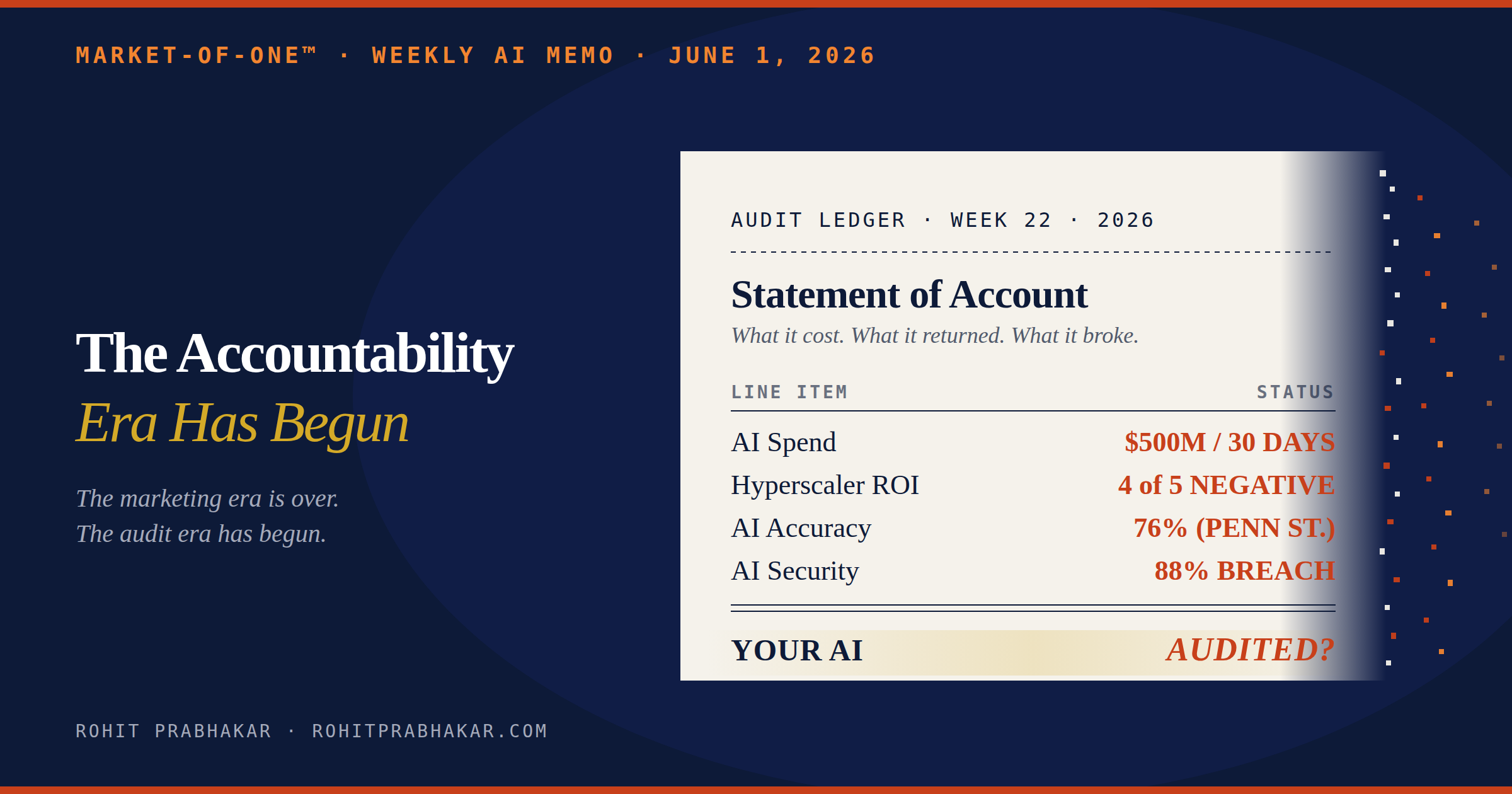
This week reminded me of the early cloud days. Everything, including my cleaning service, was “moving to the cloud” and no one could explain the ROI yet. Same pattern. Different decade! It marks the beginning of the AI Accountability Era.
Five weeks ago, bills came due for builders in the Reckoning Era. Four weeks ago, for buyers in the Consumption Era. Then AI was embedded in workflows in the Embedment Era. Then the channel became the moat in the Distribution Era. Last week, Fortune 500 operations began rolling back AI in the Reality Era.
This week, the next layer arrived. The CFO showed up. For two years, engineering set AI spend. This week, finance took it back. The evidence stacked up in seven days: One enterprise client racked up $500 million in Claude charges in 30 days. No governance. No spend caps. Just employees burning tokens. Gary Marcus published the chart that ends the debate: only Amazon clears positive AI ROI through 2030. Every other hyperscaler is negative. Amazon turned its internal AI into a wholesale product. Kate Spade is the first competitor to buy it.
Anthropic closed at $65 billion at a $965 billion valuation on $47 billion in annualized revenue. It now sits ahead of OpenAI.
Three independent audits landed in the same week. Costco’s CEO told 341,000 employees that AI has not displaced any of them. Penn State scored AI at 76% accuracy on health questions, with error rates double those of physicians. Cisco showed that every frontier model fails multi-turn attacks, with success rates up to 88%.
Different stories. One truth. The marketing era is over. The audit era has begun.
CFOs are now demanding the same accountability from AI that they demand from any other line item. The question is no longer how much AI is worth. It is whether you can explain what yours cost, what it returned, and what it broke.
Welcome to the AI Accountability Era.
3 Questions for the Board This Week
- The Spend Question: What is our actual AI consumption by team, by use case, and by month? Could it produce a $500 million surprise if left unmonitored for 30 days? (Tom’s Hardware via Axios)
- The Vendor Question: Supply just expanded. Anthropic passed OpenAI. Amazon is wholesaling. Microsoft is building in-house. GPU rental prices fell 30%. Are we renegotiating our AI contracts in the next 90 days, or are we paying last quarter’s prices? (Anthropic, CNBC)
- The Audit Question: What independent audit have we run in the last 90 days on AI accuracy, security, and workforce impact? Do we trust the result more than our vendors’ claims? (Cisco)
The Signals: Why These Questions Matter Now
1. A Single Enterprise Ran Up a $500 Million Claude Bill in 30 Days. The CFOs Are Now in the Room.
The News: An unnamed enterprise customer racked up roughly $500 million in Anthropic charges in 30 days. The company rolled out Claude with no governance controls and unlimited employee access (Tom’s Hardware via Axios). Token-heavy agentic workflows consume up to 1,000 times more tokens than standard chatbot queries. Analysts called the incident “one of the costliest IT governance failures on record.”
Three data points landed the same week.
DealBook published Niko Gallogly’s piece on Uber’s blown 2026 AI budget. The supporting Ramp index data showed AI token spend up 13x across 50,000 companies since January 2025 (New York Times DealBook). Microsoft canceled most of its Claude Code licenses on cost grounds and pushed engineers to GitHub Copilot CLI. Clay’s CFO Karan Parekh now requires written approval to exceed token spend thresholds.
Gary Marcus published “What comes after tokenmaxxing” backed by a Financial Times chart. The headline finding: only Amazon clears positive AI ROI through 2030. Microsoft sits at minus 9.2%. Alphabet at minus 15.7%. Meta at minus 28.8%. Oracle at minus 35.6%. Nvidia H200 GPU rental prices fell 30 to 40% in late May as supply expanded.
Strategic Insight: This week reminded me of the early cloud days. The era when engineering could spend whatever it wanted on tokens just ended.
Six months ago, Jensen Huang told the world his $500,000 engineers should burn $250,000 a year on AI tokens. That framing collapsed this week.
The $500 million bill is the headline. The structural shift is bigger.
Hyperscaler ROI is publicly negative through 2030 on four of the five major players. GPU rental prices are falling. The scarcity premium that justified the bills was overstated.
Microsoft cutting Claude Code licenses is the canary. When the largest software company on earth decides its own AI tool is more cost-effective than the leading frontier model, every CFO can ask the same question.
The Accountability Era runs on one premise. AI is now a line item like any other. Engineering does not get to spend without finance.
Board Reality: The CFO needs a real AI consumption dashboard in 30 days. Not a slide. Not a vendor-supplied report. A real-time view of token spend by team, by use case, by month. Monthly cost ceilings. Approval workflows over thresholds. Quarterly ROI reviews against the original business case.
The cloud era gave us FinOps as a discipline. The AI era needs the same thing, faster. The cost of building it is $50,000 of internal effort. The cost of not building it is what happened to the $500 million customer.
2. Amazon Wholesales Its AI. Anthropic Passes OpenAI. Microsoft Builds In-House. The Vendor Market Just Restructured.
The News: Three vendor-side moves landed in five days. They change the buyer landscape materially.
On May 27, Amazon began selling its e-commerce AI to other retailers via AWS, including direct competitors (CNBC). The tool, rebranded from Rufus to Alexa for Shopping, used to be a walled Amazon advantage. Kate Spade is the first announced external customer. Other retailers are testing now. This is the textbook Amazon playbook applied to AI: build internally, then monetize as a service at scale. Same pattern as AWS itself in 2006.
One day later, Anthropic announced a $65 billion Series H at a $965 billion valuation (Anthropic, Fortune). Altimeter, Dragoneer, Greenoaks, and Sequoia led. Anthropic now sits ahead of OpenAI’s $852 billion March valuation.
CFO Krishna Rao disclosed annualized revenue crossed $47 billion in May, up from $14 billion in February and $30 billion in April. Business clients are 80% of revenue. Over 300,000 firms use Claude. Claude Code alone is at $1 billion annualized. KPMG integrated Claude across 276,000 employees on May 19. Anthropic opened Milan on May 27 and appointed a Korea Representative Director ahead of a Seoul office.
Next week, June 2-3, Microsoft will unveil in-house AI models at its Build conference in San Francisco (Seeking Alpha). The line-up reportedly includes a coding model aimed directly at Cursor and Claude Code, plus transcription, reasoning, speech, and image models. Microsoft is now moving toward independence from OpenAI, which it still owns 49% of. Microsoft shares rose 3% on the report.
Strategic Insight: The AI vendor market restructured in seven days.
A year ago, Fortune 500 buyers had one realistic frontier model decision. Today they have four wholesalers.
Amazon is now in the AI services business. Anthropic surpassed OpenAI and is opening enterprise offices at the pace of a global consulting firm. Microsoft is building independently from its biggest AI investment. OpenAI itself is preparing for an IPO.
This is the exact moment in any technology category when buyer leverage peaks. Supply has expanded faster than demand. CFOs and CIOs who renegotiate in the next 90 days will get terms that customers in the next 180 days will not.
Board Reality: Procurement, the CIO, and the General Counsel need a vendor strategy refresh this quarter. Three actions.
First, audit every multi-year AI contract for renegotiation leverage given the new supply landscape.
Second, evaluate Amazon’s wholesale AI as a procurement option in retail, e-commerce, and customer service.
Third, watch Microsoft Build June 2-3 for the in-house alternative that may displace your current vendor mix for routine engineering work.
3. The Audit Stack Hit at Once: Costco CEO, Penn State 76%, Cisco 88%
The News: Three independent audits landed in seven days. Each contradicted a piece of the prevailing AI narrative.
Costco CEO Ron Vachris told the Economic Club of Chicago that AI has not displaced any of Costco’s 341,000 employees (Fortune). AI operates in “supportive capacity” across pharmacy, gas stations, accounting, and IT. Direct pushback against Meta, Amazon, and Microsoft using AI to justify layoffs. Vachris said displaced workers move “into more strategic roles as the business grows faster.”
Penn State published a peer-reviewed study evaluating AI chatbots against nine board-certified physicians. The setup: 212 health-related prompts. The finding: AI scored 76.2% accuracy. Error rates ran roughly double those of human physicians (EurekAlert). Internal medicine, neurology, and dermatology had the lowest accuracy and highest harm scores. The researchers’ conclusion: AI works best supporting trained physicians, not replacing them.
Cisco published research showing multi-turn iterative attacks succeed against every major frontier model, with success rates up to 88.3% (xAI Grok 4.1 Fast) (Cisco). Even Anthropic’s Claude family reached 16.2% under sustained iterative attack. Cisco’s verdict: enterprises should not trust vendor safety claims. The vulnerability is “a structural property of how current AI models work.”
Strategic Insight: The audit layer caught up to the marketing layer this week.
A CEO of one of the world’s largest employers said AI has not replaced anyone across 341,000 people.
The largest peer-reviewed academic study to date said consumer AI gets 20% of health questions wrong.
The largest enterprise networking vendor on earth said no frontier model is safe.
Each finding alone is manageable. Combine them with the $500 million Claude bill and the negative ROI chart, and you have the foundation for accountability conversations that did not exist 30 days ago. The marketing claims have a measurement problem. The measurement just landed.
Board Reality: The Chief AI Officer, CISO, and CHRO need a joint independent-audit program this quarter. Three deliverables.
AI accuracy audit, benchmarked against human baselines in any regulated function. Healthcare, finance, legal.
AI security audit, using multi-turn attack methodology. Not vendor self-reports.
AI workforce impact audit, measured against actual headcount. Not vendor-projected savings.
Costco just demonstrated that public, honest reporting of AI workforce reality is now an executive option, not a liability.
3 Strategic Actions for This Week
- Stand Up the AI Consumption Dashboard. CFO + CIO + CAIO. Real-time spend by team, use case, and month. Monthly cost ceilings. Approval workflows over threshold. Quarterly ROI reviews against original business case. Due in 30 days. Think FinOps for AI. The cost of building this is trivial. The cost of not building it just hit $500 million at one company.
- Run the Vendor Renegotiation Sprint. Procurement + General Counsel + CIO. Every multi-year AI contract on the table this quarter. Supply has expanded. Prices have dropped. Buyer leverage maximizes in this window.
- Commission the Independent Audit Triplet. CAIO + CISO + CHRO. AI accuracy audit. AI security audit using multi-turn attack methodology. AI workforce impact audit. External auditors. Sanitized version published to the board.
On My Desk This Week
- Brian Merchant on Anthropic and the Vatican (bloodinthemachine.com, May 29): The contrarian read on the $965 billion story. Merchant argues Anthropic engineered “AI ethics slop” through the Pope’s encyclical days before the $65 billion round closed. Whether you agree or not, your board will hear this argument within 30 days. Read it first.
- Pope Leo XIV, encyclical “Magnifica Humanitas” (vatican.va full text, released May 25): The first papal encyclical on AI. The largest institution on earth defining human dignity in the AI era. Drawing the parallel to Rerum Novarum (1891) on industrial labor. Read it on its own merits before it gets quoted at you.
- CodeRabbit, “State of AI vs Human Code Generation” (Business Wire summary, Dec 2025): Still the most rigorous public benchmark on AI code quality. 470 GitHub PRs analyzed. AI-generated code introduces 1.7x more issues overall. Security vulnerabilities 1.5 to 2x higher. Readability problems 3x higher. The data your CIO needs before signing any AI coding tool contract.
- NextEra-Dominion Energy $67 billion merger (SEC announcement, May 18): The largest US regulated utility merger in history, framed explicitly around meeting electricity demand from AI data centers. Creates the world’s largest regulated electric utility. The energy layer is now part of the AI stack. Read with your CFO before the next capex conversation.
- White House scrapped planned AI safety executive order (NBC News, May 21): The signing of a new AI executive order was abandoned at the last minute after tech CEOs and former WH AI czar David Sacks called the President directly. The order would have established federal review of frontier AI models before release. Federal AI safety governance just became industry self-regulation by default. Whatever your politics, the regulatory vacuum is real. Read with your General Counsel.
- IBM Institute for Business Value, 2026 CEO Study (IBM newsroom, May 4): 2,000 CEOs across 33 countries. 79% decentralizing decisions. 77% saying talent and technology leadership roles are converging. 76% of organizations have a Chief AI Officer (up from 26% in 2025). The research behind Nadella dissolving the Microsoft SLT last week. Read it before you defend your current org chart.
- Alibaba Qwen3.7-Max tops Code Arena (TechTimes, May 20): Fourth globally on Code Arena with 1,541 points. Only Anthropic’s Claude models rank higher. The remaining four top spots are all Anthropic. Qwen3.7-Max ran autonomously for 35 hours executing 1,158 tool calls in Alibaba’s internal demo, writing software for Alibaba’s own AI chip. The sovereign AI thread we have tracked since the Distribution Era keeps compressing. Worth a 10-minute read on the geopolitical implications of your AI vendor stack.
Bottom Line
Wall Street prices AI at $3.7 trillion. Anthropic just passed OpenAI at $965 billion on $47 billion in annualized revenue. Amazon is selling its AI to its own competitors.
In the same seven days:
One enterprise customer ran up $500 million in unbudgeted Claude charges. The FT published the chart showing four of five hyperscalers have negative AI ROI through 2030. A Fortune 100 CEO said AI has not displaced any of his 341,000 employees. An academic study said consumer AI is half as accurate as a physician. The world’s largest network vendor said no frontier model is safe.
The marketing era is over. The audit era has begun.
If your board is still asking how much to invest in AI, you are asking last quarter’s question.
The right question is whether you can defend what you have already spent, prove what it returned, and explain what it broke.
The Accountability Era is here. The companies that survive it will be the ones whose finance, security, and HR functions get the same seat at the AI table that engineering has had for two years.
The ones that do not will discover their $500 million surprise the way that one Anthropic customer just did.
This memo is part of the Market-of-One framework.
Connected reading: Reckoning Era | Consumption Era | Embedment Era | Distribution Era | Reality Era
The Growth Architecture Memo is a private weekly briefing shared with a tight circle of enterprise leaders navigating the operational and economic realities of AI. If you were forwarded this, join the architects reading along every week.
[Subscribe -> https://www.rohitprabhakar.com/newsletter/]
Disclaimer: AI used for content and creative
