

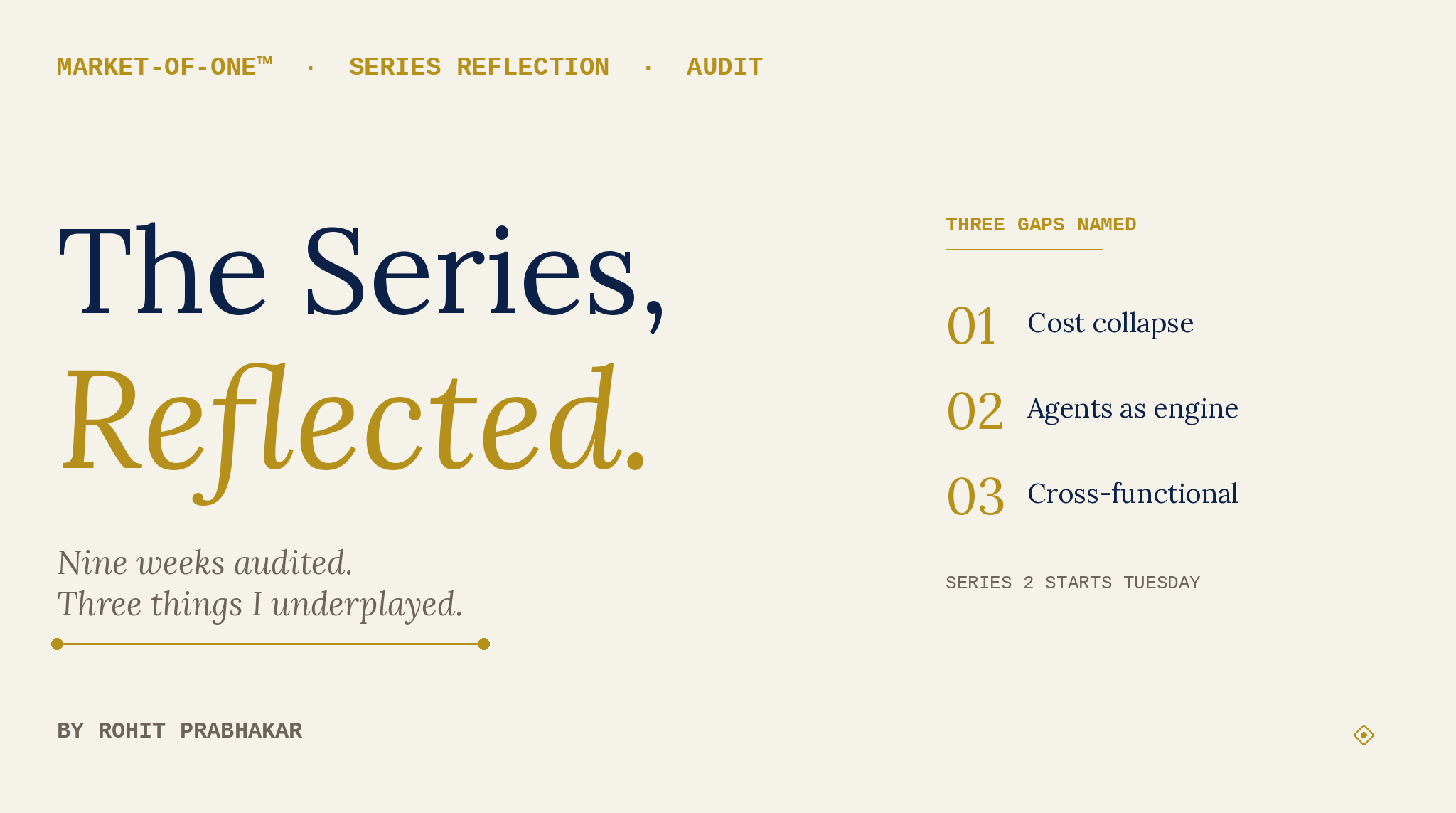
Nine weeks ago I started writing a series called Market-of-One. The argument was that the thirty-year-old promise of personalization had stayed broken because every enterprise had been treating a system problem like a component problem. Eight components, eight failure modes, one operating system to connect them, and a named destination called Customer Singularity. Last week the finale shipped.
This is the reflection post. What the series got right. What I underplayed. And what I am writing next, starting Tuesday.
I am writing this for one reason. A reader pushed back on me last week with a copy of my own original dirty thesis – the rough scribble I wrote before any of the nine essays existed. They asked, fairly, whether the series carried that thesis intact or whether it drifted. I sat with the question. The honest answer is: mostly carried, with three real gaps. Naming those gaps publicly is more useful to you than pretending they were not there.
What the series got right
The system framing held. Across nine weeks, the argument that Market-of-One is an operating system – not a campaign, not a platform, not a CMO project – was the load-bearing claim, and the data kept reinforcing it. Microsoft’s 2026 Work Trend Index landed mid-series with a number that could have been the title of the entire run: 58% of AI users produce work that was impossible a year ago, but only 19% sit in an organization that can capture it. The capability is ready. The organization is not. That is the whole series in one sentence.
The five-layer stack held. Data foundation, intelligence, generation, organizational design, and the covenant. Real practitioners pushed back on whether organization belongs in a technology stack and whether the covenant is structural or topical. Both objections sharpened the argument rather than weakened it. The triad of CMO, CDO, and CIO sharing one P&L number turned out to be the most-quoted line of the series.
The named concepts held. The Mandate (Week 6) gave readers language for the ownership vacuum. The Compounding Loop (Week 7) reframed the moat conversation away from data assets toward duration. The Surveillance Tax (Week 8) gave CFOs a number for trust failure. And Customer Singularity, the finale’s destination, gave the whole series an end-state name that travels.
ARCA, the deployment model, anchored the practical handoff. The five-dimension Assess diagnostic – data readiness, customer intelligence, agent architecture, organizational alignment, governance – turned the philosophy into something a leadership team can actually score themselves against on a Monday morning. Several CDOs have already told me they ran the diagnostic with their executive teams within a week of the finale. That was the point.
What I underplayed
Three gaps. Each one is in the original dirty thesis. Each one got softer than it should have over nine weeks of writing.
Gap 1. The cost collapse. The original thesis had three economic facts at its core. The technology is ready. The technology is no longer expensive. Generative AI and agents do at low marginal cost what teams previously did at high fixed cost. The series carried the first one loudly. The second and third I left implicit, and “implicit” is not the same as “stated.”
For thirty years, true personalization had a cost curve that made it infeasible. Serving one customer perfectly was expensive. Serving a million identically was cheap. Everything in between was a compromise called segmentation. What changed is not just that the technology arrived. What changed is that the curve flattened. The marginal cost of serving one customer as a genuine market of one collapsed toward the marginal cost of serving them in aggregate. That is the actual reason Market-of-One is now possible, and it deserved to be said in Week 1, not held back for the Customer Singularity payoff in Week 9.
If a reader stopped at Week 5, they had no clear understanding that I believed this was now economically viable. That is on me.
Gap 2. Agents as the operative engine. My deployment model is literally called the Agentic Revenue and Customer Architecture. Agents are in the name. They are foregrounded on the ARCA page. They are central to how the system actually runs.
In the nine-week series, they were not. Weeks 2 through 7 could have been written before the agentic AI wave and would read the same way. I described intelligence layers, generation layers, real-time decisioning. I did not describe what makes those layers different in 2026 than they were in 2022, which is that agents now do the work of full team functions and they do it autonomously, continuously, and cheaply. That is not a minor distinction. That is the entire mechanism by which the cost collapse becomes operational.
The series was an architecture argument when it should have been an architecture-plus-agency argument. Same conclusion, weaker mechanism.
Gap 3. Cross-functional scope. The original thesis named four functions explicitly: marketing, sales, customer service, and product. Each one treats every individual as a market. Each one builds experiences for that person. The conviction is cross-functional.
The nine-week series read as a CMO-and-CDO series. That was a deliberate choice for the primary audience, but it shrank the original conviction. The triad I named is CMO-CDO-CIO, which excludes the heads of sales, service, and product who are equally accountable for whether Market-of-One is real for the customer. A VP of sales reading the series did not immediately see themselves in it. Same for service. Same for product.
Market-of-One is not a marketing argument. It is an enterprise argument. The series spoke loudest where the audience overlap was highest. That is a publishing choice, not a conviction.
What I am writing next
Starting Tuesday, four new essays. The new series is called Market-of-One in Practice. One function per essay, four weeks total.
Week 1, Marketing. What Market-of-One actually looks like when the marketing function runs on it. Not segmentation with better data. Not personalization with first-name tokens. The marketing operating model when every individual is the market.
Week 2, Sales. The sales organization when every account becomes a unit of one and every individual buyer inside that account becomes a unit of one within the unit. Pipeline shifts. Compensation shifts. Forecasting shifts.
Week 3, Service. Customer service in the agentic era when every resolution is built for the human in front of you and not the ticket category. The shift from average handle time to average outcome per individual.
Week 4, Product. The hardest essay to write, and the one I am most looking forward to. When the product itself is built for the individual, not for the average user. The end of cohort analysis. The beginning of product-of-one.
Each essay will land the three gaps from this reflection inside its functional argument. The cost collapse will be explicit in every one. Agents will be the operative mechanism, not the implied background. And every essay will speak directly to its function leader, not orbit the CMO chair.
If the first series argued the philosophy, the system, and the destination, the second series argues the practice. Same conviction. Different audiences. Each essay built so that a head of marketing, head of sales, head of service, and head of product can each pick up the one that is theirs and recognize their own function in it.
What the reflection itself is for
I am writing this for two reasons that matter to me, and one that matters to you.
To me: I do not want to be the executive who publishes a series, takes a victory lap, and then quietly moves on. The most useful thing I can do as a writer is be specific about what I would say differently. The audit was honest. The gaps were real. Naming them is more useful than hoping nobody noticed.
To me, second reason: the only way the next four essays carry the original conviction with full force is if I publicly admit where the first nine softened it. Otherwise I am writing in the same gear.
To you: if you are running a Market-of-One transformation right now, the gaps in the first series are the gaps that will quietly creep into your own internal pitch. Cost collapse will not be in your deck. Agents will be referenced but not centered. The conviction will be marketing-shaped instead of enterprise-shaped. Catch yourself on these. Your internal stakeholders need to hear all three, loudly, the way the original thesis stated them.
Nine weeks built the philosophy and the system. Four weeks will build the practice. The conviction was never about marketing. It was always about treating every individual as a market across every function that touches them.
That is the Market-of-One thesis. Carried, sharpened, and now properly named.
Series 2 starts Tuesday. Marketing first. Read the original nine-week series at rohitprabhakar.com/market-of-one. The ARCA deployment model and the maturity diagnostic are at rohitprabhakar.com/arca.
This article was developed in partnership with AI used as a research, brainstorming, and authoring collaborator. All frameworks, positions, strategic perspectives, and opinions are my own. AI was the tool. The thinking is mine.
