

Week of June 8, 2026 | Signals from June 1 – June 7 For leaders who need signal, not noise.
This week, the Accountability Era memo I sent Tuesday got reactions from CFOs I have never met. Every single response asked the same follow-up: if AI vendors are now trillion-dollar companies, who actually controls them? That question turned into this week’s memo – AI Sovereignty Era.
Six weeks ago, the bills came due for builders in the Reckoning Era. Five weeks ago, for buyers in the Consumption Era. Then AI got embedded in workflows in the Embedment Era. Then the channel became the moat in the Distribution Era. Then Fortune 500 operations started rolling AI back in the Reality Era. Last week the CFO arrived in the Accountability Era.
This week the next layer arrived. The question of who owns what.
Three competing claims of AI sovereignty hit in seven days.
On Monday, Anthropic confidentially filed for an IPO targeting a valuation north of one trillion dollars. On Wednesday, Anthropic published a blog post calling for a coordinated global pause in frontier AI development. The same week. The same company. The same founders.
On Wednesday, NOTUS broke the story that senior US officials are in preliminary talks with major AI companies about the federal government acquiring equity stakes. On Thursday, President Trump confirmed it. Sam Altman has been pitching this idea to Trump since early 2025. Anthropic is publicly not part of the conversation, having clashed with the administration in February when it refused to let the Pentagon use its AI without safety guardrails.
On Tuesday at Microsoft Build, Satya Nadella unveiled seven new in-house MAI models. MAI-Code-1-Flash competes with Claude Code. MAI-Thinking-1 matches Claude Opus 4.6 on the toughest coding benchmark. The largest single customer of OpenAI on earth just announced it is building its own way out of that dependency.
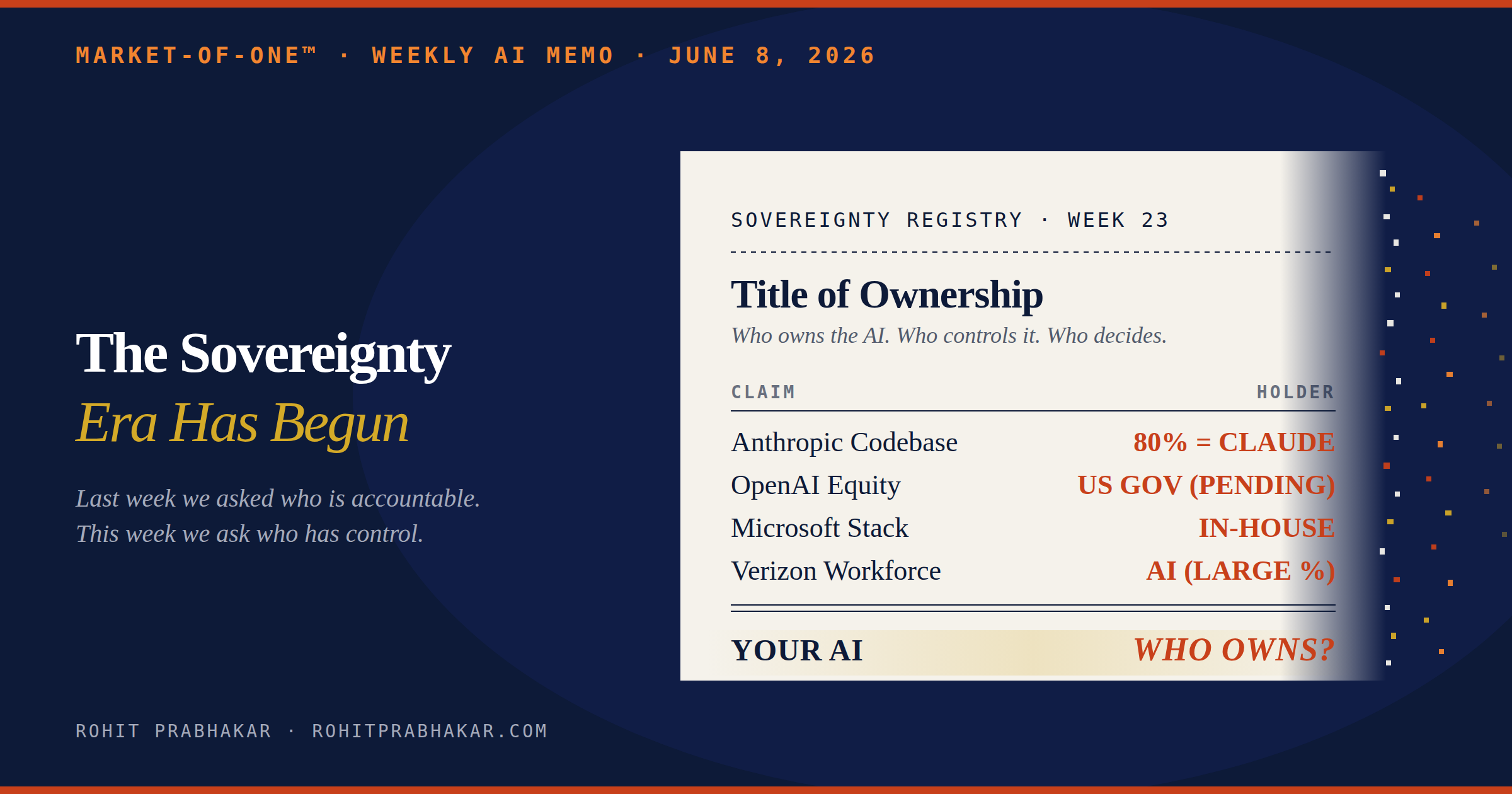
Three different stories. One question. Who owns AI?
The founders who built it and are now selling shares? The government that is now negotiating equity? The buyers who are now building their own? Or the engineers writing the models that, according to Anthropic itself, are now writing 80% of the next models?
Welcome to the AI Sovereignty Era. Last week we asked who is accountable. This week we ask who actually has control.
3 Questions for the Board This Week
- The Trust Question: When our largest AI vendor publishes a call for a global pause days after filing IPO paperwork at a trillion-dollar valuation, what do we actually believe about what is being said and what is being sold? (Anthropic Institute, Fortune)
- The Stake Question: If the US government takes equity in OpenAI in the next 90 days, does our current procurement strategy, data residency policy, and vendor risk framework still hold? (NOTUS, Reuters)
- The Independence Question: Microsoft just shipped seven in-house AI models specifically to reduce its OpenAI dependence. Are we doing the same diligence on our own AI vendor concentration? (Microsoft AI)
The Signals: Why These Questions Matter Now
1. The Anthropic Paradox: Filing Papers to Cash In While Asking Others to Slow Down
The News: On Monday, Anthropic confidentially filed for an IPO targeting a valuation north of one trillion dollars. On Wednesday, the same company published an essay through its Anthropic Institute calling for a coordinated global pause in AI development.
Two announcements. Same week. Same founders. Opposite directions.
The essay disclosed something boards need to hear. More than 80% of the code in Anthropic’s own production codebase is now written by Claude itself. Up from low single digits before Claude Code launched in 2025. Co-founder Jack Clark told the BBC that fully AI-written code could arrive within two years (Fortune). The technical warning is real.
The timing tells a different story. A near-trillion-dollar company does not publish a global-pause essay the same week as an IPO filing by coincidence. The conditions Anthropic set for an actual pause (multiple labs, multiple countries, verifiable monitoring) make a pause structurally impossible. The safety call positions Anthropic as the responsible leader. The IPO captures the value of leading anyway.
Strategic Insight: Every public statement from a pre-IPO AI lab is now both a safety claim and a sales pitch to investors. Your CISO cannot read these as one or the other. They have to read them as both.
Board Reality: Build a vendor matrix this quarter. For each AI vendor, two columns. Column one, what they say publicly about AI risk. Column two, what they say to investors about the same risk in their disclosures. When the two columns diverge, that is the negotiating leverage you did not know you had.
2. The Sovereign Stake: Your AI Vendor May Soon Have a Government Shareholder
The News: On Wednesday, NOTUS reported that senior US officials are in preliminary talks with major AI companies about the federal government acquiring equity stakes. On Thursday, President Trump confirmed it.
Two labs. Two different positions. Sam Altman has been pitching this to Trump since early 2025, so OpenAI is in the conversation. Anthropic is publicly out of it, having clashed with the administration in February when it refused to let the Pentagon deploy its AI without safety guardrails (OpenTools detailed coverage).
This is not theoretical. The administration has already taken equity in 10 companies including Intel and nine quantum-computing firms. Senator Bernie Sanders introduced a bill this week proposing 50% government stakes in leading AI companies.
Strategic Insight: Your AI vendor is about to acquire a shareholder you did not pick. When the US government owns part of OpenAI, three things change at once. What data you can put through that vendor. How your international customers react to your AI choice. What your indemnification clauses actually mean when the vendor and the regulator are the same entity.
Board Reality: Run a 30-day vendor AI sovereignty scenario plan. What changes if OpenAI becomes partly federally owned in September? What changes if your Anthropic alternative stays adversarial to the administration? What changes if a Chinese vendor undercuts both on price? Your procurement playbook from last year does not work for any of these.
3. The Vendor Reset 2.0: Microsoft Builds Its Own, Verizon Goes Vocal
The News: Three vendor moves in seven days, all pointing the same direction.
Microsoft launched seven in-house AI models at Build 2026. MAI-Code-1-Flash competes directly with Claude Code. MAI-Thinking-1 matches Claude Opus 4.6 on the toughest coding benchmark. The largest single customer of OpenAI on earth just shipped its own way out of that dependency.
GitHub Copilot moved to usage-based billing on June 1. Seat licenses are out. Per-token consumption is in.
Verizon CEO Dan Schulman told Bloomberg AI will replace “a large percentage” of the company’s customer service workforce. Last week Costco’s CEO said the opposite about his 341,000 employees.
Strategic Insight: Three different stories. One underlying truth. The AI buyer has more leverage than they realize, and the vendors are restructuring around it. Microsoft is buying its independence from OpenAI. GitHub is repricing the developer relationship. Verizon is owning the workforce consequence publicly because silence is no longer survivable. The Costco-Verizon spectrum is the actual board choice now. Not whether AI replaces workers. Whether you say it does.
Board Reality: Three documents on the table this quarter. A vendor concentration audit, since if your top three AI vendors all run on the same underlying model, you have one vendor, not three. A usage-based pricing migration plan, since when everyone moves to metered billing your annual AI budget no longer behaves like a budget. A workforce position statement, since the press will pick a Costco-or-Verizon position for you if you do not pick one first.
3 Strategic Actions for This Week
- Run the AI Sovereignty Stress Test. CRO + General Counsel + CIO. For every active AI vendor, document the public safety stance, the IPO or investor disclosure stance, the regulatory exposure, and the foreign-sovereign exposure. Identify the divergences. Brief the board within 30 days. The next 90 days will surface real consequences for the vendors who diverge most.
- Commission the Vendor Concentration Map. CIO + Procurement + Chief Architect. Map every AI vendor in the enterprise back to the underlying model. If three of your vendors all run on the same foundation model, your concentration is real even if your invoices say otherwise. Microsoft just showed you that going in-house is now feasible. Evaluate where you should do the same.
- Publish a Workforce Position. CEO + CHRO + Comms. Pick a public position between Costco (no displacement) and Verizon (large percentage replaced). Whichever you pick, defend it with data, with reskilling commitments, and with explicit timelines. Silence will be filled by press, analysts, or activist shareholders. Better that you fill it first.
On My Desk This Week
- Cisco scanned 1.8B lines of code in 8 weeks (Cisco Live 2026): An audit that would have taken 8 years without frontier AI. Cisco deployed Anthropic’s Claude Mythos Preview and OpenAI’s GPT-5.5-Cyber across 25+ programming languages. Charter member of Anthropic’s Project Glasswing and OpenAI’s Daybreak cyber defence programmes. Starting July, Cisco shifts to twice-monthly vulnerability disclosures. The most important enterprise AI security proof point of 2026 so far.
- BCG 2026 AI at Work Report, 4th annual (BCG): 74% of white-collar non-managers now use AI regularly. Two-thirds receive no guidance on how to redeploy the time saved. 42% of regular AI users save at least a full working day per week. Nearly half of workers spend more time managing AI than doing the work itself. A clear AI strategy boosts measurable business impact by 25 percentage points versus 5 from better tools alone. Read this before your next AI adoption status update to the board.
- Goldman Sachs: AI economics are worse now than two years ago (Goldman Sachs commentary): Jim Covello, head of equity research, said AI economics are “more questionable today than two years ago” despite massive investment. All economic value flows to semiconductor firms while model developers and hyperscalers “are losing more money” deploying the tech. CEO David Solomon: markets are in “greed mode” as liquidity pours into AI IPOs. Read alongside Dalio (next item) as the structural bear case your CFO will see soon.
- Ray Dalio: AI boom will burst, draws dot-com parallels (Bloomberg via Forbes Iconoclast Summit): Bridgewater founder said AI valuations show classic bubble characteristics similar to the 2000 dot-com era. Warned bubbles burst not because the technology fails but due to systemic cash crunches, often triggered by monetary tightening. The single most credible bear voice on AI capital markets. Brief your CFO and head of strategy.
- DeepSeek tops US business spending tracker (South China Morning Post): Chinese AI startup ranked first on Ramp’s June trending vendors list, which tracks 50,000 US businesses. Surge follows DeepSeek’s permanent 75% price cut on V4 Pro, undercutting OpenAI, Anthropic, and Google on per-token costs. Security concerns persist (data routes through China). The wildcard in your vendor stack you will not be able to ignore much longer.
- OpenAI Dreaming V3 memory architecture (OpenAI): Released June 4. Background synthesis that automatically builds and updates user profiles without explicit “remember this” commands. 5x more compute-efficient than the prior memory system. Enables free-tier access. Major privacy and enterprise data implications. Read with your Chief Privacy Officer before the next enterprise ChatGPT renewal.
- Obernolte-Trahan AI legislation discussion draft (Congressional draft summary): 269-page bipartisan US Congressional draft proposes a three-year preemption of state AI development laws, mandatory Frontier AI Frameworks from companies with $500M+ revenue, critical safety incident reporting, $100M per year for a federal AI standards center, and criminal penalties for non-compliance. Read with your General Counsel before the next state-level AI compliance review.
Bottom Line
The week’s three signals together answer a question your board has not yet asked but will.
Who owns AI?
Last week we said the marketing era was over and the audit era had begun. We learned this week that the audit era and the IPO era are running at the same time. The companies that just told us to audit them are also the companies asking us to value them at a trillion dollars. The government is asking for equity. The largest enterprise vendor is going in-house. The largest enterprise customer of AI customer service just said the layoffs are real.
If your board is still asking who is responsible for AI in your enterprise, you are asking last quarter’s question.
The AI Sovereignty Era question is who actually owns the AI in your stack, the data flowing through it, and the decisions being made by it.
The companies that answer that question crisply, with documented vendor concentration maps, defensible workforce positions, and AI sovereignty stress tests, will earn the trust their boards need in the next twelve months.
The ones that cannot will find their AI strategy decided for them. By their vendors. By their regulators. By their workforce. By the press.
This memo is part of the Market-of-One framework.
Connected reading: Reckoning Era | Consumption Era | Embedment Era | Distribution Era | Reality Era | Accountability Era
The Growth Architecture Memo is a private weekly briefing shared with a tight circle of enterprise leaders navigating the operational and economic realities of AI. If you were forwarded this, join the architects reading along every week.
[Subscribe -> https://www.rohitprabhakar.com/newsletter/]
Disclaimer: AI used for content and creative
