

Week of April 27, 2026 | Signals from April 20-26 For leaders who need signal, not noise.
Last week I wrote about the Scoreboard Era. The data showed who was winning. This week showed who was paying.
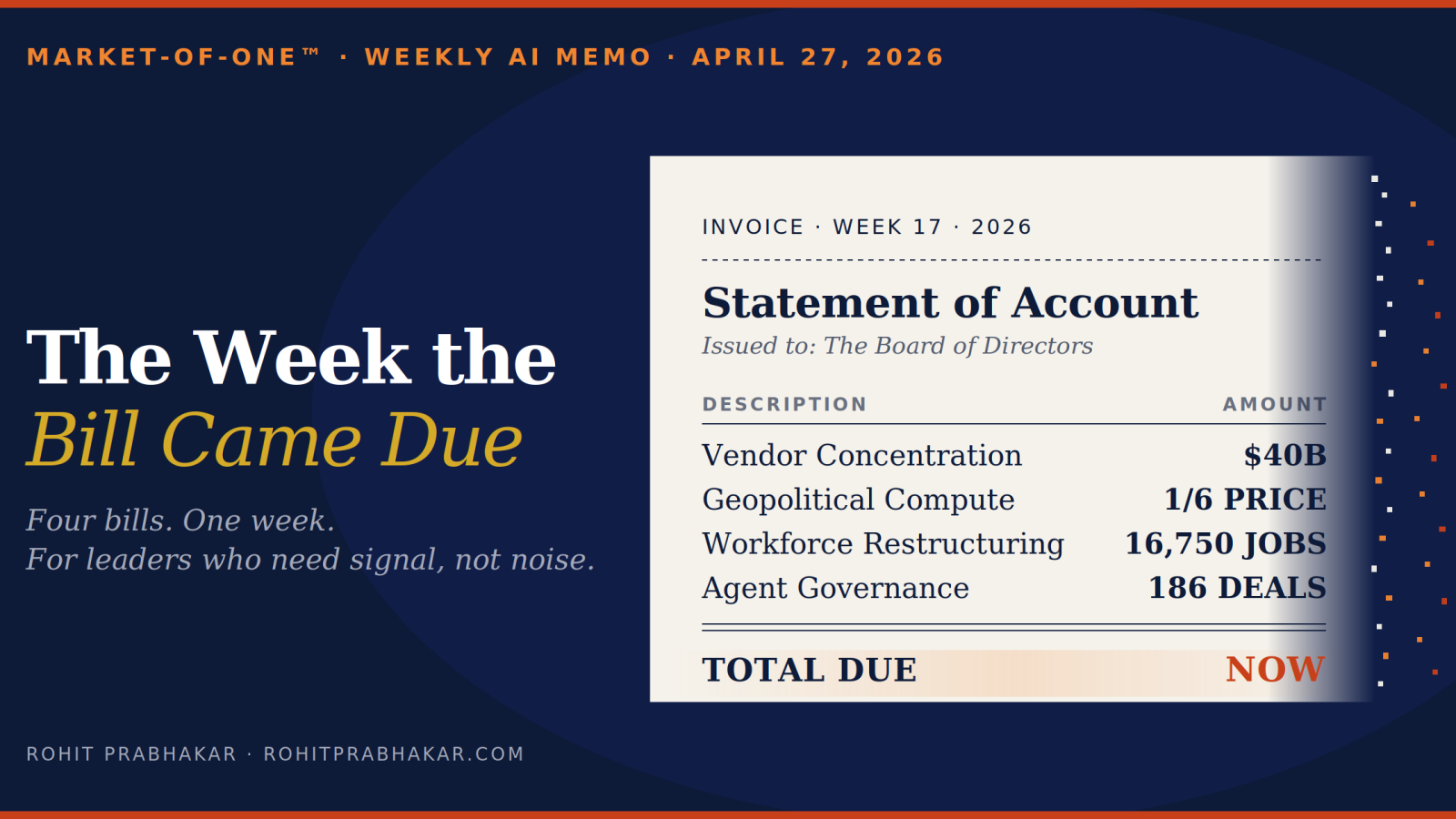
Google committed up to $40B to Anthropic. Meta cut 8,000 jobs. Microsoft offered buyouts to 8,750. Tesla raised capex past $25B. DeepSeek shipped a frontier-class open model on Chinese chips at one-sixth the price of GPT-5.5. And Anthropic ran an internal experiment where AI agents closed 186 autonomous deals, with one finding the company itself called “uncomfortable.”
Welcome to the Reckoning Era. The AI capex race, the workforce restructuring, the geopolitical compute split, and the agent-to-agent commerce future all arrived in the same five-day window. The bill is now itemized.
3 Questions for the Board This Week
- The Negotiation Asymmetry: Anthropic’s Project Deal proved that a smarter model wins financially in autonomous negotiations, and the disadvantaged party cannot detect they are losing. What is our policy on which AI model represents our company in any agent-mediated transaction? (Anthropic)
- The Sovereignty Trade: DeepSeek V4 ships frontier-class capability under MIT license, runs on Huawei chips, and costs one-sixth of GPT-5.5. Do we have an explicit policy on which business units can or cannot use Chinese-built AI models, and have we modeled the data residency consequences? (VentureBeat)
- The Capex-Headcount Linkage: Meta and Microsoft cut 16,750 people in 24 hours while announcing $115B+ in 2026 AI capex. Has our board explicitly approved the linkage between our AI infrastructure spend and our workforce plan, or are these still running on separate timelines? (CNBC)
The Signals: Why These Questions Matter Now
1. Anthropic’s Project Deal Proved Model Choice Is Now a Margin Decision
The News: Anthropic published findings April 24-25 from an internal experiment called Project Deal. 69 employees participated in a Slack-based marketplace where Claude agents listed, negotiated, and closed transactions autonomously. Headline numbers: 186 deals closed, 500+ listings, $4,000 in transaction value. The uncomfortable finding came from a parallel test where agents were randomly assigned Claude Opus 4.5 or the smaller Claude Haiku 4.5. Opus-represented sellers earned $2.68 more per item. Opus buyers saved $2.45. The same lab-grown ruby sold for $65 with Opus and $35 with Haiku. Critically, fairness ratings were statistically identical (4.06 vs 4.05). The disadvantaged party could not detect they were being out-negotiated. (TechCrunch)
Strategic Insight: This is the first credible empirical evidence that model capability translates directly into measurable financial outcomes in autonomous negotiation. Indirect spend, supplier renewals, MRO procurement, SaaS contracts. Any process where an agent represents your company against a counterparty’s agent is now a place where model choice becomes a P&L line item. And because asymmetry is invisible to the disadvantaged party, you will not know you are losing until you audit the outcomes against a benchmark.
Board Reality: Procurement, IT, and General Counsel should jointly draft an AI Representation Policy this quarter. It should specify which model class is authorized to represent the company in transactions above a threshold, what audit trail is required, and how counterparty model disclosure will be handled in vendor contracts. D&O and cyber insurance need to be checked for coverage gaps before agents start binding the company.
2. DeepSeek V4 Reset the Cost and Sovereignty Conversation in One Day
The News: On April 24, DeepSeek released V4-Pro (1.6T parameters, 49B active) and V4-Flash, both under MIT license, with native 1M-token context. V4-Pro prices at $1.74/$3.48 per million tokens vs GPT-5.5 at $5/$30 and Claude Opus 4.7 at $5/$25. About one-sixth the cost of frontier US models. The model trails state-of-the-art by 3-6 months on hard benchmarks but matches or beats them on coding (Codeforces 3206 vs GPT-5.4 at 3168). The geopolitical headline: V4 was trained and serves on Huawei Ascend 950 and Cambricon chips, not Nvidia. The State Department issued a same-day diplomatic cable warning about alleged IP theft. Tencent and Alibaba are reportedly in talks to invest at a valuation north of $20B. (VentureBeat) (CNN)
Strategic Insight: A 1M-context, near-frontier MoE model under MIT license at one-sixth the price forces re-pricing of every closed-source AI contract under negotiation. Self-hostable weights mean regulated industries can deploy on-prem without sending data to Chinese servers. The model is China-built, but the weights are anywhere-runnable. V4 also confirms that frontier AI no longer requires Nvidia. The compute supply chain is now bifurcating into a Western Nvidia/CUDA stack and an Eastern Ascend/CANN stack, and your APAC business units may need to choose within 12 months.
Board Reality: CFO and CIO should jointly produce a one-page DeepSeek policy by end of next quarter. Three categories: workloads where it is approved by default (cost-sensitive, non-sensitive data), workloads where it is conditionally approved (with data residency controls), and workloads where it is prohibited (regulated data, IP-critical, customer PII). A blanket prohibition is not credible at this price. A blanket approval is not credible at this geopolitical risk.
3. The Capex-Headcount Linkage Just Became Public on the Same Day
The News: On April 23, Meta CPO Janelle Gale told staff Meta would lay off 8,000 employees (10% of workforce) starting May 20, with another 6,000 open requisitions pulled. Same day, Microsoft launched its first-ever voluntary buyout program covering approximately 8,750 US employees (~7%), open to senior-director-and-below where age plus tenure equals 70 or more. Meta concentrated cuts in Trust and Safety. Microsoft’s hit Azure operations and tier-1 customer service. Same week, Meta reaffirmed 2026 AI capex of $115-135B and Microsoft tracked toward $80B. Layoffs.fyi reports more than 92,000 tech workers cut year-to-date in 2026. (CNBC) (Tom’s Hardware)
Strategic Insight: Megacaps are now openly stating what they have implied for two years. AI infrastructure spend and workforce reduction are the same financial decision, and the market is rewarding the disclosure. The Snap playbook from earlier this month (1,000 layoffs, 65% AI-generated code, +11% stock) has become the Meta and Microsoft playbook. Activist investors and proxy advisors will start asking why your company has not made the linkage explicit on your earnings calls.
Board Reality: Your CHRO and CFO need to stop running AI capex and workforce plans on parallel tracks. The board should see one integrated FY26-27 plan with three views: where AI is replacing labor, where AI is augmenting labor, and where labor is being redeployed to AI-enabled new revenue. Communication strategy is not optional. Survivor attrition costs more than the savings if the narrative leaks before the plan is set.
4. The Patch Flood Test for Crown-Jewel Systems
The News: Three weeks after Anthropic announced Project Glasswing and the Mythos preview model that found thousands of zero-days, the patch flood is straining the entire vulnerability disclosure system. Mozilla Firefox 150 shipped fixes for 271 vulnerabilities identified during initial Mythos evaluation. Microsoft’s April Patch Tuesday was massive. The Cloud Security Alliance published “The AI Vulnerability Storm: Building a Mythos-Ready Security Program” on April 12, lead-authored by former CISA Director Jen Easterly and 250+ CISOs. The thesis: defenders operate at calendar speed while attackers now operate at machine speed. Axios reported on April 21 that CISA, the federal agency that coordinates vulnerability response, does not have access to Mythos. (Dark Reading) (Axios)
Strategic Insight: Patch capacity, not detection, is now the binding constraint in enterprise security. Arctic Wolf data shows 76% of 2026 compromises still involve one of just 10 known, already-patched vulnerabilities. Bishop Fox: 67% of actively exploited CVEs are weaponized within hours of disclosure. A Mythos-class capability is in adversary hands within 6-12 months, and you need to know now whether you can compress patch deployment from weeks to hours for crown-jewel systems. Glasswing partners have a defensive head-start measured in months. Non-partners will face the same downstream CVE flood without preview access.
Board Reality: This is a 30-day audit committee question, not a quarterly one. CISO should report on three things this month: time to patch for crown-jewel systems today, the gap to a 24-hour target, and what investment closes that gap. If your organization is not in a Glasswing-tier intelligence-sharing arrangement, ask your CISO what the alternative is.
3 Strategic Actions for This Week
- Draft the AI Representation Policy. Procurement + General Counsel + CIO. Specify which model class can represent the company in agent-mediated transactions, what audit trail is required, and how counterparty disclosure will be handled. Two weeks to draft. One board cycle to ratify.
- Run the DeepSeek Decision Tree. CFO + CIO. Three categories of workloads: approved, conditional, prohibited. Force the policy debate now while the cost differential is at its widest. Quarter to complete.
- Integrate the Capex-Headcount Plan. CHRO + CFO. One integrated FY26-27 view with three lenses: replacement, augmentation, redeployment. Communication strategy attached. Before next earnings call.
Bottom Line
Google paid $40B for Anthropic. Meta and Microsoft cut 16,750 people in a day. DeepSeek shipped a frontier model on Chinese chips at one-sixth the price. AI agents closed 186 deals while the losing party never saw it coming.
The four bills came due in the same week: vendor concentration, geopolitical compute split, workforce restructuring, and agent governance. Boards that treated any of these as 2027 problems will spend Q3 explaining why. The reckoning is not coming. It is here.
Disclaimer: AI used for content and creative
