

Executive Brief | Week of March 16, 2026
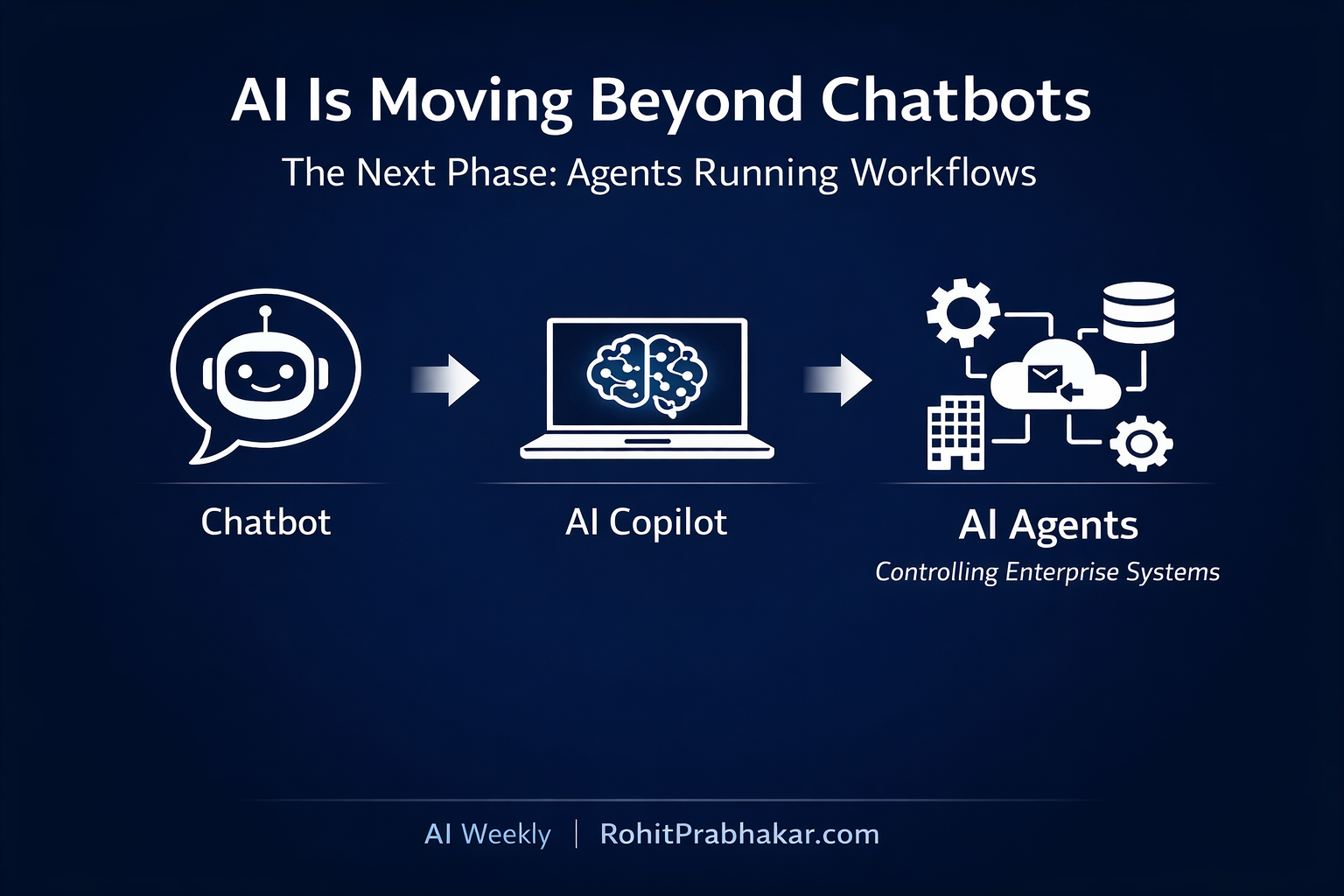
For the past two years, most companies treated AI as a productivity tool.
- Create written content
- Summarize documents
- Help employees work more efficiently
That phase is ending.
AI is beginning to operate inside real systems executing workflows, accessing tools, interacting with enterprise software, and influencing operations. This shift changes the risk profile completely.
Below are five signals leaders should pay attention to this week.
1. AI Vendors Are Becoming Strategic Dependencies
What happened
The U.S. Department of Defense labeled Anthropic a “supply-chain risk,” a designation that restricts the use of its AI tools in military contracts. The dispute stems from disagreements over how Anthropic’s models could be used in surveillance and autonomous weapons contexts.
Why this matters
AI model providers are no longer neutral infrastructure.
Their ethical policies, regulatory exposure, and geopolitical alignment can now directly affect what enterprises can build or deploy. Your AI roadmap may depend on decisions made outside your organization.
Board question
Where is our AI strategy dependent on a single model provider, cloud provider, or policy regime?
2. AI Is Moving From Conversation to Execution
What happened
Nvidia introduced Nemotron 3 Super, an open model designed to power large-scale agentic AI systems that complete multi-step tasks autonomously. These models are designed for AI agents that execute workflows rather than simply respond to prompts.
Why this matters
Once AI can trigger actions inside systems accessing data, executing processes, or interacting with applications the risk shifts:
from what AI says → to what AI can do.
This creates a new attack surface:
non-human identities operating across enterprise systems.
Board question
What controls exist before AI agents receive credentials, tool access, or workflow authority?
3. Synthetic Media Is Becoming a Corporate Risk
What happened
Generative AI systems are rapidly improving in image and video generation, enabling the creation of realistic synthetic media at scale.
Why this matters
The cost of creating convincing fake videos, executive messages, or product demonstrations is falling quickly. This expands risk across:
- brand trust
- misinformation
- legal exposure
- corporate reputation
Synthetic media capabilities are advancing alongside broader generative AI adoption, which is already raising concerns about misuse and disinformation.
Board question
If a convincing fake video of our CEO or product went viral tomorrow, who manages the response?
4. AI Is Quietly Moving Into Regulated Operations
What happened
Healthcare technology company Epic introduced Agent Factory, a platform to build and orchestrate AI agents within clinical and administrative workflows. Health systems are already using AI tools to support diagnosis, documentation, and operational workflows.
Why this matters
Healthcare is one of the most regulated industries in the world. If AI can move into live clinical and operational environments, it signals that enterprise AI adoption is moving beyond pilots and into production infrastructure.
Board question
Where are competitors already using AI operationally while we are still running pilots?
5. AI Is Becoming an Infrastructure Issue
What happened
AI workloads are dramatically increasing demand for compute capacity and data-center infrastructure. Large technology companies are investing heavily in AI infrastructure to support these workloads.
Why this matters
AI strategy is no longer just a software discussion.
It now depends on:
- compute capacity
- cloud infrastructure
- energy availability
Organizations that cannot secure these inputs may find their AI ambitions constrained.
Board question
If AI infrastructure tightens, do we have guaranteed access to compute and capacity?
Bottom Line
The story this week is simple – “AI is moving”:
From interface → infrastructure
From assistant → operator
From pilot → production
For boards and CEOs, the question is no longer whether AI matters.
The real question is whether the organization is prepared for a world where AI does the work, not just helps with it.
Disclaimer: This work includes use of AI.
