

Last week, Mike Berry asked me a question on LinkedIn that I am building this entire essay around. He asked, after the reflection post closing out the original Market-of-One series, where Quality fits in the operating system. What happens when you can personalize down to the individual interaction but the personalization itself is irrelevant, off-brand, or too expensive to be worth it. The honest answer is that Quality should have been a first-class layer in the original series and was not. This essay fixes that. Quality is now the sixth dimension of the ARCA Assess diagnostic. And Marketing is the function where its absence costs the most.
Welcome to Series 2. The first series argued the philosophy, the system, and the destination across nine weeks. This series argues the practice across four. One function per essay. Marketing, Sales, Service, Product. Each one carries the three gaps named in the reflection post: the cost collapse stated explicitly, agents centered as the operative engine, and the function leader spoken to directly rather than orbited from the CMO chair. Mike’s question is the right opening for the marketing essay because Marketing is the function that ships the most personalized touches per week, which means it pays the highest tax when the personalization is bad.
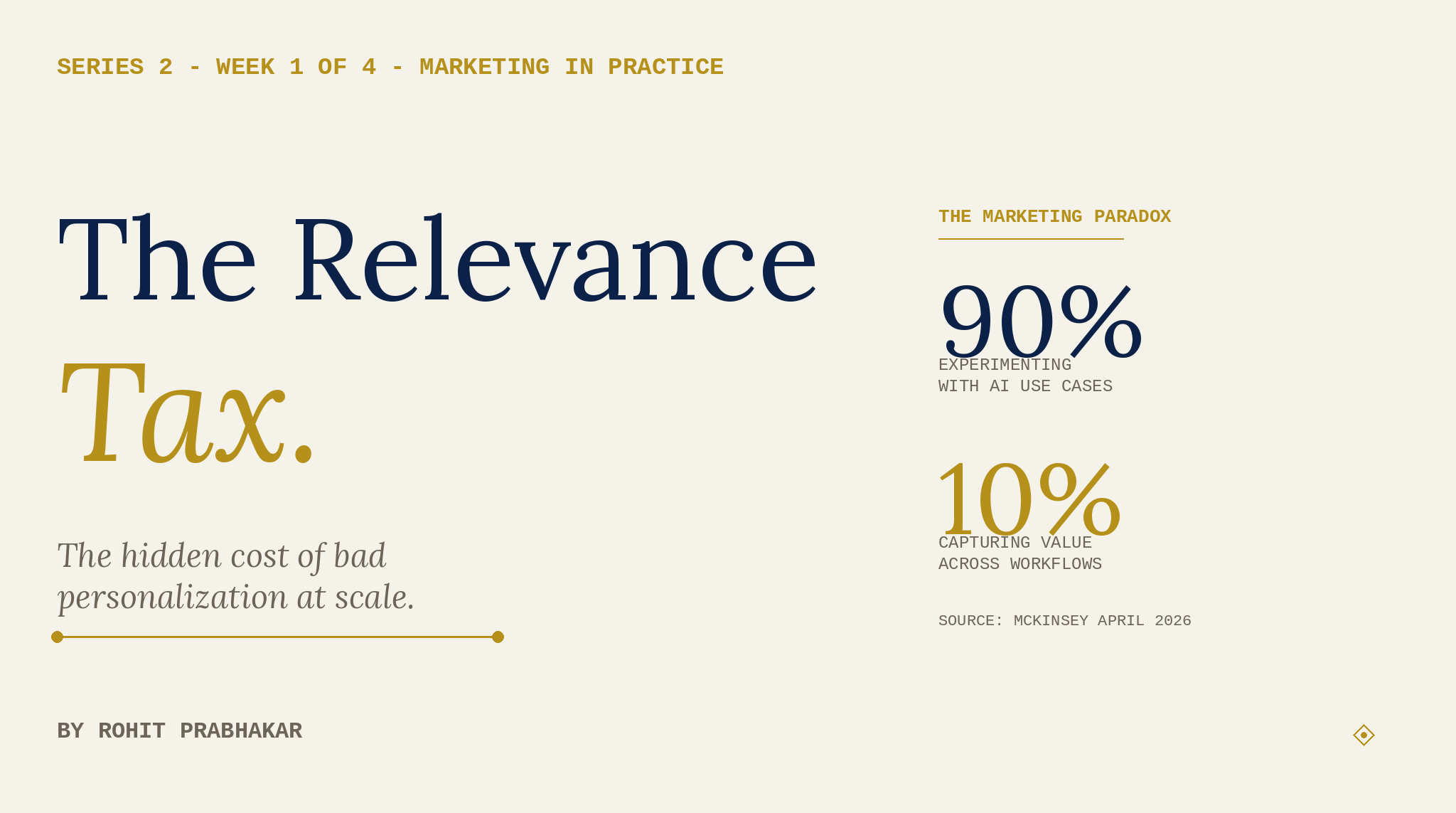
I call that tax The Relevance Tax. And it is already being paid, at scale, by most marketing organizations that do not know they are paying it.
The Marketing Paradox in 2026 Data
Three numbers from May 2026 frame the problem.
Gartner’s 2026 CMO Spend Survey, published three weeks ago, found that CMOs now allocate 15.3% of marketing budgets to AI initiatives. The money has moved. Yet only 30% of CMOs describe their marketing organization as having mature or fully developed AI readiness capabilities. The capability to spend the money well is not keeping pace with the spend.
McKinsey’s April 2026 marketing research put the gap more sharply. Nearly 90% of CMOs are experimenting with AI use cases. Fewer than 10% have captured value across end-to-end workflows. Agentic AI will eventually power up to two-thirds of current marketing activities, according to the same research, but most marketing organizations are nowhere near that operational state.
Universal adoption. Almost no value. This is the Transformation Paradox from the Series 1 finale, now stated in marketing-specific data. The capability is ready. The marketing organization is not.
Why. Michelle Taite, former CMO of Intuit Mailchimp, co-authored an HBR piece in May 2026 that names the root cause with unusual precision. Most marketing organizations are struggling to keep up because their operating model is “sequential, siloed, and coordination-heavy” and that has not changed. AI gets bolted onto a 2010-era marketing structure that is fundamentally incapable of using it well. The work was designed to flow through human teams in handoff cycles. The AI is designed to operate continuously, autonomously, across the whole flow. Those two operating logics cancel each other out.
This is the marketing-specific version of why pilots fail to scale. The technology is not the bottleneck. The function shape is the bottleneck.
The Relevance Tax
When the function shape fails to absorb agentic AI properly, marketing teams default to a predictable failure mode: they use AI to produce more output, not better output. More emails. More variants. More personalized landing pages. More everything, faster, cheaper.
This is where Mike Berry’s question lands hardest. Bad personalization at scale is not the same problem as no personalization. It is a much worse problem. And it has a name in the consumer market already.
“AI slop.” The phrase did not exist three years ago. In 2026, 54% of Americans report experiencing AI fatigue. Audiences who sense AI-generated content are measurably less likely to trust, click, or convert. The brands losing right now are not the ones who used too little AI. They are the ones who used AI to scale generic output and called it personalization.
I call this The Relevance Tax. It is the compounding cost of bad personalization at scale, and it has three components.
Engagement decay. Audiences who sense AI slop disengage faster than audiences who get nothing. A clicked-but-not-converted touch is worse than no touch, because it teaches the audience that your brand produces content that looks personalized but is not. The next touch starts from a lower base of attention. Every campaign in this mode starts in a deeper hole than the last one.
Brand erosion. The IAS / YouGov 2026 brand safety research found that 53% of US media experts now cite proximity to generic AI content as a top media challenge. Ads placed alongside or generated as low-quality synthetic content signal inauthenticity even when the ads themselves are well-produced. The brand pays a discount on every impression, whether the impression converted or not.
Compounding budget waste. Most CMOs are running 15.3% of their budget through systems that scale the low-value end of the work. Supermetrics reports that only 6% of marketers have fully embedded AI into their workflows, while 87% use it primarily for content creation and copywriting. The 87% is the Relevance Tax line item. AI used to generate more variants of average copy, more emails, more posts. Output rises. Marginal value falls. The cost-per-touch falls but the cost-per-relevant-touch rises, and only the second metric matters.
The Relevance Tax is the marketing-specific version of the Surveillance Tax from Week 8. Surveillance Tax is what you pay when you personalize without trust. Relevance Tax is what you pay when you personalize without quality. They compound on the same balance sheet.
Output Quality as the Sixth ARCA Dimension
The original ARCA Assess diagnostic measured five dimensions: data readiness, customer intelligence, agent architecture, organizational alignment, and governance. After Mike Berry’s question, I am adding a sixth. Publicly. With his name attached to the addition, because that is honest credit and because the model gets sharper when reader pushback updates it.
Output Quality. The dimension that measures whether the personalization the system produces is actually good.
It has three sub-tests, each tied to a measurable signal.
Relevance. Measured by engagement-to-impression ratio at the individual level, not the campaign level. The campaign-level number averages out the bad touches with the good ones. The individual-level number exposes the Relevance Tax directly. If your personalization engine produces 3-5x click-through against segment-level baselines (which JADA Squad’s 2026 marketing research documents as the actual ceiling for individualized personalization), the system is producing relevance. If it produces less than 1.5x, you are paying the tax.
Brand alignment. Measured by the percentage of AI-generated outputs that pass an automated brand guardrail check before delivery. The guardrail is not a human review of every touch. It is a model trained on the brand’s voice, claims, and visual standards that flags outputs falling outside the band. The metric is the flag rate over time, declining toward a steady-state acceptable floor. If your AI generates a thousand emails a day and the brand guardrail flags 30%, you have an Output Quality problem that compounds into brand erosion within a quarter.
Unit economics. Measured by cost-per-relevant-touch, not cost-per-touch. The denominator is what changes the answer. A touch that did not convert and damaged the brand is not a unit of marketing output. It is a unit of marketing waste, paid for at the same per-unit cost. Most CMOs are measuring the wrong denominator, which is why their AI spend looks efficient on the dashboard and underperforms in the P&L.
Output Quality is now sitting alongside the other five dimensions in ARCA Assess. The diagnostic produces a score per dimension and a composite. Marketing organizations that score low on Output Quality but high on the other five are exactly the failure mode Mike’s question described: capable system, irrelevant outputs, expensive personalization that punishes the brand it was supposed to serve.
The Cost Collapse, Finally Stated
The reflection post named the cost collapse as the most important gap in Series 1. Here, in the Marketing essay, it gets stated directly, because Marketing is the function where the collapse is most visible and most operational.
For thirty years, individualized personalization in marketing had a cost curve that made it economically irrational. A human team could produce one or two campaigns per quarter that were genuinely personalized at the segment-of-one level, usually for high-LTV customers in financial services or luxury. Everything else was segment-level personalization at best, demographic averaging at worst, dressed up in personalized language.
That curve has collapsed. Three numbers from the 2026 research show it.
Individualized personalization, when the operating system is genuinely in place, delivers 3 to 5x higher email click-through rates than segment-level personalization (JADA Squad 2026). Real deployments are showing 10 to 15% revenue uplifts and 15 to 20% cost reductions from agentic personalization at the individual level. McKinsey’s research found agentic AI capable of powering up to two-thirds of current marketing activities, including content generation, audience testing, and media planning, at a marginal cost per task approaching the cost of a software call rather than the cost of a human team.
This is the cost collapse. Agents now do, at low marginal cost, what teams used to do at high fixed cost. The personalization curve has flattened to the point where serving one customer perfectly costs almost the same as serving them in aggregate. This is the Customer Singularity from the Series 1 finale, applied specifically to marketing.
Most marketing teams are not running this operating model. Most are running 2015-era campaign machinery with AI bolted onto the content step. That is why the 90% experimenting / 10% capturing value gap exists. The gap is not a technology gap. It is an operating model gap, and the cost collapse is only available to organizations that rebuild the model.
The New Marketing Operating Model
Three changes. Each one cuts across an existing structure. None of them is incremental.
The campaign team becomes the agent supervision team. The work shifts from producing campaigns to designing and supervising the agents that produce campaigns. This is the inversion from Week 4, but specifically applied to the marketing function. The roles do not disappear. Brand strategists, lifecycle marketers, paid social leads, and CRM operators continue to matter. Their work changes shape. They direct systems, not just execute tasks inside them. The senior marketer’s day is now spent designing prompts, setting guardrails, reviewing agent outputs at sample, and intervening when the agents fail. Gartner’s research found that 23% of agencies reduced junior copywriting headcount in 2025 with 31% planning further cuts in 2026, while demand for senior strategists climbed. This is the function reshaping itself in real time.
The success metric moves from cost-per-touch to cost-per-relevant-touch. Every dashboard, every executive review, every quarterly planning cycle has to use the new denominator. This is the operational expression of Output Quality. If your CMO scorecard still shows cost-per-touch as the headline efficiency metric, you are systematically rewarding the production of more output regardless of whether it is good output. The dashboard has to change before the behavior changes.
Brand creative becomes brand guardrail design. The most senior creative work in 2026 marketing is not producing the next campaign. It is producing the guardrail that the agents generate against. The brand voice is no longer expressed in a style guide that a copywriter reads. It is expressed in a model that scores agent outputs in real time. The most strategic hire a CMO can make right now is the person who owns that guardrail, because that role determines the brand alignment dimension of Output Quality at scale.
These three changes are not “use AI better.” They are “rebuild the function.” Most marketing organizations will not do this. They will buy more AI tools, run more pilots, and wonder why the value is not appearing in the P&L. Per McKinsey, the value appears for the marketing organizations that pick one to three domains and rebuild them end to end, not for the ones that deploy tools horizontally.
The CMO 90-Day Move
If you are a CMO reading this, the next 90 days have a specific shape.
Days 1 to 21. Audit the Relevance Tax. Pull last quarter’s marketing data. Calculate cost-per-relevant-touch for every major channel, not cost-per-touch. Calculate engagement-to-impression at the individual level, not the campaign level. You will almost certainly find that 30 to 60% of your AI-generated output is producing negative or marginal value. That number is the Relevance Tax you are currently paying without knowing it. Bring the number to your next CFO conversation.
Days 22 to 45. Pick one workflow and convert it end to end. Not all of them. One. The deepest one in your existing operation. Recommended candidates: lifecycle email for a specific customer segment, abandoned cart recovery for one product line, or onboarding for one acquisition channel. Build the agent supervision team for that workflow. Install the Output Quality guardrail. Measure the new denominator. The McKinsey research is clear on this: one domain deep, proven end-to-end, beats ten domains shallow. The same pattern from Week 5.
Days 46 to 90. Install the brand guardrail before expanding. Before the operating model extends to a second workflow, the brand alignment guardrail must be production-ready. The model that scores agent outputs in real time. The flag-rate metric in the CMO dashboard. The escalation path when the agents fail. Without this, expansion compounds the Relevance Tax across more channels.
That is the 90-day move. It is not a transformation roadmap. The full transformation runs the ARCA timeline I described in Week 9, including the Architect, Command, and Amplify stages. This is the entry move. The thing the CMO does first because it is the thing the CMO is most equipped to start.
What Mike Berry’s Question Actually Was
I have been calling it Mike’s question. The question itself, in his words on LinkedIn last week, was: “Rohit, where does Quality fit into this? I can implement a tool that personalizes down to the individual interaction, but what if that personalization is bad? Isn’t relevant? Too expensive? The wrong product being offered?”
That is the question every CMO should be asking before they sign the next AI procurement decision. It is the question I should have been answering throughout the original Market-of-One series. Output Quality is now the sixth dimension of ARCA because Mike asked it publicly and the framework needed to update.
This is also a signal about how Series 2 should run. If you have a question about how Market-of-One works in your function, ask it in the comments or send it directly. The next three essays (Sales, Service, Product) will be sharper because of pushback. I would rather have the framework challenged in public than ship four essays that mirror the gaps of the first nine.
Next Tuesday: Sales. The function where bad personalization at scale does not just damage the brand. It damages the human relationship the rep spent quarters building. Quality control in sales is not optional. It is the operating model.
This is Week 1 of Series 2, Market-of-One in Practice. The original nine-week series is at rohitprabhakar.com/market-of-one. The ARCA deployment model, now with the Output Quality sixth dimension, is at rohitprabhakar.com/arca. The reflection post that triggered this series is at rohitprabhakar.com/blog/market-of-one-series-reflection. Thanks to Mike Berry for the question that built this essay.
This article was developed in partnership with AI used as a research, brainstorming, and authoring collaborator. All frameworks, positions, strategic perspectives, and opinions are my own. AI was the tool. The thinking is mine.
