

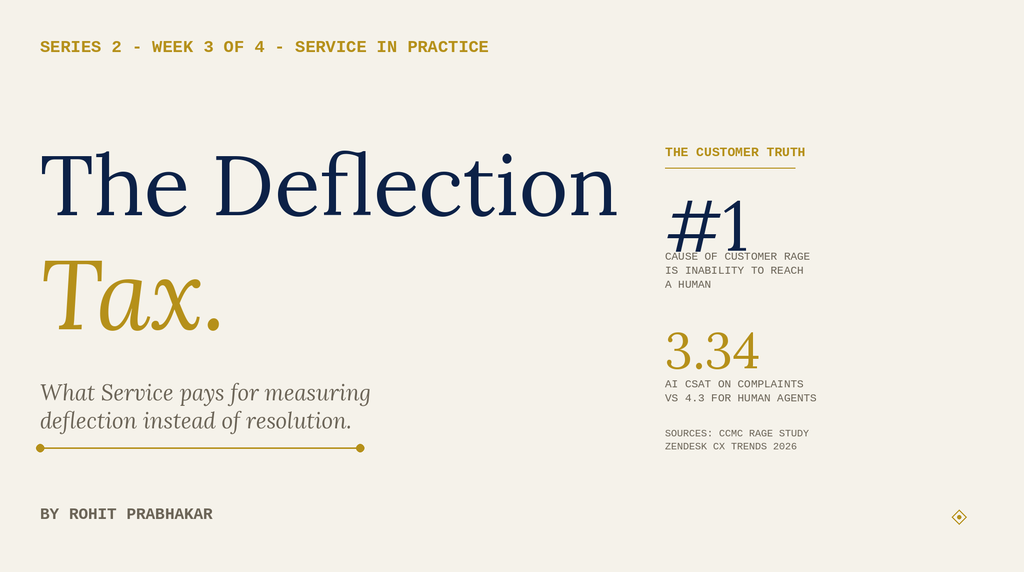
The number one cause of customer rage in 2026 is the inability to reach a human. That is the CCMC 2025 Rage Study finding, and it tells you almost everything you need to know about why most enterprise customer service AI deployments are quietly destroying brand equity even as the dashboard tells leadership the program is working. The dashboard reports a deflection rate. The customer reports a rage moment. Both numbers are accurate. Only one of them shows up on the executive review. The other one shows up on Reddit, X, and the regulator complaint that lands six months later.
This is Week 3 of Market-of-One in Practice. Marketing pays the Relevance Tax for bad personalization at scale. Sales pays the Autonomy Tax for skipping levels of the Commercial AI Maturity Model. Service has its own version, and it is the most expensive of the three because the customer paying it is already frustrated when they arrive. I call it The Deflection Tax. It is what enterprises pay when they measure their Service function by how many tickets they kept away from a human, instead of by how many customer issues they actually resolved. The metric you choose determines the operating model you build, and most Service organizations chose the wrong metric a decade ago and never went back to fix it.
The architecture of this essay builds on a LinkedIn thread that has run for two weeks now. Mike Berry pointed out the definitional vacuum at the executive level, where model calls are routinely called agents and the misnomer becomes the basis for a wrong Maturity Model self-assessment. Nav Thethi named the FEAR factor that lets the misdiagnosis stand, and welcomed Jason LeGunn and Zachary Lynde into the revenue-pipeline view of this conversation. George Ashkar reinforced the one-workflow-then-expand discipline back when Marketing kicked off Series 2. All four observations land in Service even harder than they did in Sales, because the Service function is where measurement fraud at scale becomes a customer experience felt directly by the person at the other end of the channel.
The Service Honesty Test
Most Fortune 500 Service organizations are at Level 2 of the Commercial AI Maturity Model. Most believe they are at Level 3. Sales had the same gap last week. Service has it deeper, because the executive misperception is propped up by a deflection metric that mathematically rewards exactly the behavior the customer is rage-quitting over. Leadership looks at a 41% deflection rate and concludes the AI is working. The customer looks at the same interaction and concludes the brand does not want to talk to them. Both interpretations are correct. They describe different sides of the same transaction and only one of them is on the executive scorecard.
The honesty test for Service in 2026 is one question. Are you measuring deflection or resolution? If the headline metric in your monthly leadership review is deflection rate, ticket containment rate, or self-service rate, your Service function is at Level 2 of the Maturity Model regardless of how much AI software you have purchased. If the headline metric is resolution rate by intent tier, with CSAT measured against the customer rather than against the bot, you may credibly be at Level 3. Fewer than 15% of Fortune 500 Service functions cross that line today. The rest are paying The Deflection Tax and not yet aware that it shows up in the next quarter’s churn report.
What Service Looks Like at Each Commercial AI Maturity Model Level
Each level of the Maturity Model has a Service-specific shape. This mapping does not exist anywhere else and it is the most useful diagnostic a Chief Customer Officer or VP of Service can run this quarter.
Level 1, Fragmented. The Agent Helper. Individual support agents use ChatGPT to draft responses, summarize tickets, or look up policy. The CSAT improvement is real and belongs entirely to the agent. The contact center has not changed shape. The dashboard has not added a single new metric. The customer experience is unchanged because the AI lives entirely inside the agent’s desktop and never touches the customer. Most non-Fortune 500 Service organizations sit here today.
Level 2, Accumulating. The Deflection Stack. The contact center now includes a chatbot, an AI ticket router, an AI agent assist, an AI knowledge base search, and a deflection dashboard that the COO reviews monthly. The headline metric is deflection rate. The chatbot intercepts Tier-1 inquiries. Some get resolved. Many get the customer trapped in a loop until they give up or find an alternate channel. The CSAT score on bot-handled complaints is 3.34 out of 5, which the leadership team rationalizes as “good enough for routine.” The customer who needed a human on a sensitive issue was the customer most likely to churn. The system was congratulated for handling them. This is where most Fortune 500 Service functions sit today, and it is the most expensive level to be at, because the Deflection Tax compounds the longer you stay.
Level 3, Connected. The Resolution Engine. The discontinuity. The Service function is redesigned around resolution, not deflection. End-to-end workflows route by intent tier and customer state, with shared memory across channels so the customer never repeats their issue when handed from chat to voice to human. Sentiment-triggered escalation is built in: the moment the system detects rising frustration, a human is offered, not blocked. The dashboard measures resolution rate by intent tier, CSAT measured against the customer’s stated outcome rather than the bot’s task completion, and first-contact resolution at the individual level. Cost per interaction drops, but cost is not the headline metric. Resolution is. Fewer than 15% of Fortune 500 Service functions are credibly here.
Level 4, Orchestrated. The Proactive Service Engine. Multi-agent workflows handle the bulk of routine interactions while sensing demand signals from product telemetry, account behavior, and billing systems to resolve issues before the customer ever reaches out. A payment failed, the proactive engine fixed the retry and notified the customer. A product update broke a workflow, the engine detected the support volume spike and pushed a fix-it-yourself link before the queue grew. The economic effect is a service function that prevents tickets rather than processing them. Fewer than 5% of Fortune 500 Service functions are here.
Level 5, Compounding. The Customer Intelligence Layer. Service becomes a revenue function and an intelligence asset. Every interaction produces a signal that flows back to Marketing for retention triggers, to Sales for expansion opportunities, to Product for the feature that just got mentioned three thousand times this month. The contact center is no longer a cost center. It is the single richest customer intelligence surface in the enterprise, feeding the rest of the Market-of-One Operating System with the lived experience data that no marketing analytics package can produce. This is the destination the original nine-week series pointed at. Fewer than 1% of organizations are here today and the ones that are have a moat that competitors cannot close inside three years.
The Six Dimensions Applied to Service
The Maturity Model grades six dimensions. Each one has a Service-specific shape that determines what Level you are actually operating at.
Context and Memory. The customer’s full history across every channel, every prior interaction, every product they own, every issue they have ever raised. A Level 2 Service function has this scattered across the CRM, the ticketing system, the chat logs, and the voice transcript archive. The customer is asked to “verify your account” three times in the same session. A Level 3 Service function has shared memory that every channel and every agent and every bot reads from in the same call. The customer never repeats themselves.
Customer Intelligence. Emotional state detection at the moment of interaction. This is where the 75% who prefer human agents for emotional issues lives. A Level 2 Service function cannot tell whether the customer typing “this isn’t helping” is mildly annoyed or actively rage-quitting. A Level 3 Service function reads sentiment in real time, triggers escalation when frustration crosses a threshold, and transfers the customer to a human with the full context already in front of that human’s screen.
Orchestration. The coordination between the bot, the AI agent, the live agent, and the supervisor. This is exactly where the architectural veto protocol from Nav Thethi’s framing applies. The bot can handle Level 1 deterministic queries within its closed-rule envelope. The moment the rule set is open, sentiment is escalating, or the issue carries policy exception risk, the human is in the loop with full context transfer. No agent-generated touch reaches a customer in distress without human review. This is non-negotiable at Level 3 and above.
Governance and Trust. The brand-voice guardrails on every AI response. Policy adherence on autonomous resolutions. Audit trail on every refund, credit, or policy exception the AI executed. A Level 2 Service function ships bot responses without monitoring whether they were brand-aligned. A Level 3 Service function has a model that scores every AI output for brand voice, policy compliance, and emotional appropriateness before it reaches the customer.
Operating Model. The CSO, CXO, CDO, and CIO sharing one customer experience number. The agent role redefined from ticket closer to escalation specialist and emotional resolver. The comp plan rebuilt to reward CSAT and retention rather than tickets-per-hour. The dimension where most Service transformations fail, because Service leadership treats AI as a tooling decision when it is an operating model decision.
Output Quality. The sixth dimension added publicly to the Maturity Model last month because of Mike Berry’s question. For Service, the three sub-tests of Output Quality have function-specific definitions. Resolution accuracy: did the AI actually solve what the customer asked, or did it close the ticket without solving. Sentiment appropriateness: did the tone of the AI response match the emotional state of the customer. Escalation timeliness: was the human offered at the right moment, or only after the customer had given up. Most Level 2 Service functions are not measuring any of these three.
The Deflection Tax
The Deflection Tax is what enterprises pay when they measure the wrong number and build the operating model around it. The tax has three components and each one compounds the others.
Rage cost. The CCMC 2025 Rage Study identified inability to reach a human as the number one trigger of customer rage in 2026. IVR loops and chatbots that block human escalation are the leading cause of escalating anger. A frustrated customer denied a human does not quietly close the ticket. They escalate to social media, file a complaint with the BBB or regulator, post on Reddit, and most expensively, they churn. Bot-handled complaint CSAT is 3.34 out of 5. Human-handled complaint CSAT is 4.3 out of 5. The gap, multiplied by the volume of complaint tickets, is the brand equity that gets quietly transferred from the brand to the cost-savings line on the contact center P&L.
False resolution. Deflection metrics count tickets that were closed by the bot, not tickets where the customer’s issue was actually solved. The customer comes back through a different channel a few hours later, the live agent handles the issue cold without context from the prior bot interaction, the dashboard shows two tickets resolved when really one customer experienced one failure followed by one recovery. This is measurement fraud at scale. The bot deflection KPI is true on the dashboard and false in the customer’s experience. Forrester, Notch, and Gladly all converged on the same point in independent 2026 research: deflection rewards avoiding the customer; resolution rewards solving for the customer. Pick the wrong one and the entire operating model bends in the wrong direction.
Trust erosion. Once customers learn that your Service AI is designed to keep them away from humans, the trust covenant from Week 8 of Series 1 breaks at the channel level. They stop using your support channels and route around you. They post on social media instead of opening a ticket. They DM your CEO on LinkedIn instead of calling support. They post a complaint thread that gets 50,000 views before your communications team finds out. The downstream cost is invisible until it is not, and by the time it is visible it is too late to fix the quarter’s NPS score.
The Deflection Tax compounds because each component reinforces the others. Rage drives social media exposure which drives trust erosion which drives more customers routing around your channels which lowers your support volume which makes the deflection number look better which earns the AI program continued investment. The KPI improves while the brand deteriorates. This is the structural failure mode of Service AI in 2026 and almost no Level 2 organization sees it happening because the metric they chose was specifically designed to hide it.
The Cost Collapse, Service Version
The cost collapse is real and the data is now mature enough to plan around. The question is no longer whether the economics work. The question is whether your organization is operating at the Maturity Model level required to capture them.
For well-structured intent tiers like password reset, order status, and refund status, the cost per resolution dropped from $6 to $12 per human-handled ticket to $0.50 to $2.00 per AI-resolved ticket. CSAT for these intents actually exceeds human baselines when the AI resolves rather than deflects, landing at 4.32 to 4.41 out of 5. Average handle time falls 25 to 50% when agent assist is layered correctly. Top quartile enterprise deflection sits at 58.7%, which is meaningful if it is paired with resolution measurement. Gartner forecasts $80 billion in global agent labor cost reduction in 2026 from conversational AI in contact centers. McKinsey’s published AI-Powered Bank case study documents a 100-day deployment that achieved 15% AHT reduction and identified 45% in cost cuts, with the program self-funded inside the first six months.
None of these numbers are reachable from Level 2. They require the resolution-measurement discipline that Level 3 forces on the organization. A Level 2 Service function deploying autonomous AI without the Maturity Model work captures perhaps 20 to 30% of the available economics and pays The Deflection Tax on the rest. A Level 3 Service function captures the full economic upside because the operating model is built to actually use the technology rather than to merely deploy it.
The New Service Operating Model
Three changes. Each is required for Level 3. Each is operating model surgery, not incremental.
The agent role inverts. Today’s contact center is staffed primarily with Tier-1 ticket-closers handling routine inquiries. The Level 3 contact center has fewer agents and each one is an escalation specialist. They handle the emotional, the exception, the high-value, the complex. The Level 1 volume is handled by AI. The agent role becomes harder, more skilled, and more valuable. Comp plans rebuild around it. The Tier-1 ticket-closer job category begins to disappear over a 24 to 36 month window. The escalation specialist job category grows in headcount, compensation, and seniority. This is the most painful operating model change in the entire Market-of-One series because it puts real headcount pressure on the most labor-intensive function in the enterprise.
The dashboard changes. From deflection rate to resolution rate. From AHT averaged across all interactions to AHT broken out by intent tier. From CSAT-average to CSAT-by-intent-tier, with the complaint tier monitored separately and never averaged away. From cost per ticket to cost per resolved customer issue, measured at the customer level rather than the ticket level. The denominator changes everywhere. If the executive review is still anchored on deflection, the operating model cannot move to Level 3 because the people running it are measured on the wrong number and will optimize for it correctly.
Escalation becomes the system, not the failure. Today, escalation from bot to human is treated as a failure of the AI. The bot couldn’t handle it. The agent has to pick up. The Level 3 Service function treats escalation as the system working correctly. Sentiment-triggered handoff. Context transferred completely so the human never asks the customer to repeat themselves. Warm handoff scripts that acknowledge the prior interaction. The CCMC Rage Study finding becomes a design constraint, not a footnote: the customer is never trapped, never blocked, never told to “try the chatbot again.”
These three changes are not technology decisions. They are operating model decisions, and the gap between Level 2 and Level 3 is exactly the gap between thinking AI is a tooling problem and recognizing it is an operating model problem.
What the Human Agent Must Still Own
Three things the human owns at every Maturity Model level, including Level 5.
Emotional resolution. The 75% of customers who prefer human agents for emotional, sensitive, or complex issues are not preferring the human because the AI is bad at the task. They are preferring the human because the situation requires emotional acknowledgment from another human being. A bot expressing empathy is, to a frustrated customer in 2026, indistinguishable from a brand that does not care. The human owns the emotional reset that makes resolution possible.
Policy exceptions and judgment calls. Closed-rule decisions belong to the AI. Open-rule decisions belong to the human. The line between them is where the architectural veto protocol lives. The refund the policy does not technically cover but the customer relationship requires. The exception that prevents a churn. The escalation that needs a manager. These are human work in 2026 and they will still be human work in 2030.
High-value relationships. The 11% of accounts that drive 80% of revenue. The strategic accounts where the support call is also a relationship signal. These customers get a named human, not a routed bot, regardless of intent tier. Mike Berry’s point about agent versus model call applies here directly. If your “VIP customer service AI” is just a model call with a fancier prompt, the customer can tell, and the relationship erodes. The human owns the relationship at every level.
The CXO 90-Day Move
If you are a Chief Customer Officer or VP of Service reading this, the next 90 days have a specific shape anchored to the Maturity Model.
Days 1 to 21. Take the diagnostic honestly and recalculate every metric by intent tier. Run the free Commercial AI Maturity Model diagnostic with your Service leadership team. Without the AI vendor in the room. Then recalculate your existing Service KPIs broken out by intent tier instead of averaged. Pull the complaint-tier CSAT separately from the routine-inquiry CSAT. Pull the escalation rate to human. Pull the abandonment rate after bot interaction. Pull the multi-channel re-contact rate. You will almost certainly find that your average dashboard numbers were hiding a complaint-tier performance that is destroying brand equity. That gap is The Deflection Tax. Bring the recalculated numbers to your CFO and your CEO.
Days 22 to 45. Fix one dimension to Level 3. Recommended: the Operating Model dimension. Change the headline metric in your weekly review from deflection rate to resolution rate. Add CSAT-by-intent-tier with complaint tier called out separately. Rebuild one comp plan around resolution and CSAT rather than tickets-per-hour. One dimension. End to end. Six weeks. Measured against the Maturity Model criteria.
Days 46 to 90. Install the sentiment-triggered escalation guardrail. The CCMC Rage Study finding becomes a design constraint. Every channel must offer a human within two failed bot attempts or one detected sentiment escalation, whichever comes first. Context transferred completely. No customer trapped in a loop. The architectural veto protocol applied to Service. Without this guardrail in place, expansion to additional intent tiers compounds The Deflection Tax across more of the customer base.
Where This Lands
The Commercial AI Maturity Model is the diagnostic. Market-of-One is the destination. ARCA is the deployment model. The Deflection Tax is what Service pays when leadership chooses the wrong metric and builds the operating model around it. The way out is not less AI. It is more discipline about which number you are optimizing.
Next Tuesday closes Series 2 with Product. The function where bad personalization at scale damages not the brand, not the rep relationship, and not the customer interaction. It damages the product itself, which becomes uncanny-valley for each user. The end of cohort analysis. The beginning of product-of-one. This is the hardest essay of the four to write and the one I am most looking forward to.
If you have a question about how Market-of-One works in your Service organization, send it. The Mike Berry pattern works. Output Quality is now in ARCA because of one LinkedIn comment. Sales Week was sharpened by three readers in conversation. Service Week was sharpened by an extended four-week thread including Jason LeGunn and Zachary Lynde joining the revenue pipeline view. Public pushback continues to sharpen the framework. Product Week will be sharper because of yours.
This is Week 3 of Series 2, Market-of-One in Practice. Week 1 (Marketing) and Week 2 (Sales) are live. The original nine-week series is at rohitprabhakar.com/market-of-one. The Commercial AI Maturity Model and the free diagnostic are at rohitprabhakar.com/frameworks/arca/maturity-model. The ARCA Framework is at rohitprabhakar.com/arca. Thanks to Mike Berry, Nav Thethi, George Ashkar, Jason LeGunn, and Zachary Lynde for the extended LinkedIn thread that shaped this essay.
This article was developed in partnership with AI used as a research, brainstorming, and authoring collaborator. All frameworks, positions, strategic perspectives, and opinions are my own. AI was the tool. The thinking is mine.
