Rohit Prabhakar

I build agentic revenue systems for Fortune 50 companies

  • Digital Transformation
  • Leadership
  • Marketing
  • Writing
  • Home
  • Privacy Policy

The AI Business Transformation Paradox: A C-Suite Guide to Building Real Value Beyond the Hype

July 8, 2025 by Rohit Leave a Comment

How smart executives across the C-suite navigate between FOMO and skepticism to unlock AI’s true potential across marketing, sales, and service

We’re living through the “early cloud days” of artificial intelligence. Remember 2008 when every software company suddenly became a “cloud platform”? Today, we’re seeing the same phenomenon with AI. Companies slap “AI-powered” labels on basic automation, vendors promise magical solutions that work for everyone, and executives are caught between the fear of falling behind and legitimate skepticism about what’s real versus what’s snake oil.

As someone who’s led digital transformation across Fortune 50 companies in financial services, healthcare, and technology, I’ve seen this movie before. The difference this time? The stakes are higher, the pace is faster, and the business impact—when done right—is transformational.

Whether you’re a CEO setting strategy, a CFO evaluating ROI, a CTO architecting solutions, or a CMO driving growth, you’re facing the same fundamental challenge: how do you harness AI’s potential while avoiding costly mistakes that can derail your transformation?

The Snake Oil Problem Is Real

Let me be direct about what I’m seeing across industries. A company that’s been using basic machine learning for fraud detection suddenly markets itself as an “AI-native platform.” A content creation tool that uses generative AI for one feature claims to be a “comprehensive AI transformation platform.” Marketing departments rebrand existing chatbots as “AI agents” to satisfy investor pressure.

This isn’t just misleading—it’s dangerous. When C-suite executives and especially their teams can’t distinguish between legitimate AI capabilities and marketing hype, they make decisions that waste resources and delay real transformation. CFOs approve budgets for solutions that don’t deliver promised ROI. CTOs architect platforms around vendor claims that prove false. CMOs launch campaigns based on AI tools that underperform. The result? Pilot programs that go nowhere, vendor relationships that disappoint, and teams that lose confidence in AI altogether.

But here’s what many executives miss: while there’s plenty of snake oil, there are also breakthrough opportunities that require immediate attention. The question isn’t whether AI will transform your business—it’s whether you’ll lead that transformation or be disrupted by someone who does.

The Cross-Functional Challenge: Every C-Suite Role Has Skin in the Game

Before diving into solutions, let’s acknowledge the unique perspectives each executive brings to AI transformation:

CEOs and Board Members worry about competitive positioning and capital allocation. They need to know: are we moving fast enough, and are we investing wisely?

CFOs focus on ROI and risk management. They want clear metrics on AI investments and protection against budget overruns on unproven technology.

CMOs see AI as both opportunity and threat. They need tools that deliver personalization at scale while protecting brand reputation and customer trust.

CTOs and CIOs must architect scalable, secure AI infrastructure while avoiding vendor lock-in and technical debt.

COOs care about operational efficiency and employee productivity. They want AI that enhances human performance without disrupting proven workflows.

CDOs are tasked with bridging business strategy and technology implementation, ensuring AI initiatives deliver measurable business outcomes.

The challenge? These perspectives often conflict. Marketing wants to move fast with customer-facing AI; Security wants extensive testing. Finance demands immediate ROI; Technology needs infrastructure investment. Operations wants proven solutions; Strategy demands competitive differentiation.

Smart organizations resolve this tension through a framework that serves all stakeholders.

The Two-Track Framework: Satisfying Every C-Suite Perspective

The biggest mistake I see C-suite teams make is treating AI as a tech project rather than a core business strategy. They either pursue incremental improvements that feel safe but limit upside, or they bet everything on futuristic visions that may never materialize.

Smart leadership teams do both simultaneously. They run two parallel tracks that address each executive’s concerns while building toward transformational outcomes:

Track 1: Incremental AI (Build Momentum and ROI)

Start with 90-day experiments that solve specific business problems and deliver measurable ROI. These wins build confidence, prove value to the CFO, and fund bigger bets. The key is picking battles you can win quickly while satisfying multiple stakeholder needs:

Content and Creative Generation:

  • CMO Benefit: Reduce creative timelines by 60% while maintaining brand quality
  • CFO Benefit: Lower agency costs and faster time-to-market
  • COO Benefit: Improved team productivity and reduced manual work
  • Implementation: Marketing teams generate campaign concepts, email variations, and social content at scale. Sales teams create personalized proposals and follow-up sequences.

Faster Insights and Analytics:

  • CEO/Board Benefit: Real-time business intelligence for strategic decisions
  • CFO Benefit: Faster financial reporting and anomaly detection
  • CMO Benefit: Customer behavior insights and campaign optimization
  • Implementation: Transform weeks of data analysis into hours. AI identifies patterns in customer behavior, predicts pipeline outcomes, and surfaces anomalies that humans miss.

Intelligent Customer Service:

  • COO Benefit: Reduced support costs and improved customer satisfaction
  • CSO Benefit: Consistent, compliant customer interactions
  • CMO Benefit: Enhanced customer experience and brand perception
  • Implementation: Deploy chatbots that solve 90%+ of common inquiries while seamlessly escalating complex issues to humans.

Sales Response Optimization:

  • CEO Benefit: Improved revenue predictability and growth
  • CMO Benefit: Higher conversion rates and shorter sales cycles
  • CTO Benefit: Data-driven sales processes and better lead scoring
  • Implementation: Give sales teams AI-powered next-best-action recommendations based on customer behavior, past interactions, and pipeline data.

These aren’t revolutionary changes—they’re smart automation that frees your team to focus on higher-value work. But here’s the critical insight: the data, processes, and organizational learning from these incremental wins become the foundation for more ambitious transformation.

Track 2: Reimagine Business (Prepare for Strategic Advantage)

While you’re winning with incremental AI, simultaneously experiment with fundamental changes that will define competitive advantage in the next decade. This satisfies the strategic needs of CEOs and board members while giving CTOs time to build robust infrastructure:

The Evolution of Customer Interfaces:

  • Strategic Impact: Within three years, customer interactions will shift from browsing static pages to conversational experiences
  • CMO Opportunity: First-mover advantage in customer experience differentiation
  • CTO Requirement: Investment in conversational AI infrastructure and API integration
  • Example: Instead of navigating complex product pages, customers describe their needs and receive personalized recommendations, pricing, and next steps through natural conversation

AI-First Customer Acquisition:

  • Board Impact: Fundamental shift in how new customers discover your business
  • CMO Transformation: Marketing budgets reallocated from search advertising to AI recommendation engines
  • CDO Opportunity: New data monetization strategies and partnership models
  • Reality Check: Customers increasingly start their journey with AI assistants that recommend solutions. If you’re not integrated into these systems, you don’t exist for new prospects

Autonomous Campaign Orchestration:

  • CFO Benefit: Dramatically improved marketing ROI through real-time optimization
  • CMO Evolution: Strategic focus shifts from tactical execution to creative strategy and brand positioning
  • CTO Infrastructure: AI systems that design, execute, and optimize campaigns across channels based on real-time performance data
  • Operational Impact: Human marketers focus on strategy, creative direction, and relationship building while AI handles tactical execution

This isn’t science fiction—early versions are already working in fintech, healthcare, and technology companies. The question is whether you’ll be ready when these approaches become mainstream.

C-Suite Specific Implementation Strategies

The two-track approach must be customized for your industry and functional priorities:

For CEOs and Board Members: Focus on competitive positioning and capital allocation. Track 1 delivers quick wins that prove AI value and fund Track 2 investments. Board discussions should center on market timing, competitive threats, and strategic advantage windows.

For CFOs: Demand clear ROI metrics for Track 1 initiatives (content generation ROI, customer service cost savings, sales productivity gains). For Track 2, model the cost of falling behind competitors vs. the investment required to lead transformation.

For CMOs: Track 1 addresses immediate pain points (content production, customer insights, campaign optimization). Track 2 prepares for fundamental shifts in customer acquisition and experience delivery. Budget allocation should split 70% Track 1, 30% Track 2 or 80-20 – whatever yoiu are comfortable with.

For CTOs and CIOs: Track 1 requires integration with existing marketing, sales, and service platforms. Track 2 demands architectural planning for conversational interfaces, real-time personalization engines, and autonomous campaign systems. Infrastructure decisions made today determine Track 2 feasibility.

For COOs: Track 1 improves operational efficiency across customer-facing functions. Track 2 requires change management preparation as AI reshapes roles and workflows. Focus on employee development and process redesign.

For CDOs: Bridge business strategy and technology implementation. Ensure Track 1 initiatives generate data and insights that inform Track 2 strategies. Develop frameworks for measuring business impact across both tracks.

The key insight: real-world experimentation for a few hours provides better insight than vendor promises or academic papers. Don’t buy AI capabilities—test them with your data, your processes, and your team.

The C-Suite Leadership Imperative

This isn’t just about technology—it’s about executive leadership in an era of exponential change. The leadership teams that thrive will be those who can balance healthy skepticism with bold experimentation, who can distinguish between hype and opportunity, and who can align diverse functional perspectives around both incremental improvements and transformational vision.

Your role is setting the strategic context and ensuring adequate resource allocation for both tracks. The companies that master this dual approach will define the next decade of industry competition. Your financial discipline ensures AI investments deliver measurable returns while funding the infrastructure needed for long-term competitive advantage.

The question every C-suite team must answer collectively: In three years, will you be the leadership team that transformed your industry, or the one that missed the opportunity while waiting for perfect certainty?

The time for cross-functional pilots and strategic planning is now. The time for transformation is already here.
Filed Under: The Frontier, Trends

Why Every Business Needs a Customer Master

June 16, 2025 by Rohit Leave a Comment

The hidden problem that’s costing you millions in lost opportunities—and how to fix it


The Problem Everyone Has But Nobody Talks About

Let me paint a picture you’ll probably recognize.

Sarah visits your website three times over two weeks, reads your blog, downloads a whitepaper, and finally fills out a contact form. Your marketing team is thrilled—new lead! But when Sarah calls customer service the next day with a question, the rep has no idea she’s been researching your company. When she meets with sales, they ask her to explain her needs all over again because they can’t see her website activity.

Sound familiar?

This isn’t just annoying for Sarah—it’s costing you real money. Companies lose an average of $62 million annually due to poor customer data management. More importantly, Sarah’s going to buy from someone who actually knows who she is.

The culprit? Your customer data is probably a mess.

Why Your CRM Isn’t Enough (Even Though Everyone Pretends It Is)

“But we have a CRM!” you might say. “We know our customers!”

Here’s the uncomfortable truth: your CRM only sees about 30-40% of what your customers actually do. It’s like trying to understand a movie by watching every third scene.

Think about it:

  • Your CRM knows Sarah filled out a form, but not that she spent 47 minutes reading your competitor comparison page
  • It tracks her as a “lead,” but doesn’t know she’s already a customer through a different division
  • It shows her last purchase, but misses that she’s been frustrated with your mobile app for months
  • When she calls support, they start from scratch because her service history lives in a different system

Your CRM was built to manage sales processes, not to understand customers. That’s why it fails as your customer data foundation.

What Is Customer Master, Really?

Forget the jargon for a moment. Customer Master is simply this: one place that knows everything important about each customer, and keeps everyone else informed.

Think of it as your company’s memory about customers. Just like you remember your friend’s coffee preference, their birthday, and that story they told you last month, Customer Master remembers everything meaningful about each customer interaction.

Here’s what that looks like in practice:

Before Customer Master:

  • Marketing: “We sent Sarah three emails this week”
  • Sales: “Who’s Sarah? Oh, this lead? She seems pretty cold”
  • Service: “Sarah called about login issues. No idea what she’s trying to access”
  • Website: “Anonymous visitor viewed pricing page 6 times”

With Customer Master:

  • Everyone: “Sarah’s been researching our enterprise solution for two weeks, downloaded our ROI calculator, called about implementation questions, and is ready to talk pricing. The sales rep should emphasize security features since she spent most time on that page.”

The Real Business Impact (Beyond the Buzzwords)

Let me share what happens when companies actually implement this properly.

Starbucks built a Customer Master that connects their mobile app, in-store purchases, and website behavior. Result? They can predict what you’ll order before you do, and their revenue from personalized marketing programs hit $2.65 billion. That’s not technology magic—that’s knowing their customers.

Sephora connected online browsing with in-store purchases and social media engagement. Now when you walk into a store, they can recommend products based on what you’ve been looking at online. Their customers spend 30% more because the experience feels personal, not generic.

But here’s a cautionary tale: A major retailer (I can’t name them) tried to use their CRM as their customer foundation. Three years and $15 million later, they had to rebuild everything because they couldn’t create consistent customer experiences. Their customer satisfaction actually went down during their “digital transformation.”

The Hidden Costs of Messy Customer Data

You’re probably losing more money than you realize:

Marketing Waste: You’re sending promotional emails to existing customers, advertising to people who already bought, and missing opportunities to upsell because you don’t know what they already have.

Sales Inefficiency: Your reps are starting every conversation from zero, asking questions you already know the answers to, and missing warm leads because they look cold in your system.

Service Frustration: Customers are explaining their situation over and over, feeling like just another ticket number, and getting inconsistent information from different departments.

Missed Revenue: You can’t recommend relevant products, predict when customers might churn, or identify expansion opportunities because you’re flying blind.

One client told me: “We realized we’d been treating our best customer like a stranger for two years because her data was split across five different systems. She was worth $2 million in annual revenue, and we were sending her generic promotional emails.”

What Actually Makes Customer Master Work

Forget the technical specifications for a moment. Here’s what really matters:

It Connects the Dots

Every customer interaction—web visit, phone call, purchase, complaint, social media mention—gets connected to one customer profile. No more puzzle pieces scattered across different departments.

It Happens in Real Time

When Sarah updates her preferences on your website, customer service sees it immediately. When she calls with a question, that context flows to the sales rep she’s meeting tomorrow. No delays, no syncing issues, no outdated information.

It Protects Privacy

With regulations like GDPR and CCPA, customer data isn’t just about marketing—it’s about legal compliance. Customer Master handles consent, deletion requests, and data protection automatically. One client avoided a $2.8 million fine because their Customer Master had proper audit trails when regulators came knocking.

It Speaks to Everything

Your email platform, website, mobile app, call center system, billing platform—they all get customer information through secure connections. It’s like having a universal translator for customer data.

The “But Our Situation Is Different” Objections

I’ve heard every reason why Customer Master won’t work:

“Our customers aren’t digital enough” Your customers might not be digital, but your business processes are. Even if Sarah only calls and never visits your website, Customer Master ensures her service history, purchase preferences, and communication logs are available to whoever helps her next.

“We’re too small for this” Actually, smaller companies benefit more. You can’t afford to waste opportunities or frustrate customers. One lost customer hurts more when you have fewer of them.

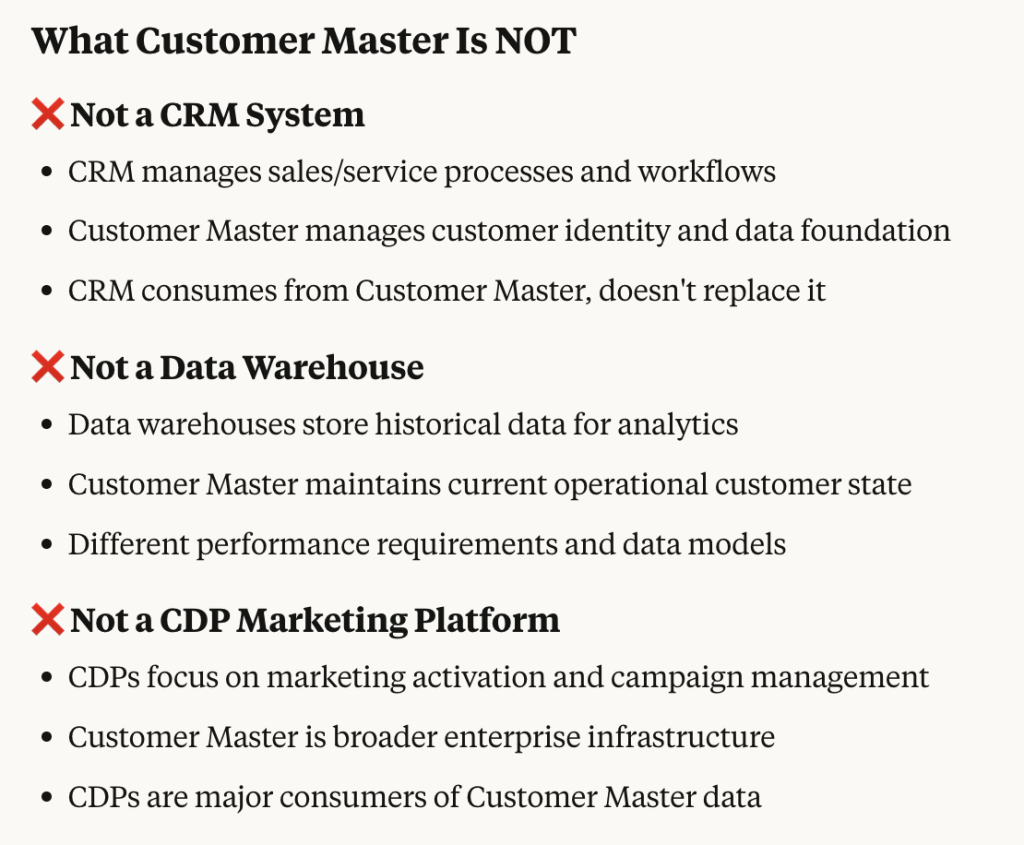
“Our CRM vendor says they can do this” Of course they do. They want to sell you more licenses. But CRM vendors are like hammer manufacturers—everything looks like a nail to them. Customer Master is specialized infrastructure, not a sales tool wearing a disguise.

“It’s too expensive” Know what’s expensive? Sending irrelevant marketing to existing customers. Having sales reps restart every conversation. Losing customers because they feel unknown. Customer Master typically pays for itself in 6-12 months through improved efficiency alone.

What Success Actually Looks Like

Here’s how you’ll know it’s working:

Your marketing team stops complaining about bad lead quality because they can see the complete customer journey, not just form fills.

Your sales reps become confident because they walk into every conversation knowing the customer’s history, preferences, and potential value.

Your customer service metrics improve because reps spend time solving problems, not gathering context they should already have.

Your customers start saying things like “You guys really get me” and “It feels like you actually know my business.”

Your revenue grows not from more advertising spend, but from better customer relationships and more relevant offers.

The Choice That Defines Your Future

Every day you wait, your competitors are getting better at knowing their customers. Amazon didn’t become Amazon by accident—they built this foundation early and never stopped improving it.

Meanwhile, companies that keep patching together customer data with spreadsheets, CRM workarounds, and “we’ll figure it out later” approaches are falling further behind.

The question isn’t whether you need Customer Master. If you have customers, you need it. The question is whether you’ll build it properly now, or spend twice as much fixing it later.

Because here’s what I know after helping dozens of companies through this: Customer Master isn’t a technology project—it’s the foundation for actually caring about customers at scale.

And in a world where customers have infinite choices, being genuinely customer-obsessed isn’t just nice to have.

It’s how you win.

Filed Under: The Frontier, Trends

AI Marketing Platforms: A Strategic Intelligence Dashboard for Enterprise Leaders

June 1, 2025 by Rohit Leave a Comment

Understanding the $5+ billion transformation reshaping how marketing gets done with AI Marketing Platforms.

We’re witnessing the most significant transformation in marketing technology since the advent of digital advertising. Global agency holding companies and consulting giants are investing billions to become AI-native organizations, fundamentally reshaping how marketing services are delivered at enterprise scale with their AI Marketing Platforms.

As a leader, you need actionable intelligence on these AI Marketing Platforms—not just vendor marketing materials, but comprehensive competitive analysis that reveals true capabilities, market positioning, and strategic implications for your organization.

That’s why I’ve created the AI Marketing Platform Competitive Landscape, an interactive intelligence tool that provides unprecedented visibility into the five major platforms competing for enterprise marketing transformation leadership.


What This AI Marketing Platforms Dashboard Reveals

The Five AI Marketing Platforms Strategies Analyzed

🔵 WPP Open – The AI-Native Operating System Approach

  • $400M+ annual investment in comprehensive marketing integration
  • Proprietary “Four Brains” AI architecture (Audience, Brand, Channel, Performance)
  • 27,000 active users across global network

🔴 Publicis CoreAI – The Data-Driven Intelligent System

  • €300M investment over three years, 2.3 billion consumer profiles
  • Superior financial performance (+6.3% growth) driving market confidence
  • Platform transformation from holding company to intelligent system

🟡 Omnicom Omni + IPG – The Scale Through Acquisition Strategy

  • $71B combined media billings creating 32% market share
  • Acxiom identity integration with commerce-focused AI development
  • Cautious but scale-driven approach to AI implementation

🟣 Dentsu Merkle – The Customer Experience Specialist

  • 280M consumer IDs with focus on privacy-compliant personalization
  • Salesforce partnership ecosystem for enterprise CRM integration
  • Proven 20% ROAS improvements and 25% reach expansion

🟢 Accenture Song – The Enterprise Consulting Heritage

  • $19B revenue scale with $3B total AI investment
  • Industry-specific AI agents and transformation methodology
  • Consulting-led approach to marketing technology implementation


The AI Marketing Platform Wars: What’s Really at Stake

Beyond Technology: Business Model Transformation

These platforms represent fundamentally different visions for the future of marketing:

  • WPP Open: Marketing as unified, AI-native operating system
  • Publicis CoreAI: Marketing as data-driven intelligent system
  • Omnicom-IPG: Marketing as scaled media and commerce platform
  • Merkle: Marketing as customer experience optimization
  • Accenture Song: Marketing as enterprise business transformation

The Winner-Take-Most Dynamic

Unlike traditional software markets, marketing platforms benefit from network effects, data accumulation, and client lock-in that create winner-take-most dynamics. Early platform choices may determine competitive positioning for the next decade.


The Request: Help Improve This Intelligence

To AI Marketing Platforms Leadership Teams

If you’re leading AI marketing initiatives at WPP, Publicis, Omnicom, IPG, Dentsu, or Accenture, this analysis would benefit from your insights:

Technical Accuracy: Are there capabilities, partnerships, or architectural elements we’ve missed or mischaracterized?

Performance Metrics: Can you share additional client success data, platform adoption rates, or technical performance benchmarks?

Strategic Direction: What future developments, partnerships, or platform enhancements should enterprise leaders anticipate?

Competitive Positioning: How do you see your platform’s unique value proposition relative to competitors?

Contact for AI Marketing Platform Intelligence Collaboration

Reach out directly if you’d like to:

  • Provide additional technical specifications
  • Share client success case studies
  • Correct any analytical errors or omissions
  • Discuss platform roadmap developments
  • Contribute to ongoing competitive intelligence

This analysis represents independent research and is updated regularly as new information becomes available.


The AI Marketing Platforms Dashboard Advantage

Use this interactive intelligence tool to:

  • Facilitate strategic discussions with standardized platform comparisons
  • Accelerate vendor evaluation with comprehensive SWOT analysis
  • Benchmark competitive positioning against industry platform investments
  • Support board presentations with authoritative market intelligence

Looking Forward: The Next Phase of Marketing AI

What I am Tracking

  • Platform consolidation and acquisition activity
  • Technical differentiation through proprietary AI development
  • Client success metrics and adoption rate acceleration
  • Partnership ecosystem development and strategic alliances
  • Regulatory impact on data-driven platform capabilities

The Ongoing Evolution

This dashboard will be updated quarterly with new platform developments, financial performance data, and client success metrics. The AI marketing platform wars are just beginning—strategic intelligence will determine who wins.


Access the Interactive Dashboard: [Link to Dashboard]

Connect for Platform Intelligence: For strategic discussions on AI marketing platform selection, competitive analysis, or collaborative intelligence development.

The future of marketing is being built now. Make sure you’re building with the right platform partner

Filed Under: The Frontier, Trends

Enterprise Video Creation Just Hit Its ChatGPT Moment

May 28, 2025 by Rohit Leave a Comment

The Breakthrough Nobody Saw Coming

This week, I created five product demo videos in under 30 minutes. Not mockups. Not storyboards. Finished, professional-quality videos ready for deployment.

You donot believe me! Just watch this video and read this article on WSJ.

Just six months ago, the same output required juggling four different AI platforms, an orchestration tool like n8n, and roughly 10x the time investment. Today? One platform. One workflow. Game changed.

Google’s Gemini Veo 3 represents more than incremental progress—it’s the inflection point where AI video generation transitions from “interesting experiment” to “mandatory enterprise capability.”

Why This Time Is Different

The Consolidation Signal

When multiple specialized tools collapse into a single platform, adoption accelerates exponentially. We saw this with:

  • Desktop publishing replacing typesetting, paste-up, and photo development
  • Smartphones replacing cameras, GPS units, and MP3 players
  • Cloud platforms replacing server farms, backup systems, and disaster recovery sites

The same consolidation just happened in AI video. What previously required orchestrating Runway for generation, ElevenLabs for voice, ElevenLabs for assets, and D-ID for avatars can now be accomplished in one interface.

The Quality Threshold

For the first time, AI-generated video passes the “LinkedIn test”—you’d share it professionally without disclaimers. The uncanny valley has been bridged. Lighting looks natural. Motion feels organic. Text overlays animate smoothly.

More importantly, brand consistency is maintainable. Enterprise marketing teams can input brand guidelines, approved messaging, and visual standards to ensure every generated video aligns with corporate identity.

The Speed Imperative

Modern marketing operates on a content treadmill that accelerates quarterly. Consider these realities:

  • Social platforms favor video content 10:1 over static posts
  • B2B buyers consume 13+ pieces of content before purchasing decisions
  • Personalized content delivers 6x higher engagement rates
  • Global teams need localized content in dozens of languages

Traditional video production—with its 4-8 week timelines and $10K-50K budgets—simply cannot scale to meet these demands.

The Enterprise Opportunity Matrix

Immediate Use Cases (Deploy This Quarter)

Product Demonstrations Transform static product pages into dynamic experiences. Generate variations for different industries, use cases, or buyer personas. A SaaS platform could create 20 targeted demos from one master script.

Social Media Content The 8-second current limitation? That’s not a bug—it’s perfect for TikTok, Instagram Reels, and LinkedIn’s new short-form video format. Create daily content that would traditionally require a full production team.

Internal Communications CEO town halls, training materials, and policy updates become infinitely more engaging. Generate versions in multiple languages simultaneously. Update content monthly instead of annually.

Sales Enablement Every sales rep becomes a content creator. Customize pitches for specific prospects. Create follow-up videos that reference actual meeting discussions. Close deals with personalized proposals that include video elements.

Strategic Advantages (6-12 Month Horizon)

A/B Testing at Scale Instead of guessing which message resonates, test 10 variations. Change narratives, visual styles, calls-to-action, or talent representation. Let data drive creative decisions.

Hyper-Personalization Imagine product videos that automatically adjust based on viewer demographics, browsing history, or CRM data. “Hi Sarah, here’s how our solution specifically addresses the challenges you mentioned in our Austin branch…”

Content Velocity as Competitive Moat While competitors deliberate their “AI strategy,” early adopters will have published thousands of videos, learned from performance data, and refined their processes. The learning curve advantage compounds.

The Implementation Playbook

Start With Controlled Experiments

  1. Secure a private instance – Work with Google or enterprise AI vendors to ensure data security and compliance
  2. Choose bounded use cases – Internal training videos offer low risk with high learning value
  3. Establish quality benchmarks – Define “good enough” for different content types
  4. Create feedback loops – Track engagement metrics religiously

Build Cross-Functional Capabilities

The biggest mistake? Treating this as purely a “marketing tool.” Winners will involve:

  • Legal/Compliance: Establish guardrails early
  • IT Security: Ensure infrastructure meets enterprise standards
  • Sales: Gather use cases and success stories
  • HR: Explore recruiting and onboarding applications
  • Product: Consider video documentation and tutorials

Prepare for Scale

Current limitations (8-second clips, generation quotas) will evaporate within months. Build processes assuming:

  • 60-second videos by Q2 2025
  • Unlimited generation by Q3 2025
  • Real-time generation by Q1 2026
  • Interactive/personalized delivery by Q2 2026

The Cost of Waiting

Every month of delay represents:

  • Hundreds of videos your competitors are creating
  • Thousands of customer touchpoints missed
  • Millions in production costs that could be redirected
  • Immeasurable learning and optimization opportunities lost

The enterprises that waited to adopt social media, mobile apps, or cloud computing paid dearly for their hesitation. AI video represents a similar discontinuity—except the adoption curve will be steeper and the advantages more pronounced.

Think – Act

The question isn’t whether to adopt AI video generation. It’s whether to lead or follow.

My recommendation? Allocate Q1 2025 as your learning quarter:

  1. Secure budget for experimentation (hint: one traditional video production covers months of AI generation)
  2. Assign a tiger team mixing creative, technical, and business talent
  3. Set aggressive targets: 100 videos in 100 days
  4. Share learnings publicly—thought leadership compounds when you teach

The tools exist. The quality threshold has been crossed. The business case is clear.

The only remaining variable is courage.

Filed Under: The Frontier, Trends

The Zero-Click Conundrum and Rise of LLM Black Box

April 26, 2025 by Rohit Leave a Comment

New Frontier of Digital Search

The digital world is evolving faster than ever. With the rise of large language models (LLMs) and AI-powered search engines, the way consumers interact with information and brands is fundamentally shifting. We must closely track two major trends that are redefining the landscape:

  • Zero-click search phenomenon
  • Black box effect created by LLM-driven search

These changes present new challenges and new opportunities for how we connect with consumers in an increasingly AI-driven world.

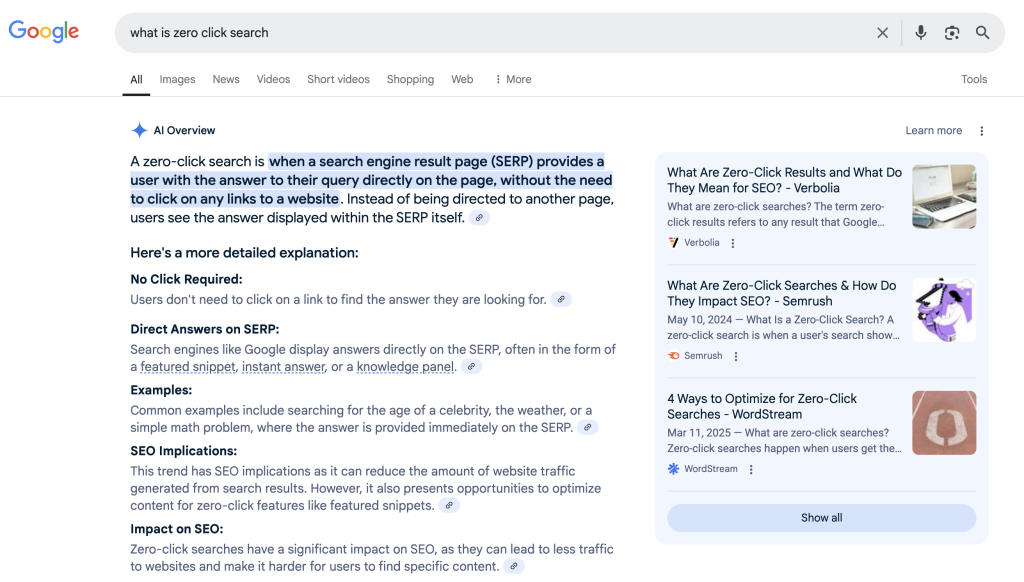
Source:
Source: SearchEngineLand

The New Competition – Google

Zero-click searches provide answers directly within the search results, bypassing brand websites and other channels 60+% times

For Business, this means:

  • Diminished brand visibility
  • Harder path to drive traffic and conversions
  • Risk of consumers missing out on learning about payment solutions

Frontdoor to Web is Changing

Internet was once navigated primarily through apps, search engines, and browsers, LLMs now serve as a new gateway to the web. In future LLMs will dominate the entry points

Google Search is still 373x bigger than ChatGPT search but LLM search market is growing. Just CHatGPTs Market Share Has Exploded by 740% in last 12 Months. We donot understand the magnitude of this shift as other apps like Perplexity don’t make data public.

One major hurdle we face with LLMs is the opacity surrounding user prompts. In contrast to conventional search engines, where keyword data is accessible, the exact questions and dialogues that lead to LLM responses often remain concealed. Making it difficult for brands to:

  • Understand consumer behavior
  • Measure campaign performance
  • Optimize content strategies

Implications for business

Brand Marketing: Zero-click search and LLM blackbox will make it harder to build brand awareness. We need to innovate ways to connect with consumers.

B2B Marketing: Lead generation becomes more complex with opaque search content. We need innovative indentifying and targeting strategies within and outside LLM ecosystems.

Consumer Marketing: A more experimental and iterative approach is necessary to optimize both zero-click and conversational search outcomes to effectively reach out and connect with consumers.

So what’s the plan

To thrive in this new era, every business must adapt and adopt some cutting-edge solutions

  • Optimize for AI crawlability. Adapt your content for semantic search, emphasizing high-intent, long-tail terms. Forget PDFs and gated content—they’re relics in an AI-driven ecosystem.
  • Enhanced Content Optimization for LLMs: Tailoring content for conversational AI platforms. Go beyond text. Use video and interactive formats to boost visibility in generative AI search. Prioritize deep topical authority over shallow keyword tactics.
  • Strategic Content Partnerships: Collaborating with publishers and creators to embed company’s message within broader online conversations.
  • Exploring New Platforms and Formats: Experimenting with short-form videos and interactive content.
  • Investing in Advanced Analytics: Tracking nuanced user behaviors across the new search landscape. Shift from click-focused metrics to measuring search impressions and AI reach. Optimize for influence over direct conversions.
  • Building Direct Consumer Relationships: Creating personalized, trust-driven relationships with consumers and clients at scale.

By combining bold strategic partnerships, pioneering internal expertise, and relentless innovation, we are poised to not just survive but lead in the shifting sands of search.

Filed Under: The Frontier, Trends

The Illusion of Corporate Empires: Why Legacy Outlasts Ambition

March 14, 2025 by Rohit Leave a Comment

In the fast-paced, high-stakes world of corporate life, it’s tempting to equate success with building empires—towering structures of influence, profit, and power. We often pour their energy into amassing resources, expanding reach, and cementing their names atop the organizational hierarchy. But history, at least of my few years in this corporate world, whispers a sobering truth: even the mightiest empires crumble. What remains, long after the corner office is vacated and the balance sheets fade, is the legacy you leave behind—the imprint of your business impact, the way you led your team, and the relationships you cultivated.

The pursuit of empire-building in the corporate realm is often a mirage that I have also struggled with. It’s a race to construct something grand, only to realize that organization shifts, disruptive arrangements, or simple frailty can topple it overnight. Think of the titans of industry from decades past—leaders once deemed invincible, now eliminated from even our memory. The lesson isn’t that ambition is futile; it’s that ambition misdirected toward scale alone misses the mark. True staying power lies not in the size of the empire, but in the substance of what you create.

Your business impact is the first pillar of a lasting legacy. It’s not just about revenue or market share—it’s about the value you deliver to customers, the problems you solve, and the innovation you spark. Did your work make lives better? Did it push an industry forward? A leader who focuses on meaningful outcomes over mere expansion plants seeds that outlive quarterly reports. Take the example of leaders that prioritized focusing on basics and build strong foundations in their area of accountability —years later, their influence endures not because they dominated, but because they did what mattered.

How you lead your team is the second cornerstone. Empires may be built by individuals, but they’re sustained—or undone—by the people behind them. A leader who inspires, empowers, and respects their team creates a ripple effect that extends beyond their tenure. Contrast this with the manager: their empire might soar briefly, but it collapses under the weight of unhappiness and turnover. Great leaders build loyalty, not just headcount. They mentor, listen, and foster a culture where others can thrive. Years later, it’s the team members who say, “I grew because of them,” that cement a leader’s true legacy.

Finally, the relationships you forge are the threads that tie it all together. Corporate life can feel transactional—handshakes, arrangements, and networking —but the connections that endure are the ones built on trust and authenticity. A colleague you supported in a tough moment, a client you went the extra mile for, a team member you invested your time in —these are the human bonds that outlast corporate battles. Empires may dazzle with their scale, but relationships quietly anchor your influence in the lives of others.

In the end, corporate life isn’t about erecting an unassailable fortress; it’s about leaving a mark that time can’t erase. Empires will rise and fall, as they always have. But a legacy of impact, leadership, and connection? That’s what stands the test of time. So, the next time you’re tempted to chase the throne, ask yourself: What will they remember me for when the dust settles?

Filed Under: The Frontier, Trends

Different Is Not Bad

January 28, 2025 by Rohit Leave a Comment

Sometimes I find myself in situations where things don’t go the way I’m used to, and my immediate reaction is to label them as bad. Sometimes, I even get frustrated and behave differently, which I hate.

Occasionally, I manage to resist the urge to run away from the unfamiliar and temporarily embrace it, often due to external circumstances or necessity. Many of those times, I discover that the new approach is actually better than what I was accustomed to. Yet, despite this realization, I often revert to my old habits.

I’m making a conscious effort to remember those new experiences, focus on their benefits, and actively embrace change. It’s not easy, but I believe it’s essential for personal growth and becoming a better leader. Different is not bad—it’s often an opportunity to grow.

Filed Under: The Frontier, Trends

  • « Previous Page
  • 1
  • 2
  • 3
  • 4
  • 5
  • 6
  • …
  • 17
  • Next Page »

Copyright © 2026 · Genesis Framework · WordPress · Log in