

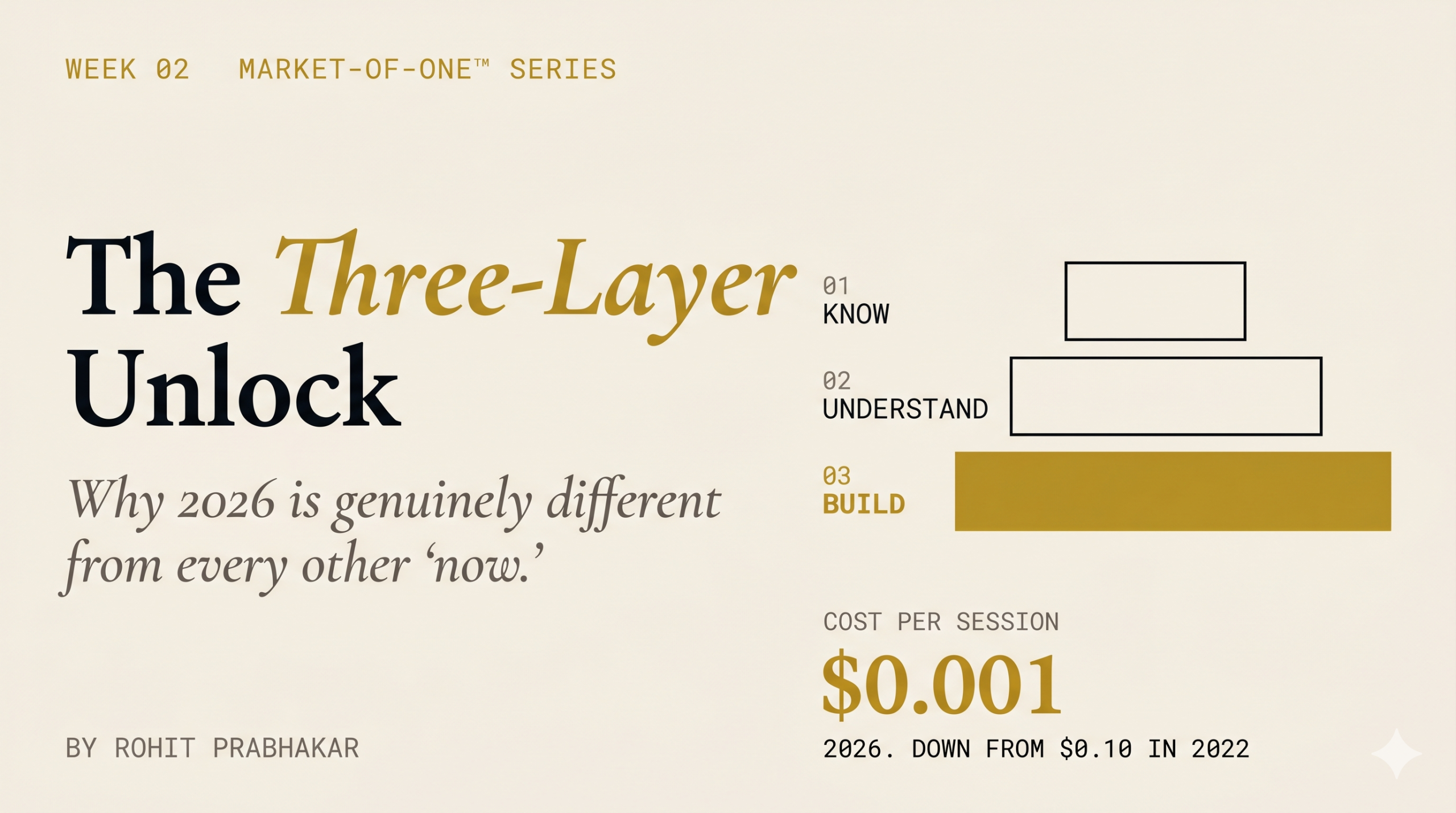
Why 2026 is genuinely different from every other “now.”
Three capabilities arrived simultaneously in 2026 that make the Market-of-One operationally possible for the first time. But the infrastructure that enables deep individual understanding is the same infrastructure that enables deep individual surveillance. The only thing separating them is intent, design, and consent. This article covers both.
Week 1 of this series sparked a conversation I did not expect. Over 500 people joined the thread in 48 hours. Scott Brinker, who has mapped the martech landscape for over a decade and whose work on marketing technology strategy is foundational for anyone in this field, put his finger on something critical: the real failure of personalization has never been the technology. It has been strategy debt. Organizations kept buying better tools to execute a fundamentally flawed model. The tools got smarter. The model never changed.
He is right. And it clarified something I have been building toward in my own thinking.
The model was flawed because it was built on a static assumption: that a customer’s identity, intent, and need could be captured once, stored in a profile, and acted upon. That we could freeze a living, changing human being into a database row and call it “knowing” them.
I call that Digital Taxidermy. The art of making a dead profile from yesterday look alive today. The industry got very sophisticated at Digital Taxidermy. It built entire technology categories around it. And customers felt none of it. You cannot stuff a living thing and expect it to breathe.
What changes in 2026 is not just the technology. It is the model itself. Three distinct capabilities arrived at roughly the same moment, and their combination, for the first time, makes genuine real-time individual understanding operationally possible.
But before naming those capabilities, there is a prerequisite that must come first. It does not appear in most personalization frameworks. It should be the first principle in every one.
The Prerequisite: Consent Is Not a Checkbox
The customer must choose to let you know them. Not opt-out. Not implied. An active, informed, reciprocal choice, where they understand what they are sharing, why, and what they receive in return.
This is not regulatory minimalism. Zero-party data (preferences, intentions, and context that customers voluntarily declare) is both the most ethical and the highest-quality signal available. It does not expire when a cookie policy changes. It does not disappear when a platform removes tracking. It does not erode trust when a customer realizes what you knew without asking.
The regulatory landscape reinforces this. The EU AI Act’s transparency requirements for automated decision-making, and CCPA’s expanding consent obligations, make consent-first architecture not just ethical but legally prudent and strategically superior. The Market-of-One built on zero-party data does not feel like surveillance. It feels like a relationship. That distinction is everything.
With that foundation in place, everything below rests on top of it.
The Same Customer. Three Different Worlds.
Meet Sarah, a VP of Sales at a mid-size software company. She arrives at a B2B SaaS vendor’s website at 2:17pm on a Tuesday. She has been in back-to-back calls since 9am. Her quarter closes in eleven days. She just lost her top SDR to a competitor. She also uses a screen reader, having been diagnosed with a visual impairment two years ago.
Here is what she experiences, depending on which world her vendor is operating in.
- 01
Layer 1 only: Know them. The database speaks.
Sarah sees a homepage built for “VP of Sales at mid-market SaaS companies.” The headline is about pipeline visibility. Relevant. Completely generic. Built six months ago for a segment of 40,000 people. It knows nothing about her eleven-day quarter, her lost SDR, or the eight minutes of attention she has left. The hero image has no alt text. The CTA button is labeled “click here.” Her screen reader navigates a broken experience. The system never knew she was there at all. She bounces in four minutes.
- 02
Layers 1 plus 2: Know and understand them. The system reads the signals.
The agentic context layer reads Sarah’s behavior in real time. She spent 47 seconds on the SDR productivity page. She ignored enterprise pricing. She clicked “fast onboarding” twice. The system infers her moment of need: fast fix to a talent gap before quarter close. It routes her to the right content bucket. Still better. Still not personal. The bucket was built for “urgency plus talent gap” visitors. There are 800 of them this month. And the accessibility problem is still there. The understanding layer was never designed to incorporate assistive technology signals into experience generation. The data existed. The intention did not.
- 03
All three layers: The Market-of-One. The page is written for Sarah, all of Sarah.
The generative layer takes Sarah’s full context profile, including her device signals and assistive technology, and builds a page that has never existed before. The headline: “11 days to quarter close. Here is how to hit your number without your best SDR.” The insight addresses SDR attrition directly, as a response, not a case study. The recommended path is the 48-hour onboarding track. The social proof is from a VP of Sales who hit quota during a team transition. Images have meaningful alt text generated in context. The CTA says “Book a 20-minute demo.” Her screen reader navigates it cleanly. She books in six minutes. Personalization and accessibility are not separate goals here. They are the same goal: build for the complete individual, not the median profile.
Same product. Same website. Same visitor. Three completely different outcomes, because three completely different infrastructures were operating underneath.
The Three Layers, With Their Obligations
The reason personalization has failed for thirty years is not that any one layer was missing. It is that all three were never present simultaneously. And even when individual layers existed, they carried no accountability to the person they were profiling. Each layer creates capability. Each layer also carries a specific responsibility.
- 01
Know Them. (Has existed 30 years: CDP, data warehouse, behavioral signals.)
This layer assembles everything knowable about a customer: purchase history, behavioral patterns, stated preferences. It answers: who is this person, historically? The problem: it describes a snapshot from last week. No mechanism to capture intent as it evolves. Alone, it produces sophisticated segmentation. Not the Market-of-One. Consent obligation: Data in this layer must be consented, not harvested. Zero-party data is both the most ethical and the highest-quality signal. Third-party data is dying for regulatory and technical reasons simultaneously.
- 02
Understand Them. (Agentic AI, arrived 2024-2025: context inference in milliseconds.)
Agentic AI reads the live behavioral stream and infers intent, urgency, emotional state, and moment of need in real time. This is the shift from Historical Personalization to Contextual Co-Evolution. But even with perfect understanding, without the ability to generate a response, the insight is stranded. Ethical inference obligation: Reading signals to serve someone better is helpful. Reading signals to manufacture urgency or exploit vulnerability is predatory. Inference is used to remove friction, never to manufacture it. This is a design decision, not a policy disclaimer.
- 03
Build For Them. (Generative AI, production-viable in 2026: the missing piece.)
Once you know who someone is and understand what they need right now, generative AI constructs the experience, written for this specific individual, in this moment, for the first time. No content library. No variant selection. This single shift, from selecting to generating, removes the content ceiling that has constrained every personalization initiative for thirty years. Accessibility obligation: When content is generated on the fly, accessibility is no longer a retrofit. It is a generation parameter. The output must be WCAG 2.2 AA-compliant by default. An experience that excludes 1.3 billion people with disabilities is not a Market-of-One. It is a Market-of-Some.
The Inversion: From Selecting to Generating
This distinction is the most significant architectural shift in personalization since the invention of the cookie. It deserves to be stated without ambiguity.
Old model: Understand then Select. Build the largest possible content library. Use ML to route the best pre-built asset to the best-matched segment. The ceiling is your content library size. No matter how sophisticated the routing, you are still delivering experiences built for clusters of people, not for individuals.
New model: Understand then Generate. There is no library. The experience is constructed in response to the individual. The ceiling is your depth of customer understanding, not your content production capacity. The number of unique, accessible, consented experiences is effectively unbounded.
Every brand that claims personalization today is running the old model. They are doing increasingly sophisticated segmentation, routing people to buckets faster, with better data, using smarter ML. But they are still selecting from a finite set of pre-built experiences. That is not the Market-of-One. It never was.
From Digital Taxidermy to Contextual Co-Evolution
Layer 2 is the layer that separates genuinely intelligent systems from very sophisticated automation. It is the layer Scott Brinker’s observation points directly toward. Strategy debt in personalization has always lived here: organizations invested in Layer 1 (knowing customers historically) and Layer 3 (delivering content) while skipping the connective layer that reads intent as it moves.
Traditional personalization operates on historical data. Build a profile, score it, act on the score. The profile is updated periodically, daily at best, weekly in most enterprises. In between updates, the system operates on a snapshot of who the customer was at the time of the last refresh.
The profile looks like a customer. It has dimensions, attributes, scores. But it is not alive. It does not update when the customer just got off a difficult call, when their board approved a budget, when they are eight minutes from a quarterly deadline. It operates on the preserved version of who they were.
Layer 2 changes this. Agentic AI reads the live behavioral stream and continuously recalculates intent. Every scroll, every hover, every back-button, all of it feeds a real-time inference engine that answers not just who this person is but what they are trying to accomplish in the next ten minutes, and what would genuinely help them do it.
Intent is not a state. It is a vector. It is moving. The Market-of-One moves with it. Historical Personalization captures what you did. Contextual Co-Evolution responds to what you are doing.
Why 2026 Specifically: Two Unlocks, Not One
Layer 3, generative content on the fly, has been technically possible since large language models emerged in 2022. Two things prevented enterprise deployment: cost and reliability.
The cost unlock. In 2022, generating a single personalized page experience cost roughly $0.10 per interaction. At enterprise scale, a mid-size site with 5 million monthly visitors, that was $500,000 per month in AI inference alone. Between 2023 and 2026, token prices fell between 70 percent and 95 percent annually, depending on model tier, a pace with no precedent in enterprise software history. The same interaction costs less than $0.001 today. The economics did not improve incrementally. They collapsed.
The reliability unlock. In 2022, generative models produced inconsistent output that no brand team would trust with autonomous deployment. Hallucinations, off-brand tone, factual errors. The failure modes were real. In 2026, structured output formats, multi-agent validation pipelines, and model guardrails make brand-safe generation at scale engineeringly solvable, not just economically viable. Both unlocks had to arrive together. Cost without reliability is a liability. Reliability without affordability is a pilot.
To put the cost economics concretely: generating a fully personalized, accessible experience for every visitor to a 5-million-session-per-month site now costs approximately $5,000 per month in AI inference. The same capability cost $500,000 per month in 2022. It went from a CFO conversation-ender to a rounding error in a marketing budget.
The Governance Question, And What Comes Next
The conversation that Week 1 sparked surfaced a tension that every CMO in this series needs to answer: how do you maintain brand integrity, consent compliance, and accessibility standards when a system is writing copy autonomously, for millions of individuals, at speeds no human reviewer can match?
The answer is not a policy document. It is not a legal review process. It is not a post-deployment audit.
It is an agent. One built specifically to evaluate every generated experience before it fires. One that scores brand alignment, enforces consent signals, checks accessibility parameters, and calculates what I call the Propensity-to-Annoy, the probability that this specific experience, for this specific individual, crosses the line from helpful to intrusive.
Autonomous generation without that accountability layer is not personalization at scale. It is liability at scale.
That agent has a name in the Market-of-One framework. It is next week’s entire subject.
Layer 1 tells you who they were, if they chose to tell you. Layer 2 tells you who they are becoming in real time. Layer 3 builds an experience that has never existed before, one that includes everyone, respects every individual’s right to privacy, and never mistakes knowing someone deeply for owning them. That is the Market-of-One.
This article was developed in partnership with AI, used as a research, brainstorming, and authoring collaborator. All frameworks, positions, strategic perspectives, and opinions are Rohit Prabhakar’s own. AI was the tool. The thinking is mine.
