

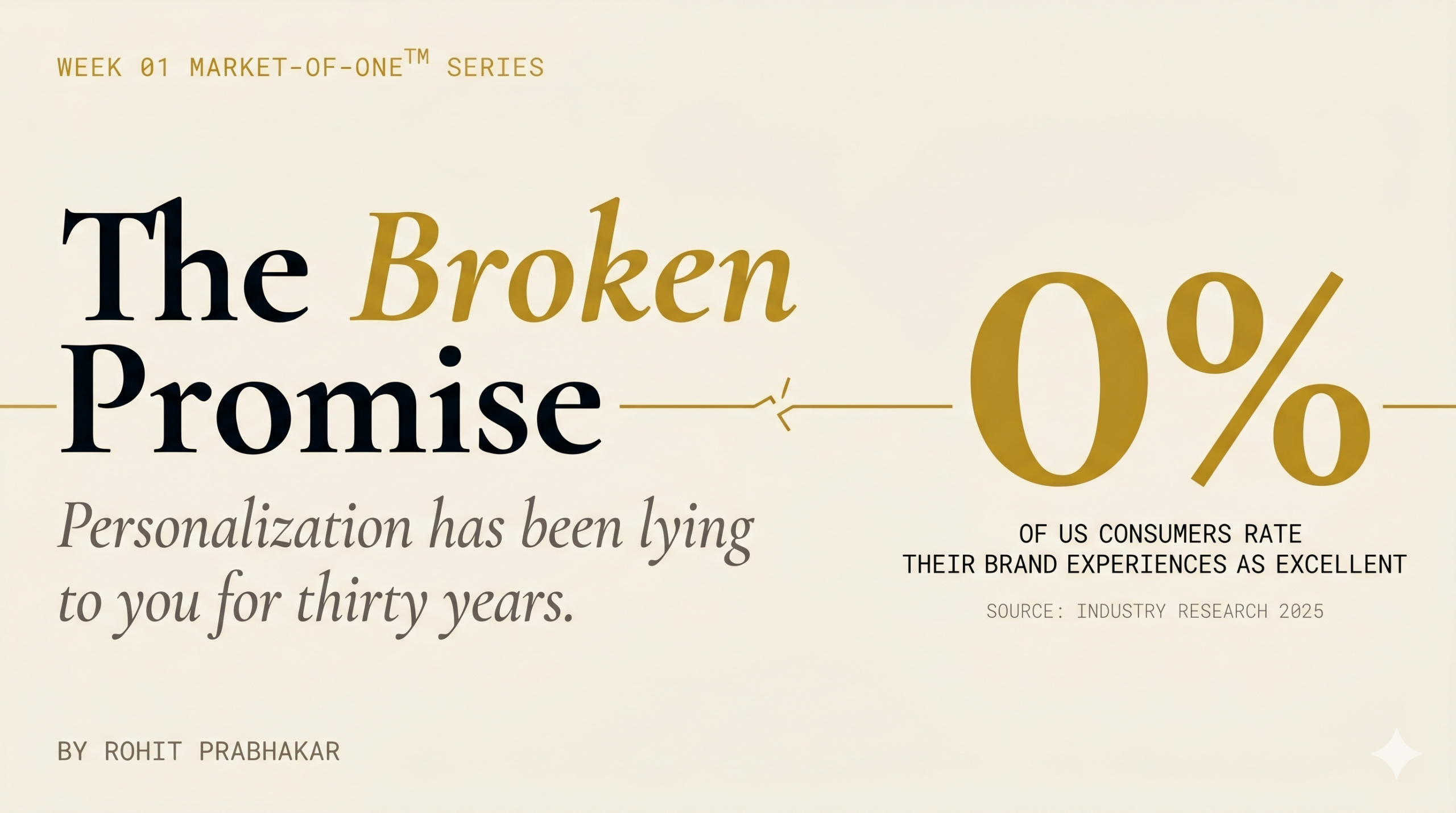
Personalization has been lying to you for thirty years.
Every brand claims it. Every platform sells it. Every conference deck has a slide about it. And yet the data tells a story the industry refuses to say out loud: after three decades and hundreds of billions in investment, personalization is still mostly theater.
In 1993, Don Peppers and Martha Rogers published The One to One Future. They described a world where marketing would cease to be broadcast and become a conversation, where every company would know individual customers so precisely that mass advertising would feel as antiquated as the town crier.
It was the most prescient business book of its decade. And for thirty-three years, it has been treated as a destination we are perpetually almost approaching.
Consider what the industry actually built in that time. CRM systems. Data warehouses. DMPs. CDPs. Recommendation engines. Dynamic content tools. Behavioral targeting. Predictive analytics. AI-driven segmentation. The martech landscape grew from roughly 150 tools in 2011 to over 14,000 by 2025. Global spending on marketing technology exceeded $600 billion annually.
And the result? Sixty-seven percent of US consumers rate their brand experiences as merely “okay.” Zero percent rate them as excellent.
Not disappointing. Not failing. Zero percent excellent, after thirty years and six hundred billion dollars a year.
That is the broken promise. And it is worth understanding precisely, because understanding why it broke is the prerequisite to building something that actually works.
The Gap Nobody Talks About at the All-Hands
There is a specific number that should be printed on the wall of every marketing operations center in the world. It comes from Deloitte research, and it is brutal in its simplicity.
Brands believe they personalize 61 percent of customer experiences. Customers perceive only 43 percent of those experiences as personalized. That is an 18-point perception gap, a systematic delusion baked into how the industry measures its own performance.
The industry is grading itself on metrics customers do not share. Brands celebrate open rates and click-through rates and personalization “coverage” while their customers quietly switch to competitors who feel less like they are talking to a database and more like they understand them.
The frustration compounds from the customer side. Seventy-six percent of consumers say they get frustrated when a brand fails to deliver a personalized interaction. Fifty-one percent have received irrelevant content or offers in the past six months alone. Sixty-two percent say a brand that does not feel personal could lose their business.
We have created a world in which customers both demand personalization and experience almost none of it. The demand is real. The delivery is not. That is the gap this series is about closing.
Brands celebrate open rates and click-through rates while their customers quietly switch to competitors who feel less like they are talking to a database, and more like someone actually understands them.
Why It Keeps Failing: Three Root Causes
The failure of personalization is not a technology problem. The technology has been improving continuously for three decades. The failure is structural. It lives in how organizations conceptualize, fund, and measure personalization as a discipline.
- 01
Confusing segmentation with personalization
The industry built increasingly sophisticated tools to route people to increasingly granular buckets faster. That is segmentation, not personalization. The difference is not semantic. It is architectural. Segmentation asks “which group does this person belong to?” Personalization asks “what does this specific person need, right now?” Thirty years of martech investment answered the first question. Nobody built the infrastructure for the second.
- 02
Measuring what is easy, not what matters
The personalization industry optimizes for metrics it can produce: open rates, click-through rates, conversion rates per variant. These are real metrics. They are just not the right metrics. The right metric is whether the customer felt understood. Whether the experience felt built for them rather than selected for them from a library. That is qualitative, hard to measure, and almost never tracked. So the industry chases the measurable proxy and wonders why the customer experience does not improve.
- 03
The content bottleneck no one admits
Every personalization initiative eventually runs into the same wall: the content library runs out. You can build the most sophisticated segmentation engine in the world, but if you only have twelve variants of your hero message, you are delivering twelve experiences to three hundred million people. The content production capacity has always been the silent ceiling on how personal “personalized” can actually get. Until now, there was no solution. Building content at individual scale was humanly impossible.
The Cost of Getting It Wrong
There is a dimension of the personalization failure story that rarely surfaces in conference presentations, because it is uncomfortable. Bad personalization is not neutral. It is actively harmful.
A Gartner study found that personalized marketing generates negative experiences for 53 percent of customers, making them three times more likely to regret a purchase and 44 percent less likely to buy again. The same customers who experienced personalization were twice as likely to feel overwhelmed and nearly three times more likely to feel pressured into a decision.
The industry built a machine that, at scale, is as likely to erode trust as build it. When your AI sends a cart abandonment email to someone who just bought the item in-store, when your recommendation engine surfaces a product the customer returned last month, when your “personalized” message arrives at 11pm on a Sunday with irrelevant content, you are not failing to personalize. You are actively demonstrating that you do not know your customer at all.
The Prize, If You Get It Right
This is not a story about failure. It is a story about a gap. And gaps, by definition, contain opportunity.
McKinsey’s research across hundreds of companies is unambiguous: personalization leaders generate 5 to 15 percent revenue lift and 10 to 30 percent improvements in marketing efficiency. The companies at the top of the curve generate 40 percent more revenue from personalization than average performers. Faster-growing companies consistently derive more of their revenue from personalization than slower-growing peers, not as a correlation but as a causal driver.
The prize for getting this right is not incremental. It is structural. A company that genuinely knows its customers at the individual level builds an asset, a depth of understanding, that compounds with every interaction and becomes exponentially harder for competitors to replicate over time. That is a moat. Not a feature. A moat.
The question is what “getting it right” actually means, and why the answer is fundamentally different in 2026 than it was in any prior year.
Real personalization is not selecting the best pre-built content for a person. It is generating an experience that has never existed before, constructed in real time, in response to who this specific individual is, what they need right now, and how they communicate. Everything before this was segmentation. This is the Market-of-One.
The Shift That Changes Everything
The third root cause, the content bottleneck, has been the silent killer of every serious personalization initiative for thirty years. You can understand your customer perfectly. Without the ability to generate a response calibrated to that understanding, at scale, in real time, the knowledge is useless.
That bottleneck has been removed. Generative AI does not just make content creation faster. It eliminates the ceiling entirely. When content can be generated on the fly, when the experience itself is built in response to the individual rather than selected from a catalog, the Market-of-One is no longer a vision. It is an engineering problem with a known solution.
That is the subject of next week’s piece. The infrastructure that makes it possible. The three layers that had to arrive simultaneously. And why 2026, specifically, is the inflection point that three decades of investment was building toward.
This article was developed in partnership with AI, used as a research, brainstorming, and authoring collaborator. All frameworks, positions, strategic perspectives, and opinions are Rohit Prabhakar’s own. AI was the tool. The thinking is mine.
