

Week of April 20, 2026 | Signals from April 13-19 For leaders who need signal, not noise.
The Thesis
Last week I wrote about the Consequence Era. This week I’m retiring that frame. We have entered the Scoreboard Era.
PwC just published the numbers. Stanford published the benchmarks. Snap published the playbook. And Anthropic showed us what happens next by shipping a design tool that erased 2-4% of Figma’s, Adobe’s, Wix’s, and GoDaddy’s market cap in a single day.
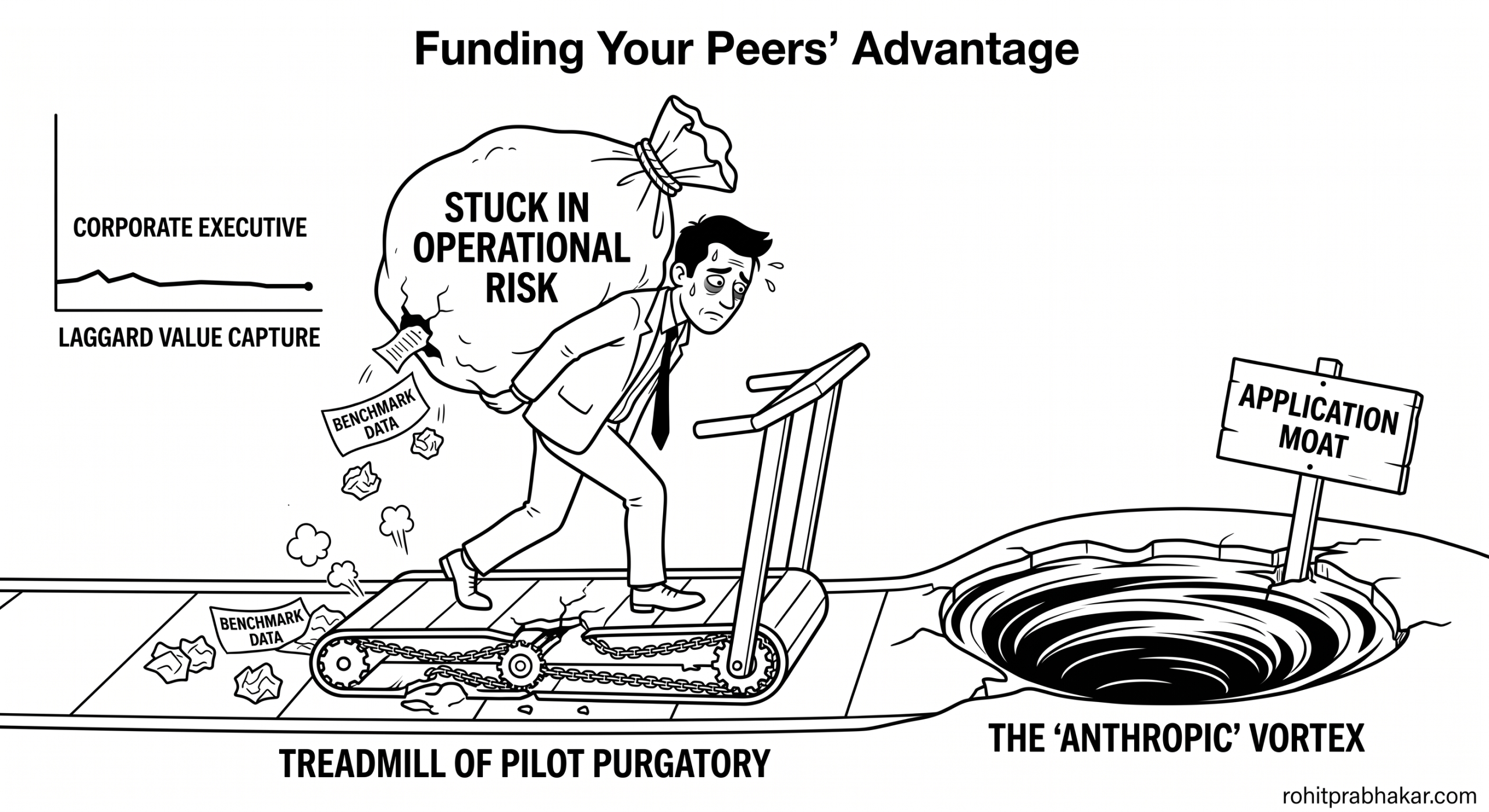
The data no longer supports ambiguity. 74% of AI’s economic value is going to 20% of companies. The rest are funding experiments. Boards can no longer claim uncertainty as a defense for inaction.
3 Questions for the Board This Week
- The 20% Question: PwC just proved 74% of AI’s economic value accrues to the top 20% of companies. Are we in the 20% – and if not, what specifically is blocking us from crossing the line? (PwC)
- The Snap Playbook: Snap cut 16% of its workforce, cited AI writing 65% of new code, and the stock jumped 11%. Has our CFO modeled what a similar AI-driven restructuring would yield – and are we ready for the board question when an activist investor asks? (CNBC)
- The Stack Compression Question: Anthropic just shipped a design tool and shaved billions off Figma and Adobe in hours. Which of our current software vendors is one product launch away from irrelevance – and what does that mean for our 3-year IT roadmap? (9to5Mac)
The Signals: Why These Questions Matter Now
1. PwC Put a Number on the AI Winners-and-Losers Divide
The News: On April 13, PwC published its 2026 AI Performance Study. 1,217 senior executives across 25 sectors, globally. The headline: 74% of AI’s economic value is captured by just 20% of organizations. The top performers are nearly twice as likely to use AI in autonomous, self-optimizing ways (1.9x). They are increasing decisions made without human intervention at 2.8x the rate of peers. Their employees are 2x more likely to trust AI outputs, because leadership invested in governance frameworks (1.7x) and cross-functional governance boards (1.5x). (PwC)
Strategic Insight: This is not a pilot problem anymore. It is a compounding advantage problem. The 20% are learning faster, scaling proven use cases, and reinvesting the gains. The performance gap is widening structurally. And the differentiator is not model selection or spend level. It is AI governance maturity and organizational trust architecture.
Board Reality: Ask your CIO one question this week. “What is our pilot-to-production conversion rate?” If the answer is below 30%, you are funding experiments, not building capability. Waiting another quarter costs more than acting imperfectly now.
2. Snap Proved the AI Workforce Restructuring Playbook
The News: On April 15, Snap CEO Evan Spiegel announced layoffs of 1,000 employees (16% of workforce) and the closure of 300+ open roles. He cited AI directly. AI now generates 65% of Snap’s new code. The restructuring will deliver $500M+ in annualized cost savings by H2 2026. The stock rose 11% on the news. Activist investor Irenic Capital had pushed for the cuts, writing that “AI can and should replace many existing roles.” (TechCrunch) (CNBC)
Strategic Insight: The market did not just tolerate AI-driven layoffs. It rewarded them with an 11% stock pop. This joins Oracle (20,000-30,000 cuts), Amazon (16,000 cuts), and Dow (4,500 cuts) in establishing a repeatable pattern: cut labor, cite AI efficiency, redirect savings to AI infrastructure, get rewarded by investors. Snap is notable because Spiegel quantified it. 65% of new code generated by AI. That is a concrete benchmark boards can now use to pressure their own teams.
Board Reality: If you do not have a clear view of where AI is compressing labor in your organization, an activist investor or a board member will ask the question for you. The Snap model – quantify the AI productivity gain, restructure, reinvest – is now the playbook. CHROs and CFOs should be running this analysis proactively, not reactively.
3. Stanford’s AI Index Exposed the “Jagged Frontier” Problem
The News: On April 13, Stanford HAI released its 2026 AI Index Report. 400+ pages. AI organizational adoption hit 88%. On SWE-bench coding, performance jumped from 60% to near 100% in a single year. Generative AI reached 53% of the global population within three years, faster than the PC or the internet. But the “jagged frontier” is real. Models that earn gold at the International Mathematical Olympiad can only read an analog clock correctly 50.1% of the time. AI agent task success went from 12% to 66%, but they still fail one in three structured tasks. And this week a separate Lightrun study found 43% of AI-generated code changes require manual debugging in production even after passing QA and staging. (Stanford HAI) (VentureBeat via SingularityHub)
Strategic Insight: This is the most dangerous assumption in enterprise AI today. That headline benchmarks predict production reliability. They do not. A model that scores 100% on coding benchmarks and still requires debugging 43% of the time in production is not “almost perfect.” It is unpredictably unreliable. Stanford’s framing is the one I’d use in a boardroom: “We do not have generally reliable AI. We have AI that is superhuman in narrow domains and unreliable in others, sometimes within the same conversation.”
Board Reality: Direct your CTO to audit every production AI deployment against task-specific reliability metrics, not vendor benchmark scores. A 34% failure rate on structured tasks means one in three AI agent outputs needs human review. If your governance does not account for that error rate, you are accumulating operational risk on the balance sheet.
4. Anthropic Just Showed What Stack Compression Looks Like
The News: On April 16, Anthropic released Claude Opus 4.7 with significantly improved vision (3.75 megapixel image support, up from 1.15), better long-horizon agentic execution, and sharper design capabilities. One day later, on April 17, Anthropic shipped Claude Design, a prompt-based tool that generates prototypes, slides, and one-pagers by reading your codebase and design files. Figma dropped 2-4%. Adobe, Wix, and GoDaddy followed. Polymarket reset to 98% probability of launch before it even shipped. The Information called it “The Information exclusive that vaporized billions.” (Anthropic) (9to5Mac)
Strategic Insight: This is the first clean example of what I call stack compression. A model provider absorbs an application category by shipping the application itself. Figma was a $60B market. Canva was a $26B company. Neither is obsolete this week, but both just lost a structural argument about why enterprises need a separate design tool. And Anthropic is not stopping. Claude Code took on developer tools. Claude Cowork took on knowledge work. Claude Design took on creative software. The application layer is being absorbed into the model layer, one vertical at a time.
Board Reality: Every enterprise software vendor in your stack is now exposed to a version of this question. Ask your CIO: “Which of our current SaaS contracts are most at risk of being replaced by a generalist AI product in the next 24 months?” Contracts above $5M annually should get a second look this quarter. Not to cancel. To renegotiate terms, shorten commitments, and build in exit flexibility.
3 Strategic Actions for This Week
- Run the PwC Self-Assessment: Benchmark your organization against PwC’s AI Performance Study criteria. Are you using AI autonomously (1.9x indicator), increasing decisions without human intervention (2.8x), and governing through cross-functional boards (1.5x)? If not, you are in the 80%. CEO + CIO action.
- Quantify Your AI Productivity Gain: Snap disclosed 65% AI-generated code. Ask every business unit leader for their equivalent metric this month. What percentage of output is AI-assisted, and what labor reallocation does that enable? CHRO + CFO action.
- Pressure-Test Your Top 10 SaaS Contracts: Which are most exposed to model-layer absorption? Renegotiate the most exposed before your next renewal window. General Counsel + CIO action.
Bottom Line
74% of AI’s economic value goes to 20% of companies. Snap cut 16% of its workforce, cited AI generating 65% of its code, and the stock jumped 11%. Stanford proved the same AI that wins Math Olympiad gold still requires debugging 43% of the time in production. And Anthropic shipped a design tool that erased billions from Figma and Adobe in a day.
The scoreboard is public. Every board in the Fortune 500 can see exactly where the divide is forming. The question is no longer whether AI works.
It is whether your organization is structured to capture the value, or fund someone else’s advantage.
Disclaimer: AI used for content and creative
