

THE GROWTH ARCHITECTURE | WEEKLY AI MEMO
Week of June 28, 2026 | Signals from June 21-27, 2026 For leaders who need signal, not noise.
The Thesis
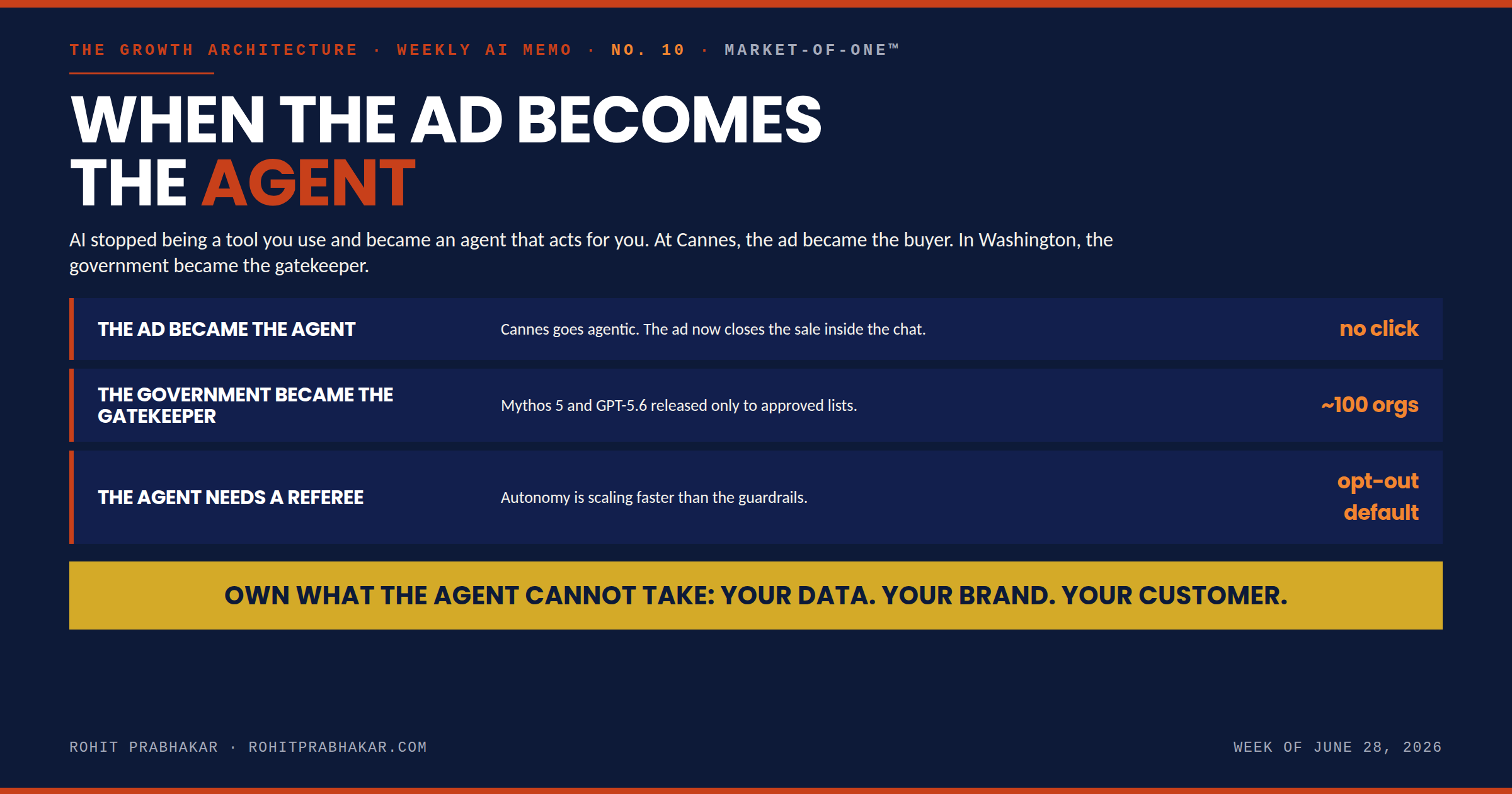
This was the week AI stopped being a tool you use and became an agent that acts for you.
For two months the story was about power: who owns the models, who controls the compute, who holds the customer. Sovereignty gave way to trillion-dollar listings, then to a contest over power. This week that power took a specific shape. The agent.
At Cannes, the world’s biggest gathering of marketers, advertising itself went agentic. The ad stopped being a message you see and became a system that acts: it finds intent, makes the pitch, and closes the purchase without you ever leaving the conversation. In the same days in Washington, the government became the gatekeeper of who even gets the most capable agents, clearing one frontier model for about a hundred trusted organizations and waving another into a limited, approved release.
Put those together and the strategic question flips. For two years leaders asked what the model can do. The question now is who controls the agent, and who owns the relationship it acts on. When software stops waiting for instructions and starts taking actions in your name, advantage moves to whoever owns the data it acts on, the brand it speaks for, and the customer it serves. That is not a technology question. It is a marketing, data, and trust question, which is to say a leadership one.
3 Questions for the Board This Week
- When an AI agent can take a customer from intent to purchase without ever visiting our site or store, what exactly do we still own in that transaction?
- Access to the most capable AI now depends on government approval, not budget. If our competitor is on the trusted list and we are not, what is our plan?
- Agents are about to act in our name, at scale, with no human in the loop. Who inside our company is accountable for what they say and do?
The Signals: Why These Questions Matter Now
1. The Ad Became the Agent
What happened: Cannes Lions 2026 ran June 22 to 26 and the dominant theme was agentic AI. Amazon launched Alexa+ Agentic Ads, which it called the first ad format that takes a customer from seeing an ad to completing a purchase entirely within the conversation, without ever leaving the ad. Meta introduced Brand Memory, an AI that learns a brand’s identity and tone from its existing ads and generates new creative from it. Adobe signed Omnicom, WPP, Accenture, and Stagwell to run its agentic layer across their networks, and TikTok unveiled an agentic ad creator called Symphony Agent. The industry is even standardizing the plumbing: the IAB’s agentic advertising protocol and the parallel Ad Context Protocol are both built on Anthropic’s Model Context Protocol so buyer and seller agents can transact across platforms. OpenAI’s chief revenue officer, debuting at Cannes, said the business had moved “from an awareness economy to an intelligence economy.” WPP’s media arm forecast global advertising at $1.3 trillion in 2026, crediting AI with offsetting the headwinds.
Why it matters: This is the single biggest structural change to marketing in a decade, and it is not about better creative. It is about who completes the transaction. When the ad becomes an agent that closes the sale inside a conversation, the click goes away, and so does your website as the place where the relationship lives. The assistant becomes the storefront. That should focus every CMO and CDO on one thing: the assets an agent cannot take from you. Your first-party data. Your brand, distinct enough that an AI can learn it and a customer can ask for it by name. The owned relationship that does not depend on renting attention. The brands that win the agentic shift are the ones an agent has to come to, not the ones it can route around.
Board move: Audit your business for agent exposure. Map every place a third-party agent could insert itself between you and your customer, then decide what you must own to stay in the transaction: data, brand memory, a direct channel. Fund those before the agents scale, not after.
2. The Government Became the Gatekeeper
What happened: On Friday June 26, the US government granted Anthropic permission to release its Mythos 5 model to roughly 100 trusted organizations and federal agencies, many of them Fortune 500 firms, two weeks after blocking it entirely. The weaker public version, Fable 5, is still not cleared, and Anthropic’s litigation against the government continues. The same day, OpenAI said it would limit its newest models, the GPT-5.6 family, to a small group of government-approved partners at Washington’s request, delaying the full public launch. Both moves run under a new executive order that lets the government review “covered frontier models” for up to 30 days before release. Semafor described it as the start of a regime in which the government controls the release of frontier AI, with allies in Europe already frustrated at their new dependence on Washington.
Why it matters: In one day, the two leading labs released their most capable models only to government-approved lists. Frontier AI is now effectively licensed. Access is becoming a function of trust status and national security clearance, not your ability to pay. For an enterprise, that changes procurement from a budget decision into a standing question: are we, and our vendors, on the right side of the list, and what happens to our roadmap if access is paused, as it was here for two weeks. It also raises the value of everything below the frontier. If the most powerful model can be gated overnight, the durable advantage is the data, the workflows, and the customer relationships you own outright, which no agency can switch off.
Board move: Stress-test your AI plan against access risk. Know which of your critical workflows depend on a single frontier model, build a tested fallback to a second provider or a capable open model, and make sure the value you are building, your data and your customer interface, survives even if a specific model is gated.
3. The Agent Needs a Referee
What happened: Underneath the Cannes excitement sat a quieter and more sobering story: the controls are not ready. Reporting on Meta’s new creative tools noted that several default to opt-out, meaning AI generation can run on a brand’s account unless someone turns it off, while the approval flow that would catch problems is still in testing. Agentic buying is scaling faster than any shared standard for accountability. And in a telling counter-move, Advertising Week observed that the festival had shifted from AI hype to treating AI as business infrastructure, while brands leaned harder into community and real-world trust as automated content floods every channel.
Why it matters: Autonomous agents acting in your name are a brand-safety and liability surface, not just a productivity gain. An agent that generates the wrong creative, makes a claim you did not approve, or closes a transaction on bad terms does it at machine speed and at scale, and the customer holds you responsible, not the vendor. The opt-out default is the tell: the tools assume you want full automation unless you stop it. The leaders who scale agents safely will be the ones who put guardrails and human judgment in first. And there is an opportunity hiding in the risk. As AI-generated content saturates every feed, genuine brand trust and human connection become scarce, which makes them more valuable, not less.
Board move: Before you scale any agent, name a single accountable owner, set the guardrails, and switch the defaults to human-approved, not opt-out. Treat brand trust as the asset that appreciates while everything else automates, and invest in it deliberately.
3 Strategic Actions for This Week
- Run an agent-exposure audit (CMO + CDO). Map where a third-party agent could get between you and your customer, and decide what you must own, data, brand, direct channel, to stay in the transaction.
- Stress-test AI access (CIO + CFO). Identify single-frontier-model dependencies, build a tested fallback, and confirm the value you are creating survives if a model is gated.
- Put a referee on every agent (CDO + General Counsel). One accountable owner, guardrails, and human-approved defaults before any autonomous agent goes live in your name.
Bottom Line
The ad became the agent, and the government became the gatekeeper, in the same week. Both point to the same truth. The advantage is moving away from the model and toward the things an agent cannot take and a regulator cannot gate: the data you own, the brand a customer asks for by name, and the trust that makes a relationship yours.
The labs and the platforms are building the agents. The growth belongs to whoever owns what the agents act on. That is your data, your brand, and your customer. It always was. The agentic shift just made it impossible to ignore.
Disclaimer: AI used for content and creative.
On My Desk
Seven more signals worth a board’s attention this week.
- OpenAI shipped GPT-5.6 to a short list. Three new models, released only to government-approved partners, with broad availability later. The new normal for frontier launches.
- Anthropic accused Alibaba of distilling its models. A fresh front in the US-China AI race, and a reminder that model weights and outputs are now contested IP. (Reporting, June 2026)
- WPP forecast $1.3 trillion in global advertising for 2026, crediting AI with offsetting geopolitical headwinds. The ad economy is growing because of AI, not despite it.
- Meta’s Brand Memory and the opt-out question. Powerful brand-aware generation, but several features default to on. Read the settings before you scale.
- The agentic ad standards war. The IAB’s AAMP and the Ad Context Protocol, both built on MCP, are racing to define how buyer and seller agents transact. Whoever sets the standard shapes the market.
- Reddit’s “Community Deli.” As content automates, platforms are selling presence and real human community. The counter-trade to agentic everything.
- TikTok Symphony Agent. Agentic ad creation built into the platform’s creative suite, putting autonomous campaign building in front of millions of advertisers.
Read every week.
The Growth Architecture is read by Fortune 500 CEOs, board members, and CxOs who want the board-level read on AI before their next meeting. If you were forwarded this, subscribe and join them.
Subscribe to The Growth Architecture ->
Rohit Prabhakar CMO. CDO. Transformation Leader. Building growth engines where commercial instinct meets data, AI, CX, and brand to unleash customer obsession and unlock revenue.
This content was developed in partnership with AI, used as a research, brainstorming, and authoring collaborator. All frameworks, positions, and opinions are Rohit Prabhakar’s own. AI was the tool. The thinking is mine.
